


There is a contradiction at the heart of America’s Bitcoin financial strategy. The Bitcoin pile is growing even as stock prices are moving in the opposite direction.
The Eric Trump-related company recently announced that its holdings have reached 8,000 BTC, up from more than 7,000 BTC at the end of the first quarter.
Separately, the company announced a 15-for-1 reverse stock split, consolidating 15 shares into 1 share. This is used to increase the price of each remaining share, but does not increase the value of the company or change the value of the investor’s position at the time of the split.
The split took effect after market close on July 2nd, and split-adjusted trading began on the Nasdaq on July 6th.
American Bitcoin currently has 8,000 BTC on one side of the ledger, and the market no longer believes in that valuation. Despite the reverse split, this valuation could be maintained if buyers continue to reward Bitcoin per share growth and the mining economy.
The defense would become even more difficult if the stock split was seen as evidence that demand for the stock was too weak to support the strategy.

Bitcoin strategy needs to maintain stock price
America has built up huge reserves of Bitcoin.
In its first quarter 2026 financial results filed with the SEC, the company stated that its Bitcoin holdings increased from approximately 5,401 BTC at the end of 2025 to approximately 7,021 BTC as of March 31st.
Eric Trump, the company’s co-founder and chief strategy officer, said at the time that the company holds more than 7,300 BTC, making it one of the largest publicly traded Bitcoin companies.
The company also reported that it mined approximately 817 BTC and purchased an additional 803 BTC during the quarter.
He also said that despite Bitcoin prices falling by about 22% quarter-over-quarter, mining gross profit margins remained above 50%, and the cost of mining had fallen to about $36,200 per BTC.
This operating model is important because Bitcoin America seeks to differentiate itself from treasury companies that primarily rely on raising funds to purchase Bitcoin.
The company claims that mining allows it to acquire Bitcoin at below-market prices, and that additional purchases can be made as capital and market conditions permit.
However, the same filing also showed why the increase in Bitcoin reserves is not enough to support the stock price.
American Bitcoin reported first quarter mining revenue of approximately $62.1 million, net loss of $81.8 million, negative adjusted EBITDA of approximately $91.3 million, and a loss of $117.2 million in digital assets.
While the company can point to mining production and BTC accumulation, investors need to decide whether those gains justify the stock’s valuation.
The 8,000BTC milestone strengthens the reserves story but does not resolve the issues affecting the stock.
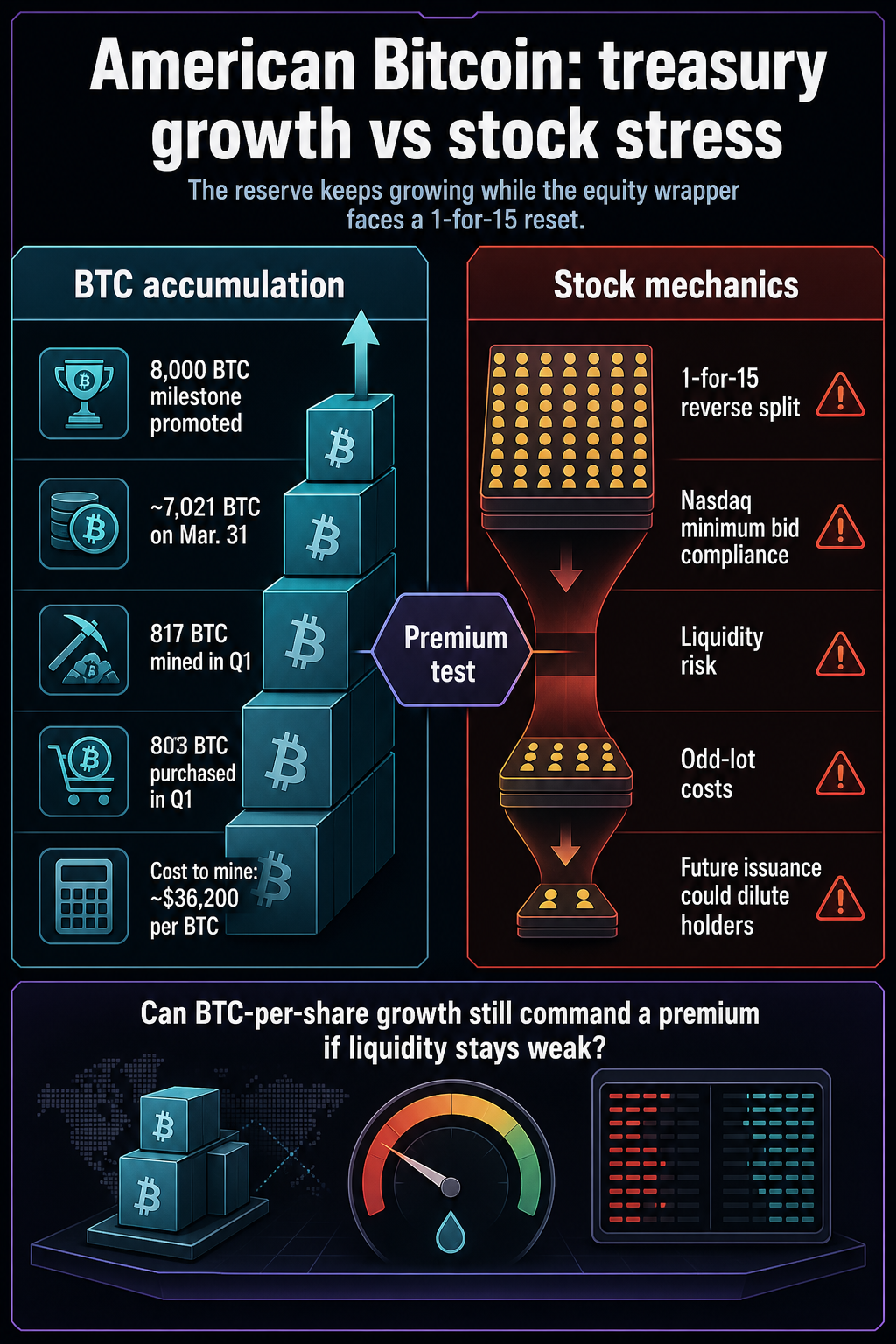
American Bitcoin said the primary purpose of this reverse split is to increase the price of its Class A shares to meet Nasdaq’s minimum bid requirements.
A June 22 Form 8-K showed shareholders approved a reverse split ranging from 5-for-5 to 40-to-1. The board approved the ratio of 1 in 15 after the annual general meeting.
The company’s proxy statement also describes the risks of its model.
Bitcoin in America warned that the stock price may not rise in proportion to the decrease in outstanding shares. He also said that the split could not attract new investors and could be viewed negatively by the market.
It also said the split could reduce liquidity and increase transaction costs for holders of fractional shares.
These risks will change how investors view the 8,000 BTC milestone.
If investors decide that a company deserves a lower valuation, it could face a downturn in the stock market even as it increases its BTC stack.
For Bitcoin treasury companies, stock prices are very important. A strong stock allows the company to issue shares at attractive prices, raise capital with less dilution, and take advantage of investor demand to acquire more Bitcoin.

The attorney’s statement also highlighted the second issue. This means that the number of authorized shares will not change even after the reverse stock split.
The number of outstanding shares decreases, but the total number of shares a company can issue remains the same. This leaves more shares available for future issuance.
The company said these shares could be used for capital increases, acquisitions or other corporate purposes, but warned that future issuances could significantly dilute the value of existing holders.
American Bitcoin does not need to issue these shares given that future dilution could affect the stock price.
The market only needs to believe that the Bitcoin financial agent may need the stock market again.
Stock valuation is the real test.
The biggest question now is whether Bitcoin America offers enough added value to justify buying its shares instead of holding Bitcoin directly or using simpler Bitcoin investment products.
There is a bullish case for this.
American Bitcoin will continue to add BTC, maintain mining economics, avoid significant dilution, and liquidity may stabilize after the split. In that scenario, the reverse split may ultimately be remembered as an ugly but manageable step in a larger accumulation strategy.
The bearish case is equally clear.
If liquidity remains weak, stocks will continue to trade like stressed small-cap stocks. Alternatively, if future funding offsets the benefit of the reserve increase, the 8,000 BTC milestone will carry much less weight.
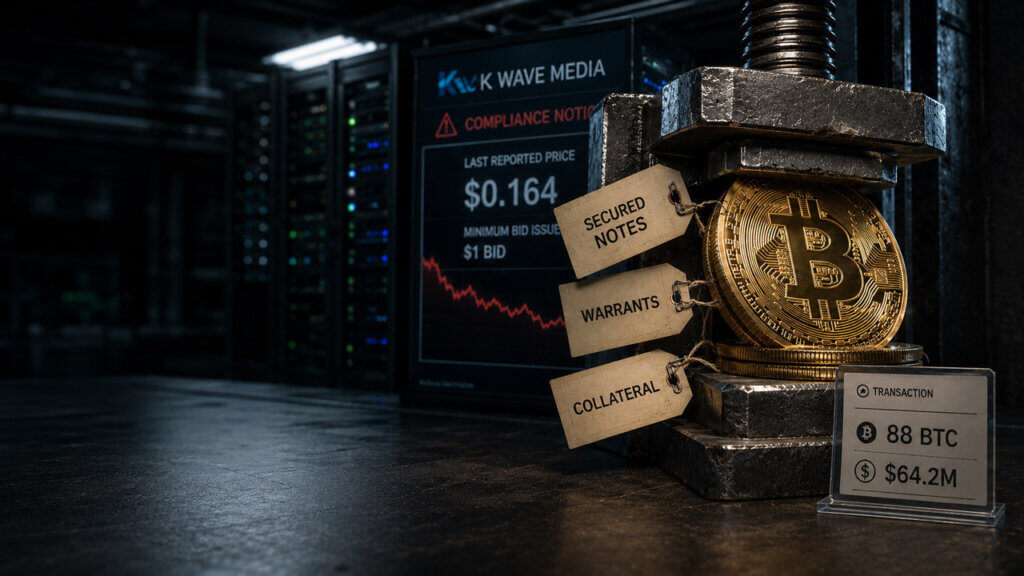
Investors can praise the Treasury while downgrading the companies that own it.
As of July 12, Bitcoin is trading at just under $64,000, about 50% below its all-time high set in October 2025.
Risk appetite across the cryptocurrency market also remains uneven. In that environment, treasury companies will automatically receive less credit for simply adding BTC.
They have to show that owning their stock adds something that investors can’t get anywhere else.
The differentiating factor for American Bitcoin is the ability to mine and acquire BTC on a large scale. The key question is whether the model can fund continued accumulation without relying on future equity issues, which could dilute existing holders.
The next test will be whether investors will support the stock if weak liquidity continues to put pressure on Bitcoin treasury agents.
Signals to watch include whether trading and liquidity stabilize, whether the company provides a detailed update explaining how it holds the 8,000 BTC, and whether any future capital raising will result in more Bitcoin per share or simply fund additional purchases.
This is why Bitcoin in America is a stress test for broader Bitcoin Treasury trading. Political branding can attract attention, and BTC accumulation could strengthen the Treasury’s case.
Neither of these addresses the fundamental weakness when a company requires a consolidation split to maintain compliance with exchange pricing requirements.
If buyers continue to reward reserve accumulation, American Bitcoin could argue that the split was a painful but temporary step toward larger Bitcoin balances.
If that support wanes, the company’s 8,000 BTC milestone will look like the moment the gap between the Treasury and the stock becomes impossible to ignore.
(Tag Translation) Bitcoin


