



Vitalik Buterin said the Ethereum Foundation (EF) is aiming for a smaller, more focused, and more opinionated role by reducing ETH sales and tightening its mandates regarding Ethereum’s long-term resilience, privacy, security, and capture resistance.
In a lengthy post posted via X on Sunday, Buterin called the transition a deliberate move away from treating EF as “the heart of Ethereum” and toward a more narrow function within the broader ecosystem. He also emphasized that his comments reflected his own views and were not an official unilateral directive.
“First of all, this is just my personal opinion. The board is not just about me. I have no special authority on the board that other board members don’t have,” Buterin wrote. He added that the board is growing and that his influence within the organization “will continue to diminish,” adding, “Honestly, that’s what I want.”
Small Ethereum Foundation with Narrow Authority
Buterin said that EF’s changes in the 2025 era have improved execution, efficiency and focus on specific goals. However, he argued that with these issues partially resolved, it has become difficult to ignore another criticism: that Ethereum’s public values regarding decentralization, privacy, and “sanctuary technology” are not always reflected strongly enough in the foundation’s actions.
Buterin says the result is a transition to a foundation that operates with less volume but more conviction. He described EF as “one node with a clear purpose alongside other nodes” rather than a central regulator for Ethereum.
This difference is important both economically and culturally. Buterin noted that EF only holds about 0.16% of all ETH, which he said is “less than many other individual ETH holders,” but said central foundations in other blockchain ecosystems often hold much larger shares. He also said that EF’s original financial role is limited and is to fund the development of the chain software through milestones outlined in Ethereum’s pre-launch materials, with a scope “to be fully completed in 2022.”
“And today, EF is choosing to use its remaining resources to pursue longevity over breadth,” Buterin wrote. “Yes, this means that ETH sales have decreased.”
The foundation will specifically focus on efforts that are “critical to Ethereum’s success as an open, private, and secure system that is resistant to censorship and capture,” he said. This means that some respected figures and projects may sit outside of EF, even if they align with Ethereum’s broader mission.
Ethereum should not only pursue speed
Buterin’s technical discussion centered around what he called the “CROPS” dimensions: censorship resistance, openness, privacy, and security. He contrasted this with the view that Ethereum should primarily define its goals through ultra-low latency and extreme throughput.
“For some, ‘impressive’ means 250ms of latency and 1 million TPS. I think it’s a mistake for Ethereum to try to go down that path,” he wrote. “Being as fast and scalable as possible and only marginally more decentralized than the rest of Epsilon is a path to mediocrity, and if you try that you’ll lose.”
Buterin said Ethereum still needs to scale, but argued that its most defensible edges should be deeper. He cited AI-assisted formal verification as a potential path toward a “proven bug-free Ethereum,” a goal that until recently would have seemed unreasonable to many cybersecurity researchers. He also emphasized “available chain consensus” and argued that Ethereum’s direction with lean consensus maintains characteristics that he believes are different from both Bitcoin-style and traditional BFT-style systems.
The third priority is intermediate minimization. Buterin called it “honestly embarrassing” that smart contract wallets and privacy protocols often rely on intermediaries to include transactions on-chain. He cited FOCIL, EIP-8141, EIP-7701, and Kohaku as part of the push for stronger inclusion properties, public memory pool access, and user-layer infrastructure that does not leak personal data across multiple third-party services.
ETH assets remain important
Buterin also connected the technical direction to ETH’s economic role, calling ETH “financially speaking the most valuable ‘product’ on the Ethereum blockchain.” He said Ethereum has secured $250 billion of ETH and argued that the properties he described are beneficial to the asset.
He added that nearly 90% of his net worth is in ETH, with most of the rest being around $40 million in on-chain fiat, already allocated to open source biotech, software, or hardware efforts. Still, he noted that some of the efforts needed to support ETH as an asset are outside the scope of the EF and will require intervention from other organizations and major ETH holders.
Buterin said the foundation’s new long-term structure is expected to stabilize in the coming months. His final explanation was straightforward. EF will be a “smaller ship than previous years,” more opinionated, longer-lived, and more narrowly suited to ensuring Ethereum “brings something meaningful to the world.”
At the time of writing, ETH was trading at $2,108.
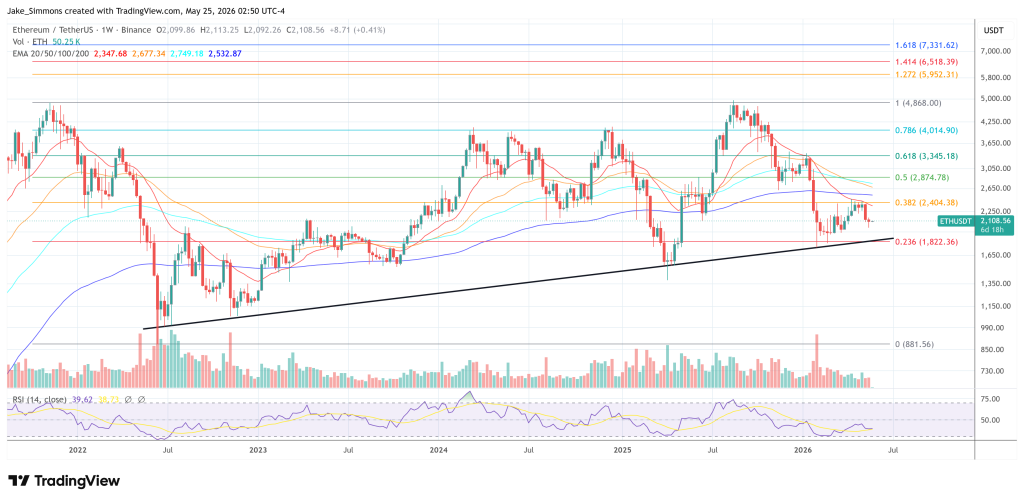
Featured image created with DALL.E, chart on TradingView.com
editing process for is focused on providing thoroughly researched, accurate, and unbiased content. We adhere to strict sourcing standards, and each page is carefully reviewed by our team of top technology experts and experienced editors. This process ensures the integrity, relevance, and value of your content to your readers.


