


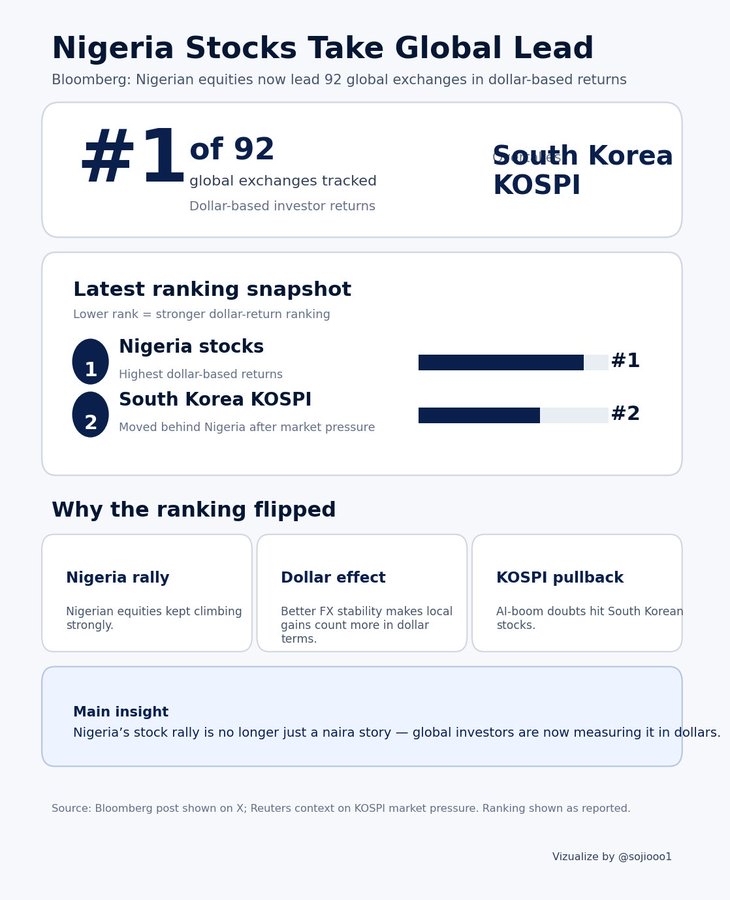
Nigeria topped this year’s global stock market rankings, with its main stock index returning 67% in dollar terms. This puts it slightly ahead of South Korea’s Kospi, which rose 66%. Bloomberg compared 92 exchanges and found Nigeria to be the best performing exchange.
As investors chased artificial intelligence stocks, South Korea was leading the way. This trade later cooled down, pushing the market into bear territory. Nigeria took the top spot as domestic stocks continued to rise, the naira rose 4% since January, oil prices remained strong, and foreign currency became more readily available.
Nigerian stocks continue to rise on economic reforms and improved dollar access
As we suggested, there are multiple drivers in the rally. The government implemented extensive economic reforms. Oil revenues improved due to the rise in crude oil prices. Banks and investors have also found more foreign currency, which is important as global funds need to exchange naira and remit proceeds abroad without long delays.
Currency appreciation added to returns. A depreciation of the local currency could erase gains in domestic stocks for foreign buyers. That hasn’t happened this year. The 4% rise in the naira increased the dollar value of gains already made in Nigerian stocks.
However, the proposed increase in the index merits further attention from investors. This is because Nigeria is set to be upgraded to a frontier market, according to S&P Dow Jones Indices, a subsidiary of S&P Global (NYSE: SPGI). At present, Nigeria is in a single category.
The Nigerian Securities and Exchange Commission has begun work to keep the review on track. Regulators will establish a committee to monitor each of the conditions S&P DJI seeks before reaching a final decision.
The committee issues accreditation reports on a quarterly basis. These files include trade settlements, time periods for foreign investors to repatriate funds, market liquidity, and other figures requested during the review.
SEC Director-General Emomotimi Agama said the review “represents the country’s most important opportunity in a decade to restore global investor confidence and attract increased portfolio investment from abroad.”
“The reform program has been completed. The evidence program will now begin,” Emomotimi said.
IMF forecasts Nigeria ahead, but global growth slows
The rise in stock prices comes as the overall economic outlook improves. The International Monetary Fund projects Nigeria’s growth rate to be 4.1% in 2026 and 4.3% in 2027.
These figures appear in the IMF’s updated July 2026 World Economic Outlook, released on Wednesday. A global economy where war and technology intersect.
The report expects global growth to slow from 3.5% in 2025 to 3.0% in 2026, before reaching 3.4% in 2027.
The IMF linked Nigeria’s outlook to stabilizing economic conditions, improved terms of trade and recent policy changes. He also warned that rising prices for food and other essential goods continue to hit household budgets.
“Nigeria is supported by the effects of improved macroeconomic stability and favorable terms of trade, but poverty and food insecurity are expected to worsen due to higher prices for essential goods,” the IMF said.
The global outlook remains grim. The IMF cited conflicts in the Middle East, inflationary pressures and unequal benefits from new technologies. Artificial intelligence is driving business growth, but its benefits are not reaching all economies at the same rate.
In the United States, we see a similar divide between markets and everyday economic conditions. Economists said growth was weaker than the rise in stock prices. Many consumers and investors expect both to rise and fall at the same time, but that hasn’t happened.
The S&P 500 rose about 10% in the first half of 2026. The Dow Jones Industrial Average rose about 9%, its highest level since the first half of 2021.
After that, the S&P 500 index went on to post three significant gains during the year. It rose 24% in 2023, 23% in 2024, and 16% in 2025. This was the second-highest three-year increase since 2000.
Meanwhile, consumer confidence fell to an all-time low in May due to inflation concerns, according to a University of Michigan consumer survey. Although there was some improvement in June, the survey says sentiment remains unfavorable.


