


This article has been updated with comments from Bitmine Chairman Tom Lee.
While Ethereum price has failed to regain key long-term resistance levels and remains under pressure near the $2,100 zone, analysts warned that Ethereum price risks further significant declines unless bulls regain momentum above $2,500.
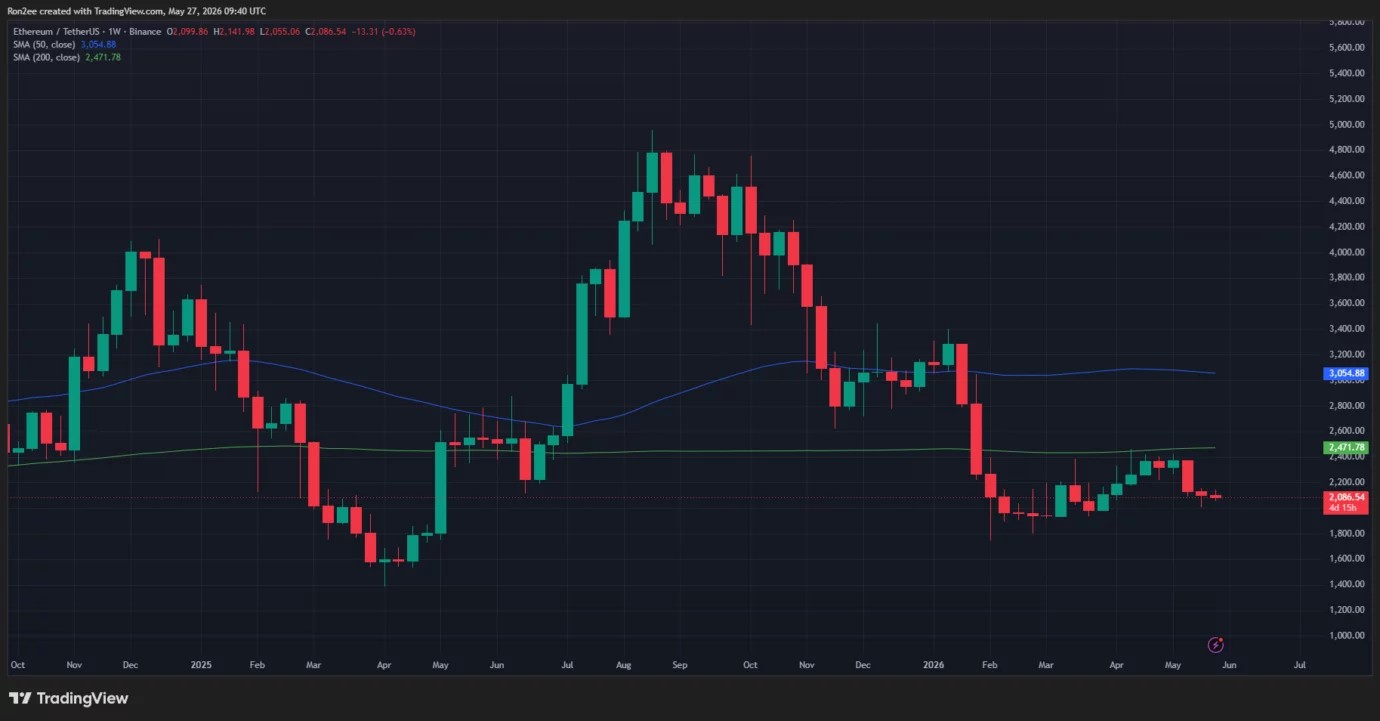
According to data from crypto.news, Ethereum ($ETH) Price traded around $2,086 on Wednesday and remained just above the psychological support area of $2,000 after weeks of sideways consolidation.
The token has struggled to sustain a rebound since rejecting its 200-week simple moving average near $2,470 earlier this quarter, and traders have continued to rotate it cautiously amid mixed ETF demand and weak momentum across major altcoins.
Analyst Ali Martinez said Ethereum needs to “regain the 200-week SMA of $2,500” and then “fully break above the 50-week SMA of $3,100” for Ethereum to return to its bullish structure. Until then, $ETH It remains trapped within a multi-year range that he described as including price movements since 2021.
The weekly chart supports that view. $ETH After failing to sustain a rally above intermediate resistance earlier this year, the stock continues to trade below both its 200-week SMA near $2,472 and its 50-week SMA near $3,054. Since peaking around $4,800 in late 2025, the price has seen consecutive lows, but recent attempts at a rebound stalled below the $2,400-$2,500 supply zone.
Meanwhile, Ethereum’s daily chart shows a bearish Adam and Eve structure developing from April to May.
the pattern formed afterwards $ETH After a vertical spike towards the $2,420 resistance zone, it entered a gradual and rounded consolidation phase before turning into fresh selling pressure. The neckline is currently near the $1,950 support area.
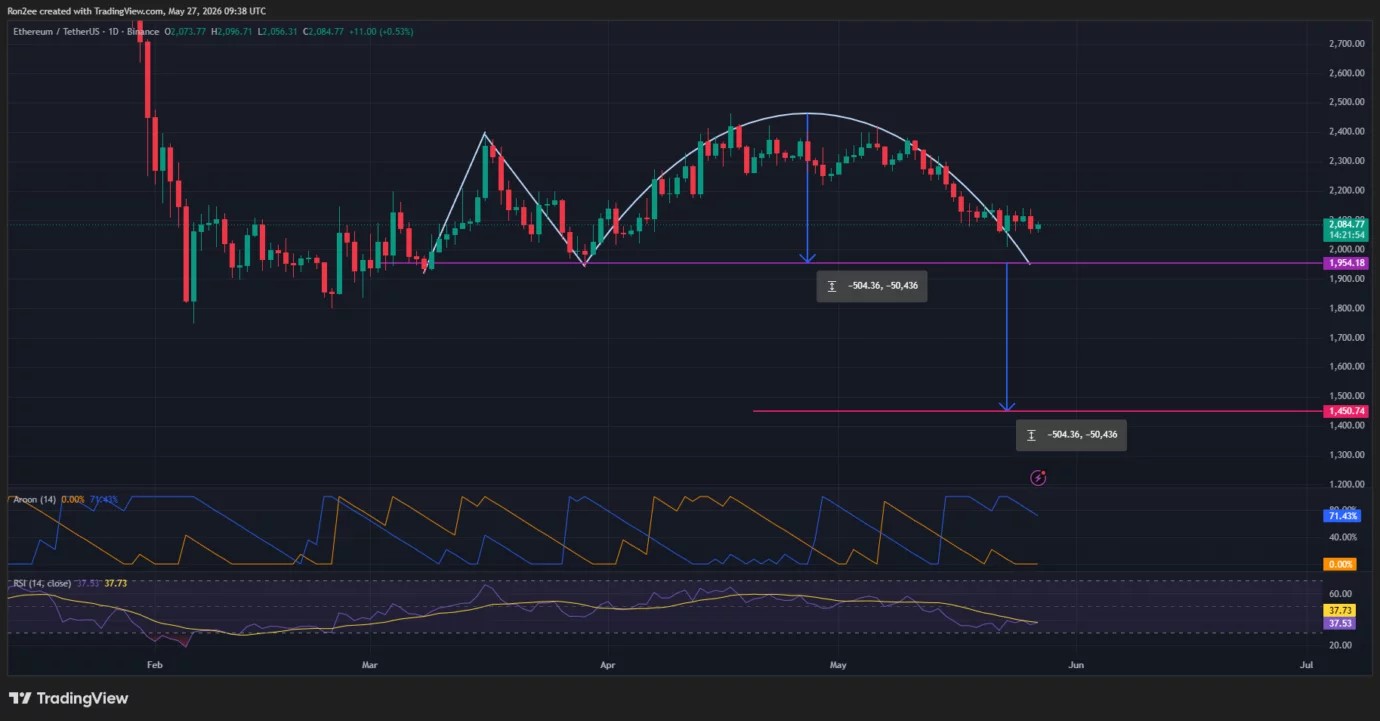
If a break below that level is confirmed, we would expect the measured downside target to be around $1,450 based on the height of the formation.
Momentum indicators are also showing weakness. The daily RSI is hovering around 37 at the time of writing, remaining below the neutral 50 line after a downward trend throughout May. At the same time, the Aroon indicator shows that bearish trend elements remain dominant, with the Aroon downside near 71, while the Aroon upside remained pinned near zero during the latest down sequence.
In a May 26 X post discussing Ethereum’s weekly structure, Martinez warned that the most important support level is currently near $1,850. If the weekly close is below that level, downside volatility is likely to accelerate towards $1,560, before retesting the lower end of the multi-year range around $1,070, the analyst said.
“From a purely technical perspective, the broader channel structure points to two major downside targets following this rejection,” Martinez said.
Meanwhile, fellow analyst Dennis warned that if Bitcoin falls to $65,000, it could fall towards the $1,600-$1,700 area as the market slumps again.
Institutional investors accumulate $ETH Market slump
Although the technical setup remains fragile, large corporate buyers continue to accumulate Ether during the correction period.
Bitmine Immersion Technologies revealed this week that it had purchased an additional 111,942 units. $ETH The recent market pullback caused the price to briefly drop below $2,200. The acquisition brings the company’s stake to nearly $5.4 million. $ETHstrengthening its position as the largest Ethereum treasury company on the market.
In a recent company press release, Bitmine Chairman Tom Lee said the company still expects “a crypto-Ethereum supercycle to arrive,” citing demand for tokenization from Wall Street and the expansion of AI-powered blockchain agents as long-term catalysts for the network.
Although Bitmine’s accumulation strategy has been compared to Michael Saylor’s Bitcoin financial model, the company is entirely focused on Ethereum. The company previously purchased more than 100,000 units $ETH per week for three consecutive weeks of purchases earlier this year. According to Lee, Bitmine ultimately wants to control about 5% of Ethereum’s circulating supply, a goal that would require more than $6 million. $ETH.
Vitalik Buterin has added a new layer to the institution’s story after confirming that the Ethereum Foundation will narrow down its operational priorities and focus primarily on “critical and non-substitutable activities.” The Ethereum co-founder also revealed that almost 90% of his personal net worth is still allocated to the following areas: $ETH Even though the correction took a long time.
discuss at the same time $ETHThe long-term accumulation of value is being strengthened within the Ethereum community itself.
Bankless co-founder David Hoffman said he recently sold his assets. $ETH Because he no longer believes that the success of the Ethereum network fully translates into proportional returns on assets.
“I am extremely bullish on Ethereum,” Hoffman wrote, claiming that only “a small fraction” of the ecosystem’s future growth will ultimately benefit. $ETH Directly to the holder.
Hoffman’s comments came as Ethereum exchange-traded fund flows remained volatile throughout May. Several US Spot Ethereum ETFs have recorded alternating inflow and outflow sessions in recent weeks as institutional investors continue to favor Bitcoin exposure during periods of macro uncertainty.
Ethereum’s open interest has also declined from its local highs earlier this quarter, according to CoinGlass data, suggesting that leveraged traders have reduced their directional exposure after multiple failed attempts to breakout above $2,400. Funding rates on major perpetual futures exchanges have remained near neutral to slightly negative, indicating limited appetite for aggressive long positions at current levels.
Liquidation maps from derivatives platforms continue to show a dense short-term leverage cluster concentrated between $2,250 and $2,400. A sharp move above this region could cause a temporary squeeze towards the 200-week SMA near $2,500. Below the current price, liquidation pockets are forming around the $1,900 and $1,800 zones, increasing the risk of sharp volatility if support fails.
Macro risks continue to weigh on Ethereum sentiment
Outside of crypto-specific catalysts, the macro environment continues to limit risk appetite across digital assets.
Federal Reserve policy expectations remain a key variable for Ethereum and the broader altcoin market. Traders continue to monitor U.S. inflation data, Treasury yields and labor market reports for clues about the timing of future rate cuts. The long-term rising interest rate outlook generally weighed on speculative assets throughout 2026, particularly the technology-related cryptocurrency sector, such as Ethereum and AI-related tokens.
The oil market is becoming more uncertain. Brent crude oil prices remain volatile due to repeated geopolitical tensions over shipping routes in the Middle East and ongoing negotiations related to the Strait of Hormuz. A previous spike in energy prices this year triggered widespread declines across cryptocurrency markets as investors reduced their exposure to high-risk assets.
However, despite the weak chart structure, on-chain evaluation metrics are beginning to attract long-term accumulation interest.
Martinez highlighted Ethereum’s market-to-realized price range of $1,850, around $0.8, as a historically significant area of accumulation. Analysts say it used to be rare for stocks to fall below that threshold for much longer. $ETH We have established a macro bottom and entered a new bullish cycle.
Ethereum anytime $ETH Once below the 0.8 MVRV band, the movement will not last long.
History shows that this very zone represents a high-probability macro accumulation window that will build the ultimate foundation for the next major bull market. https://t.co/LNkygeXO5n pic.twitter.com/D6IJTRlo8M
— Ali Charts (@alicharts) May 27, 2026


