


Bitcoin miners entered June with revenue exceeding $1 billion for the first time in four months, but falling Bitcoin prices are already putting new pressure on the mining economy.
According to data from Newhedge, miners generated $1.086 billion in revenue in May, the highest monthly total since January. Most of that income came from 3.125. $BTC Block grants contributed about $1.079 billion, while transaction fees accounted for a small portion of the revenue.
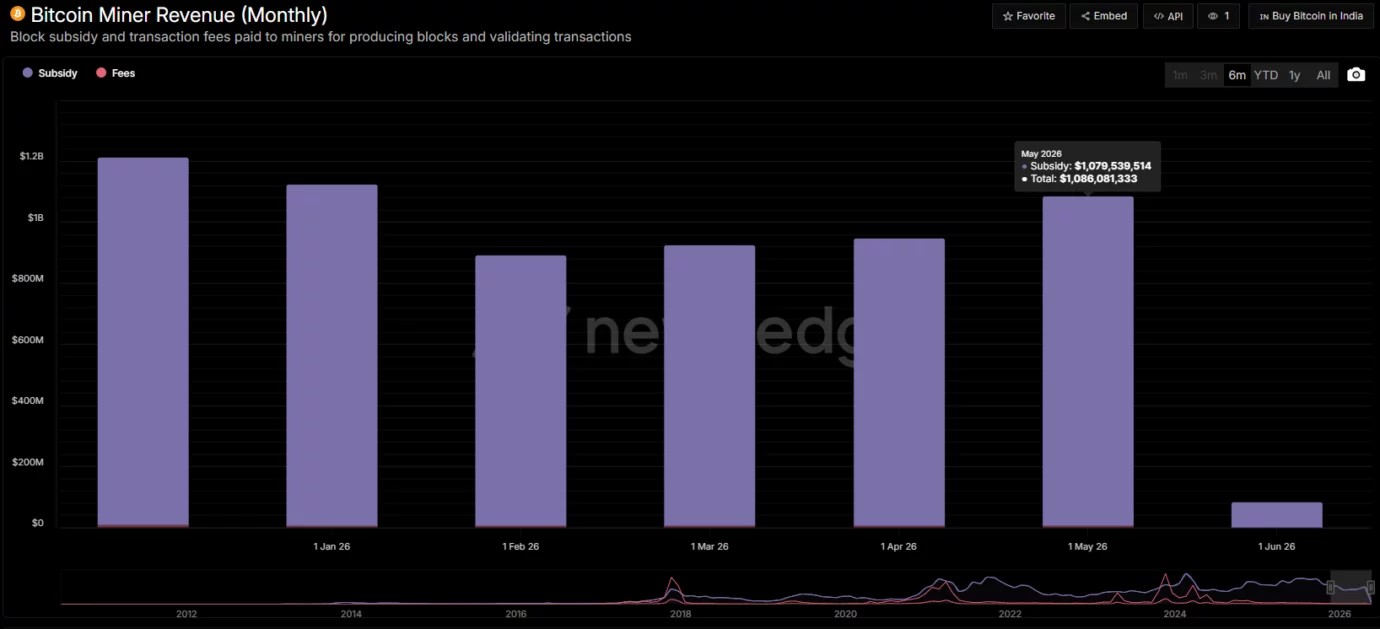
Despite a good month for miners, the situation has worsened since early June. According to data from crypto.news, Bitcoin ($BTC) price fell by 4.5% on June 3, reaching an intraday low of $65,700. The leading crypto asset was trading slightly higher at $65,800 at the time of writing.
Bitcoin’s recent decline prompted widespread risk-off moves across financial markets as geopolitical tensions escalated after Iran launched retaliatory attacks against US targets.
Meanwhile, Citigroup analysts recently argued that sustained outflows in the Spot Bitcoin ETF are a more important factor in Bitcoin’s decline than Strategy’s 32-share sale. $BTC. The bank noted in a research note that ETF withdrawals amounted to nearly $4 billion, and said ETF flows are one of the strongest indicators of asset demand.
Falling Bitcoin prices are reducing miner profitability
Mining profitability continues to deteriorate as Bitcoin price approaches the key support area of $65,000.
The daily value generated by one petahash of mining power per second has fallen to about $30.77 from $37.44 a month ago, according to Hashrate Index data. This drop is nearly 18% over the past 30 days, pushing hash prices to levels last seen in early April.
Mining companies have already begun to respond to the economic downturn. As some operators reduced activity or disconnected less efficient machines, the network’s hashrate dropped from about 1,000 exahashes per second to less than 975 EH/s.
Meanwhile, the slowdown in mining activity is impacting block production times. According to Hashrate Index data, a block was created every 10 minutes and 59 seconds on average, well above Bitcoin’s 10-minute goal. If the current situation continues until the next adjustment period around June 13th, estimates suggest mining difficulty could drop by around 9%.

A lower difficulty level reduces competition between miners, allowing the remaining participants to earn slightly more Bitcoins with the same amount of computing power.
Technical and network signals indicate key moments ahead
While the expected decrease in difficulty may provide temporary relief, Bitcoin price remains the biggest factor influencing miners’ profits.
According to a previous analysis report by crypto.news, Bitcoin is nearing the completion of a round top formation on the daily chart. Such a pattern is generally considered a bearish reversal formation, and a decisive break below $65,000 could expose the next major demand zone around $60,000.
On the other hand, the same analysis states that a recovery above $68,700 could weaken the bearish setup and create conditions for a move back towards $72,000.
Support through transaction fees is limited. After long periods of less than 0.6% of total block rewards, fee income has recently improved. According to recent network data, fees accounted for approximately 1.16% of total block rewards in the past 24 hours.
For now, miners are balancing the benefits of an expected reduction in difficulty with a market that remains under pressure from ETF outflows and geopolitical uncertainty. Whether May’s strong earnings performance can be sustained into June may largely depend on whether Bitcoin can sustain above key support levels.


