


BlackRock, Coinbase, and Strategy are backing a $15 million effort to protect Bitcoin from future quantum computing attacks.
The companies are among nine founding members of the Bitcoin Security Consortium, announced on July 23 to support developers and researchers working on the long-term security of the network.
The consortium, which also includes Anchorage Digital, ARK Invest, Block, Blockstream, Fidelity Digital Assets, and Galaxy, brings together asset managers, custodians, exchanges, infrastructure providers, and companies with substantial operations and holdings related to Bitcoin.
Quantum computing will be the group’s initial focus as advances in technology draw increased attention to cryptographic systems that could eventually become vulnerable.
von Leh, Chief Executive Officer of Strategy, said:
“As long-term holders, we have every incentive to want Bitcoin to remain secure for generations. Helping to fund the people who do this work and inform the conversation around it is a natural way for us to contribute.”
Quantum advances increase pressure on Bitcoin’s security schedule
The institutional funding is getting a boost as governments and technology researchers ramp up preparations for cryptography to withstand future quantum computers.
Over the past year, researchers, including the team behind Google Quantum AI, have been lowering their estimates of the computing resources that may ultimately be needed to crack the kind of encryption Bitcoin uses.
Bitcoin utilizes elliptic curve cryptography to create digital signatures that prove that the owner controls the private keys needed to use the coin.
Although it is practically impossible for a classical computer to reverse that relationship, a sufficiently powerful quantum computer running Scholl’s algorithm could theoretically derive a private key from its corresponding public key.
This creates a potential vulnerability in Bitcoin, where the public key is already publicly available on the blockchain.
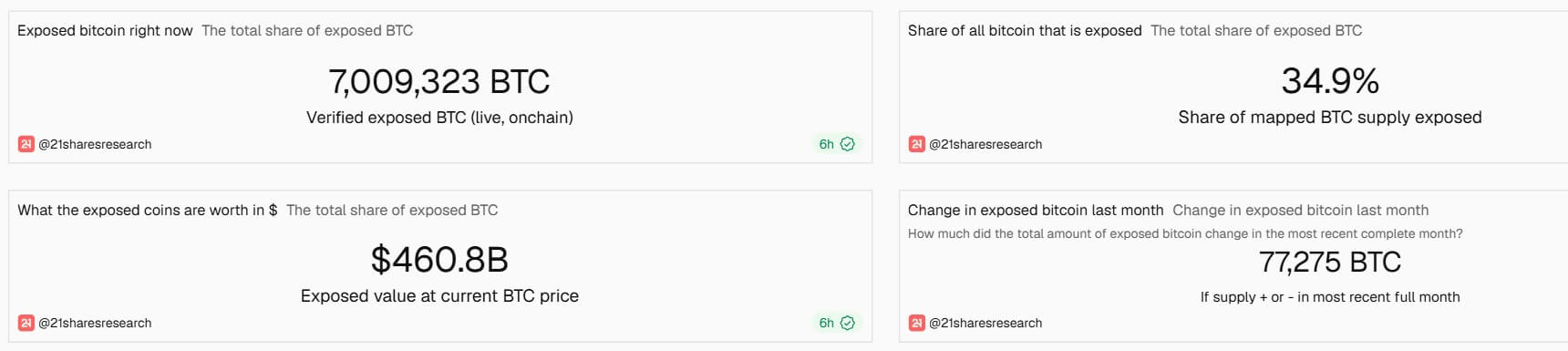
The Dune Analytics dashboard shows an output of over 7 million BTC with public keys exposed, which is approximately 34.9% of the analyzed supply.
These holdings are worth approximately $460.8 billion at recent prices, while the amount classified as exposure increased by approximately 77,275 BTC over the most recent full month.
Today, these coins cannot be stolen with quantum attacks, as it is known that there are no cryptographically related quantum computers that can decipher Bitcoin signatures. The concern is how long it will take to prepare networks if the resources required for such attacks are further reduced.
Charles Edwards, founder of Capriol Investments, pointed to that uncertainty, noting that Bitcoin’s unique “quantum discount rate” recently reached 30% and calling quantum computing the network’s biggest long-term technological threat.
The combination of increased exposed supply and lower estimates of future attacks helps explain why Bitcoin-related institutions are funding research years before such machines are expected to be in practical use.
The transition to quantum-resistant signatures will require developers to design, review, and test new cryptos before wallets, exchanges, miners, node operators, and users adopt them across the network.
For BlackRock, Coinbase, Strategy, and other members of the consortium, funding that effort will give developers more time to prepare while the threat remains theoretical.
Corporate funds can’t solve Bitcoin’s quantum dilemma
While the consortium’s structure is designed to limit the companies’ influence, these safeguards demonstrate how little control members have over Bitcoin’s ultimate quantum defenses.
With millions of dollars being poured into open source development by some of Bitcoin’s biggest corporate stakeholders, immediate governance questions arise about how to support the network without letting financial backers dictate its technical direction.
The consortium has appointed Mike Schmidt, executive director of Brink, a nonprofit organization that funds Bitcoin developers, to coordinate day-to-day operations on a volunteer basis.
Schmidt said he spoke with each member individually before taking on the role and sought assurances that the effort would remain compatible with Bitcoin’s decentralized development model.
To ensure this, the group has adopted two key safety measures.
We do not pool members’ funds or select grant recipients. Each company independently decides which developers, researchers, and organizations receive funding.
The consortium also does not take an official position on changes to the Bitcoin protocol. Members can express their opinions, but the group does not develop the protocol or dictate the contributors who maintain it.
These restrictions allow BlackRock, Coinbase, Strategy, and other members to put more resources into quantum research without deciding which solution Bitcoin ultimately adopts.
This distinction becomes even more important as networks move from identifying threats to deciding how to respond to them.
No government, company, or developer group can impose a new signature system on all of Bitcoin. Major cryptographic changes must be designed, reviewed, and tested before adoption among developers, wallet providers, exchanges, miners, node operators, and users.
Galaxy said the number of developers specifically working on Bitcoin’s quantum resilience remains small compared to the scale of the problem. More funding could expand that pool, but the technical and governance trade-offs associated with migration cannot be eliminated.

One of the most difficult questions is what will happen to Bitcoin that remains protected by old signatures once quantum-resistant alternatives become available.
BIP-361 is a draft proposal co-authored by Casa co-founder Jameson Lopp and other developers that outlines a gradual transition away from ECDSA and Schnorr signatures.
The proposal would first prohibit users from sending additional BTC to outputs that are considered vulnerable to quantum attacks.
Later stages will tighten rules on the use of legacy coins, while introducing a proposed redress mechanism aimed at distinguishing legitimate owners from attackers who have used quantum computers to derive their private keys.
One possible approach could allow the owner of a deterministic wallet to prove knowledge of information originating from the original wallet seed that is not in the quantum attacker’s possession. The researchers also discussed zero-knowledge and commit-revealing methods to recover affected coins.
These approaches cannot cover every type of Bitcoin output.
The authors of BIP-361 note that some older public-key payment outputs do not offer the same clear benefits to legitimate owners, leaving open questions about how these coins can remain usable without remaining vulnerable to future quantum attackers. This proposal describes the compatibility of some of these holdings with an alternative approach known as Hourglass.
As a result, developers face difficult trade-offs.
Leaving legacy signatures available indefinitely could eventually expose some coins to quantum theft. Restricting it too aggressively could prevent legitimate holders from using the Bitcoins they were unable to transfer in time.
BIP-361 still remains a draft and its inclusion in the Bitcoin Improvement Proposal repository does not mean the network has accepted the plan.
A consortium could provide funding for more people to work on these issues and give developers more time to prepare. However, it cannot resolve the choices that Bitcoin users may ultimately have to make.
(Tag translation) Bitcoin


