


Bitcoin fell below $75,000 for the second time in May, hitting an intraday low near $74,200 as the market’s recovery from spring lows again lost momentum.
The first break came on May 23rd, when spot ETF outflows and forced liquidations pushed BTC below $75,000. Bitcoin has since fallen to $73,600 at the time of writing, with a low of $72,600 amid a decline in Asian markets.
Glassnode’s May 27 report summarizes that both moves are signs of Bitcoin stabilizing above deeper cycle support, but spot demand, ETF flows, and options positions have all retreated too far for the market’s $75,000 to $78,000 band to facilitate a convincing recovery.
This band sits directly below the short-term holder cost basis and the true market average, both of which converge around $78,000, two on-chain metrics that Glassnode recognizes as important for the next leg.
Trading below that cluster leaves behind the most price-sensitive cohort in the market, recent buyers who clustered around the spot, break-even, or underwater, increasing their exposure without reward and turning from a support base into a potential source of selling.
According to Glassnode, dealers are concentrating their positions around the $75,000 to $76,000 strike price for the monthly expiration in May, with more than $8 billion of negative gamma around $75,000.
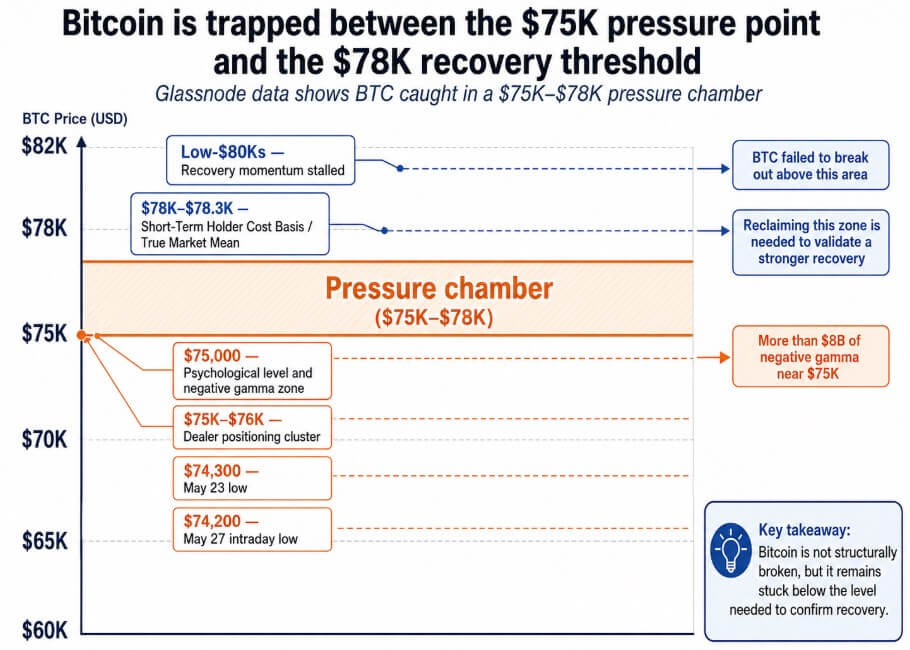
This exposure forces dealers to sell on falling prices and buy on rising prices, narrowing the range and making spot unusually responsive to small order flow near the strike.
Before the deadline overhang formed, price had already stalled at the $78,000 wall, pointing to demand failure rather than mechanical hedging as the main driver of the range.
What on-chain data shows
Glassnode spot volume delta has retreated towards sell-side dominance in recent trading, erasing the brief recovery from early May when BTC moved away from the low-$80,000 region.
ETF flows drove the initial rally, which has now reversed, with U.S. Bitcoin spot ETFs recording roughly $2.26 billion in outflows in the two-week period ending in late May. According to Tars’ daily data, outflows were $648.6 million on May 18, $331.1 million on May 19, $105.2 million on May 22, and $333.6 million on May 26.
Glassnode cited liquidity constraints, rising yields, oil price volatility, a strong dollar, and unresolved geopolitical uncertainty related to Iran as factors holding Bitcoin in line with global risk appetite.
| pressure point | current signal | why is it important |
|---|---|---|
| spot demand | Spot volume delta retreats towards sell-side dominance | Buyers are not actively absorbing supply |
| ETF flow | Approximately $2.26 billion leaked in two weeks | Remove major structural bids |
| Option placement | More than $8 billion in negative gamma close to $75,000 | Amplifies movement around the strike |
| macro liquidity | Rising yields and liquidity constraints | Decreasing risk appetite |
| dollar / oil / geopolitics | Strong dollar, oil volatility, Iran uncertainty | Continue to trade BTC like a risky asset |
| On-chain capital flow | Realized profit/loss ratio is 1.56 | Positive but below early bull market strength |
BTC was closely tracking the deterioration as U.S. stock funds recorded more than $12 billion in outflows in the week ending May 20 as long-term borrowing costs rose.
Glassnode’s on-chain data shows Bitcoin is in a partial recovery, lacking the strength in capital flows to support a bullish transition.
The realized P/L was 1.56, supporting net positive flows since the $60,000 floor, but below the 2-5 range that the company associates with an early sustained bull market.
Net realized gains and losses for short-term holders have recovered to around -0.02% from -0.44% in February, indicating that recent buyers have crawled out of deep capitulation without accumulating the capital flow momentum needed to fuel expansion above the true market average.
What does $78,000 determine?
In the bearish case, Bitcoin will not be able to recover $78,000 even after the May option expiration unwinds, ETF outflows will continue, and spot volume delta will remain on the sell side.
The negative gamma overhang around $75,000 will disappear at expiration, but without new spot buying or ETF demand, the price will structurally stay below $75,000.
This result rules out the pre-bullish transition that Glassnode finds plausible and moves the conversation back toward the $60,000 floor.
Since the realized P&L has been positive since spring, the on-chain structure has been maintained, but the recovery theory built on declining inflows and receding spot demand has taken off.
In the bullish case, the expiration removes the negative gamma overhang and BTC regains $78,000 in a spot-driven buy rather than a mechanical squeeze.
Glassnode states that a threshold consisting of the convergence of short-term holders’ cost basis and the true market average around $78,000 to $78,300 is the level needed to validate a transition to a bull market.
If ETF flows stabilize or turn positive, that would lend structural credibility to the movement, and if the recovery were driven solely by the maturity mechanism, the same demand gap would remain a week later.
| scenario | Bearish case: BTC fails below $78,000 | Bull case: BTC regains $78,000 |
|---|---|---|
| key trigger | ETF outflows continue, but spot demand remains on the sell side | Spot-led buybacks, ETF flows stabilize |
| Impact of options | Gamma pressure recovers, but prices still do not recover | Expiration relieves pressure and keeps price above threshold |
| On-chain read | Net inflows are still increasing, but the recovery is slowing | More reliable transition to bullish phase |
| Impact on price | Continuation below $75,000 brings $60,000 floor back into discussion | Regions in the low $80,000 range are back in the picture. |
| market message | Stable but low bid price | Regain trust through recovery |
Macro conditions also need to be supported by lower yields, a weaker dollar, and less geopolitical uncertainty to provide external tailwinds that internal data alone cannot provide.
Below $78,000, we see that the recent group of buyers that have been sitting between $75,000 and $80,000 since April has become a liability, potentially leading to loss-aversion selling if the sell-side session continues.
(Tag translation) Bitcoin


