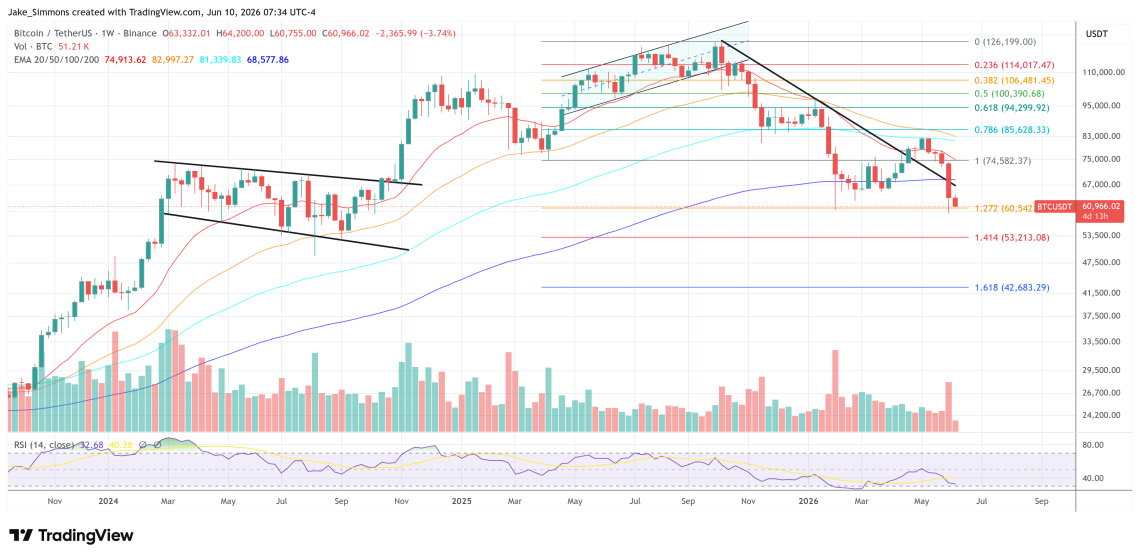
Luke Gromen said Bitcoin’s failure to reach new decisive highs could simply reflect weak spot demand, arguing that paper products can temporarily absorb buying pressure, just as derivatives have shaped the gold market for years.
Macro analysts who spoke with Nathalie Brunel in an interview on June 6 said that they have not substantially restructured their previously reduced Bitcoin positions. “We’ve taken a few bites,” Gromen said, but added: “We haven’t really bought it back.” The reason for this, he suggested, is that Bitcoin’s recent price movements may signal something important about liquidity, market structure, and the political sensitivity of hard asset signals.
Paper Bitcoin and the $58,000-$72,000 frustration zone
Brunel asked about Gromen’s earlier statement that Bitcoin could remain in what he described as a “$58,000 to $72,000 gang for a while.” $BTC And the price of gold may also be suppressed. Gromen clarified that the comment was partly a “joke,” but said there was a serious mechanism behind the idea.
“I think the way they’re doing it is by expanding derivatives, which is the way they’ve done it historically with gold,” he said. “I think it can be done in the long term. I don’t think it can be done with Bitcoin, but as long as you can scale derivatives, it could be important in the short term.”
Gromen’s argument is not that the supply of Bitcoin can be changed, but that the demand can be diverted. Buyers who require spot purchases $BTC You can also buy a call option or another synthetic instrument instead. While this still represents bullish exposure, it does not necessarily remove the coin from the market in the same way as self-custodial spot accumulation.
“Someone wants to own Bitcoin, but they’re not buying Bitcoin. They’re buying Bitcoin calls,” Gromen said. “If there weren’t derivatives there, if you wanted to own Bitcoin, you had to own Bitcoin. Now you can buy derivatives with Bitcoin, and it’s starting to get cruder and cruder and looser.”
For Gromen, that distinction is more important than a short period of time. He argued that policymakers can manage optics “to a lot” in the short term, even if they cannot do so indefinitely.
Luke Gromen on why Bitcoin keeps stalling around $58,000 to $72,000: Major companies can meet demand with paper bets instead of buying real #Bitcoin, which keeps the price down.
After years of working on #gold, he doesn’t think it will last forever with Bitcoin… https://t.co/yPAuJA3dKI pic.twitter.com/CwZ2cGwwW6
— Natalie Brunel ⚡️ (@natbrunell) June 9, 2026
Bitcoin as a liquidity alarm
Derivative restraint theory sits within a broader macro framework. Gromen described Bitcoin as “one of, if not the last, working alarm bells when it comes to liquidity,” and said that Bitcoin’s recent weakness “suggests that things are not good.” In his view, liquidity is being absorbed elsewhere, most notably in AI stocks and in energy and commodities after the Iran war.
“The AI is sucking all the oxygen and all the fluidity out of the room, and it’s all concentrated in one area,” Gromen said. “And I think that’s happening with Bitcoin. I think Bitcoin is also a victim of that.”
He argued that the rise in stock prices was narrower than the composite index indicated, with AI-related stocks accounting for most of the rise. That makes Bitcoin’s lag all the more important to him. $BTC is a liquidity-sensitive asset and does not support stock price strength, so the market may be less healthy than the index level indicates.
Mr. Gromen linked the issue to U.S. efforts to overheat the economy, depreciate the dollar, and bring production back. These forces should be positive for gold and bitcoin in freer markets, he said. However, there is also the risk of sending an unpleasant message.
“There are elements in the United States that don’t want to see that, because those things get transmitted to the world. Hey, you guys are just inflating it,” he said. “Hey, you’re just having inflation. And that creates some problems on the funding side of the Treasury market.”
His basic case is not a traditional crash, but a change in the yardstick. He expects the stock price to rise in dollar terms, but to fall given the prices of gold and Bitcoin. In this scenario, hard assets would outperform nominal debt, while the 10-year Treasury yield would remain roughly in the 4% to 4.5% range.
That’s why Gromen doesn’t think Bitcoin’s potential curbs are permanent. Movements in the paper market may be delayed. The signal may become blurry. However, his framework cannot eliminate underlying macro pressures.
“In the short term, they will be able to manage the optics,” he said. “In the long run, that’s not possible.”
At press time, $BTC It traded for $60,966.