

Tokenization will become mainstream. Over the past three years, the tokenized market capitalization of real world assets (RWA) has increased 20x.
Similarly, the market capitalization of tokenized RWA has grown to a new high of approximately $29 billion, representing a 238% increase in one year.
RWA market cap peaks after 238% jump
The active market capitalization of RWA is $26.15 billion, more than $1 billion less than the total on-chain RWA of $27.77 billion.
DeFi active TVL for the sector was $2.38 billion, growing alongside RWA Perps open interest (OI) of $1.95 billion.
Looking at the different asset classes in RWA, fixed income accounts for the majority of the sector’s market value, accounting for more than half of the capital invested. These bonds include U.S. Treasury bill (T-bill) funds and money market funds (MMFs), which are capped at $16.25 billion.
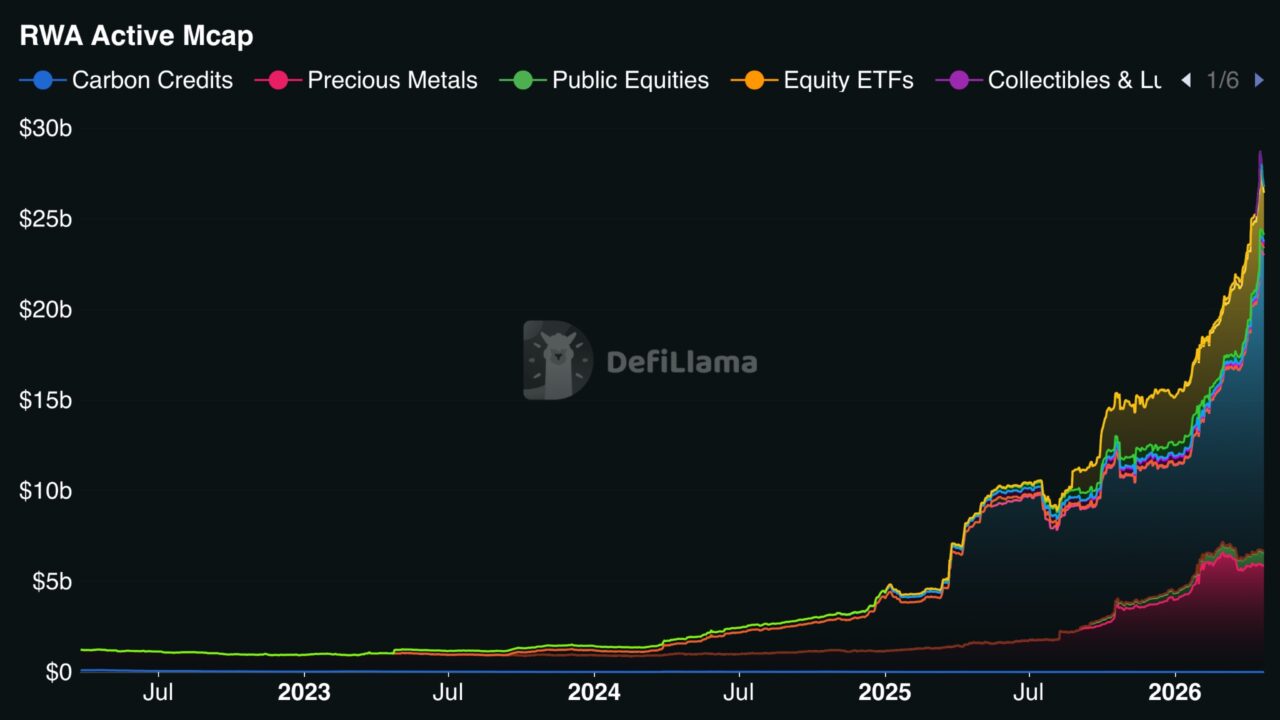
Precious metals ranked second with a market capitalization of $5.83 billion, representing one-third of bond holdings.
Some companies had market capitalizations of less than $2.3 billion. That is, followed by private credit, tokenized stocks, real estate, reinsurance, stocks, indexes, and ETFs, respectively.
However, there are three different types of stock ownership.
Actual ownership includes native stocks, which are completely on-chain with no intermediaries, and wrappers, where the actual stocks are held elsewhere. The last one is synthetic, which tracks the price without having actual ownership.
How U.S. Treasury bills account for RWA market capitalization
It’s worth analyzing the top issuers vying for supremacy, following the leadership of U.S. Treasury bills in this space. But why did Treasury bills dominate?
Treasury bill funds are considered one of the safest assets in the world.
The context is that you lend money to the government and receive a fixed return on maturity, usually within a year. These are typically short-term debt obligations issued to the U.S. government.
Circle issued 18.75% of the T-bill fund’s market capitalization of $16 billion, totaling nearly $3 billion.
This showed USYC, Circle’s money market fund, outperformed Securitize’s BUIDL, which has a cap of $2.5 billion. As shown, US dollar banknotes were most often tokenized in the form of stablecoins.
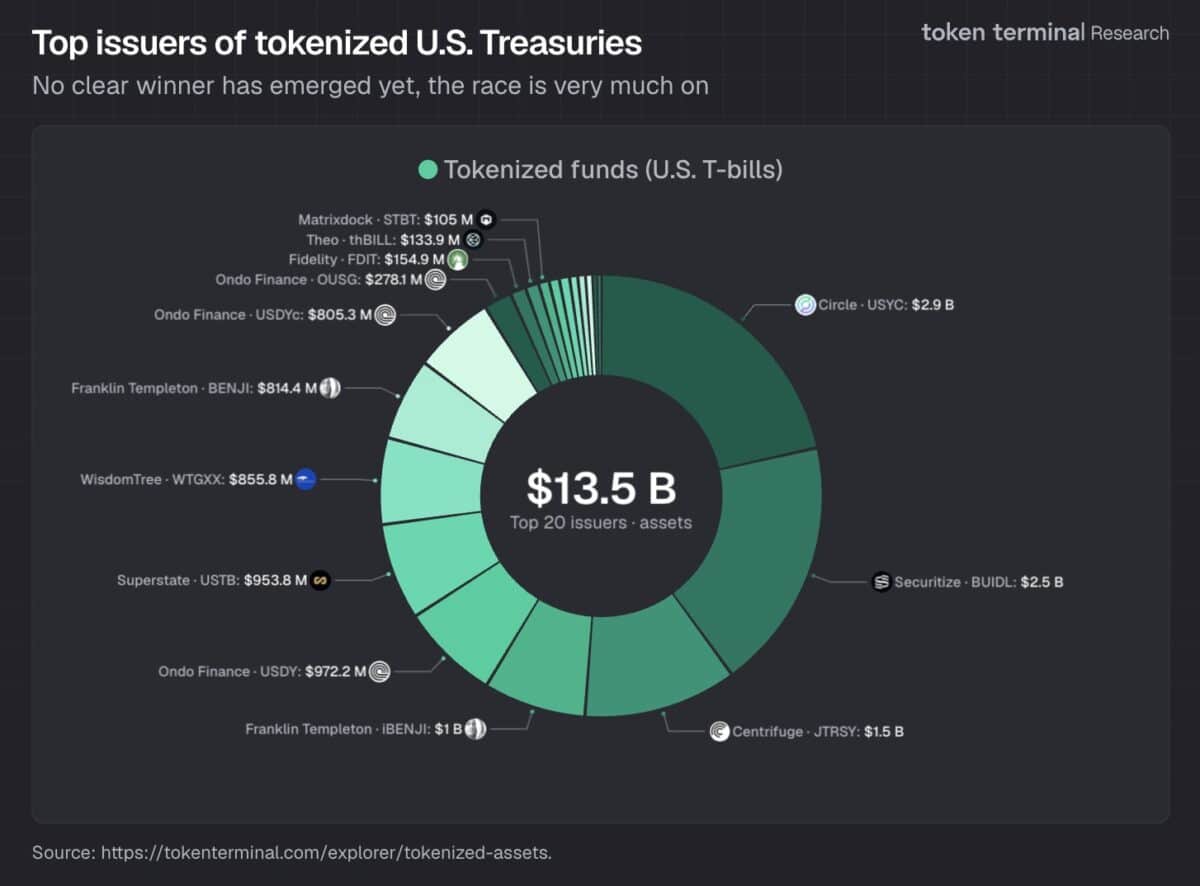
Centrifuge (CFG) ranked third among the top issuers with $1.5 billion. Franklin Templeton and Ondo Finance (ONDO) round out the top five with caps of $1 billion and $972 million, respectively.
Issuance competition intensifies
The data showed that issuers are competing to tokenize assets around the world. The closeness between the top five caps meant there was no clear winner at the moment.
With more RWAs being tokenized, competition has become much more intense.
However, stablecoin issuers had an advantage over other issuers because they were used to exposing traditional investors to cryptocurrencies. Therefore, as more users join the cryptocurrency market, its demand has naturally increased.
Final summary
- RWA’s market capitalization peaked at $29 billion, representing 238% growth in one year.
- US Treasury securities funds dominated the market capitalization of tokenized assets with $16 billion.


