

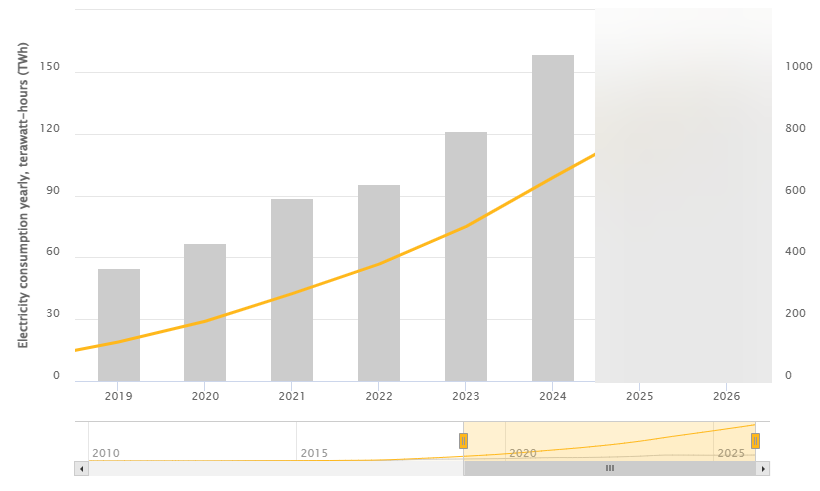
Bitcoin ($BTC) Mining and artificial intelligence (AI) computing both consume large amounts of electricity, sparking intense debate about their environmental impact in 2026. Bitcoin, the pioneering cryptocurrency, secures its decentralized network through energy-intensive proof-of-work mining, which consumes 150-170 TWh and emits 65-75 million tonnes (Mt) of CO₂e annually.
Meanwhile, AI computing is powering everything from large-scale language models like GPT to image generators to recommendation systems in large GPU data centers, which are already generating between 33 and 80 million tons of CO₂e. Amid the global net-zero drive, both technologies consume vast amounts of electricity, raising the urgent question of which leaves a larger carbon footprint.
$BTC Mine energy consumption and carbon footprint
Bitcoin mining relies on a proof-of-work consensus mechanism that uses specialized application-specific integrated circuit (ASIC) hardware to compete to solve cryptographic puzzles. This process secures the network by validating transactions approximately every 10 minutes.
This competitive computation is essential to Bitcoin’s decentralized security model, but it also creates significant power demands.
As of mid-2026, globally $BTC The network hashrate ranges from approximately 950 to 1070 EH/s. Continuous improvements in mining hardware efficiency have allowed energy growth to slow down even as computational demands continue to increase.
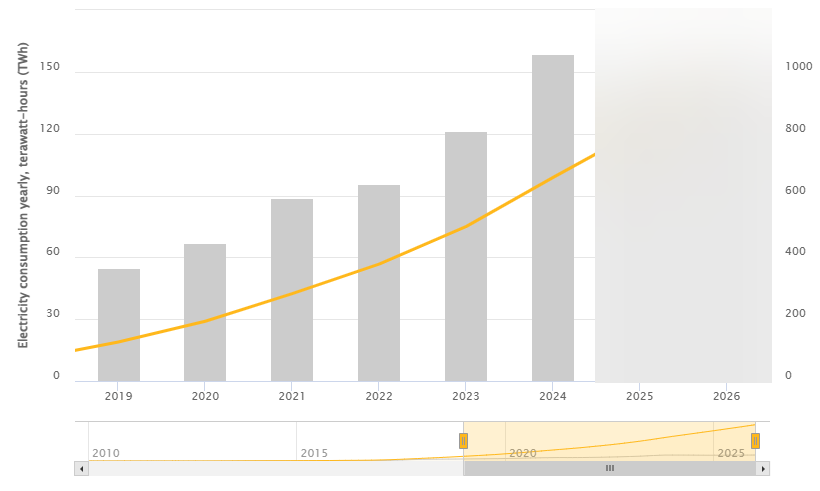
sauce: CBECI
Annual electricity consumption is estimated to be between 145 and 165 TWh, with many models converging to around 155 TWh. This consumption level is comparable to the annual electricity use of countries such as Poland, Argentina and Egypt, and represents about 0.5% of global electricity production, which will exceed 31,000 TWh in 2025.
$BTCThe carbon footprint of is estimated to be approximately 50-80 Mt CO₂e per year, depending on the assumed energy mix. More detailed analysis suggests typical estimates range from 65 to 75 Mt CO₂e. Share is expanding $BTC It is estimated that 52-58% of mining energy currently comes from sustainable sources such as renewable energy and nuclear power.
Despite these developments, $BTCThe throughput of is limited to about 7 transactions per second, so the energy impact per transaction remains high. However, continued efficiency improvements in mining hardware, geographic migration to lower carbon power sources, and increased adoption of layer 2 scaling solutions continue to improve the overall environmental performance of the network over time.
AI data centers and their carbon footprint
AI datacenters that power the training and inference of large-scale language models and generation systems rely on highly energy-intensive GPU clusters and specialized hardware. Unlike traditional data centers, AI facilities require continuous high availability, advanced cooling systems, and massively parallel computing, often at hyperscale levels of over 100 MW per site. Global data centers will consume approximately 485 TWh in 2025, an increase of 17% from the previous year. As of mid-2026, total consumption will be around 500-550 TWh.
In particular, per-query and lifecycle impacts highlight the strength of AI. A single interaction like ChatGPT can consume 10 to 50 times more energy than traditional search, and training a frontier model requires weeks of gigawatts of power. However, rapid improvements in chip efficiency, model optimization, and inference scaling continue to constrain per-task growth.
Carbon emissions are highly dependent on a region’s power mix, and many hyperscalers in the grid still rely on natural gas and coal. The annual CO₂e emissions of AI systems in 2025-2026 are estimated to range from 33 million to 80 million tons in a moderate scenario, increasing significantly with growth.
A direct comparison of the carbon footprint of Bitcoin and AI
$BTC Mining and AI computing represent two of the most energy-intensive digital activities, but they differ significantly in terms of scale, growth dynamics, flexibility, and eco-efficiency. $BTC’s Proof-of-Work model enables predictable and constrained consumption related to network security, while the explosive demand for AI, driven by training and especially inference, drives rapid expansion within the broader data center infrastructure.
$BTC Mining has maintained a more subdued and relatively stable power usage, typically ranging from 155 TWh by popular consensus estimates to around 204 TWh by high-end ratings such as Digiconomist. This corresponds to approximately 0.5-0.6% of global electricity consumption. In contrast, global data centers already consume more than 415-500 TWh, of which AI workloads, especially inference, account for the fastest growing share, estimated at 80-400 TWh or more depending on the scenario. AI growth trajectory significantly exceeds $BTCdelivers an average annual return of 15-30% from hyperscale deployments.
The carbon footprint is still comparable in the lower range, but AI tends to be higher when considering the overall impact on the data center. $BTC It produces around 50-114 Mt of CO₂e per year and benefits from a 52-58% (often said to be closer to 56.7%) sustainable energy mix that includes renewables and nuclear, with economic incentives for miners to seek the cheapest power, often stranded or surplus renewable energy sources. AI-specific emissions estimates range from 3,3 to 80 million tons CO₂e, while broader data center emissions exceed 180 million tons and are often associated with regions that are highly grid-dependent and rich in natural gas. $BTC’s flexible load profile further enables grid support operations such as demand response.
Future prospects
It is predicted that data centers heavily influenced by AI could consume 950 to 1,200 TWh per year by 2030 to 2035. $BTCAs hardware advances and renewable energy deployment increases, emissions intensity is expected to stabilize or even decline.
Key opportunities include greater synergies between the two sectors. $BTC Mining serves as a flexible and reducible load that complements intermittent renewable energy and helps balance power grids with high AI demands. Meanwhile, AI systems are increasingly being used to optimize energy consumption, improve mining efficiency, enhance power grid management, and support climate modeling, with the potential to deliver meaningful emissions offsets across the broader economy.
Effective decarbonization will therefore depend on a supportive policy framework that fosters increased renewable capacity, advanced cooling technologies, improved efficiency of algorithms, carbon-aware computing practices, transparent measurement and responsible scaling-up.
Related: AI will not destroy Bitcoin mining, says analyst Van de Poppe


