

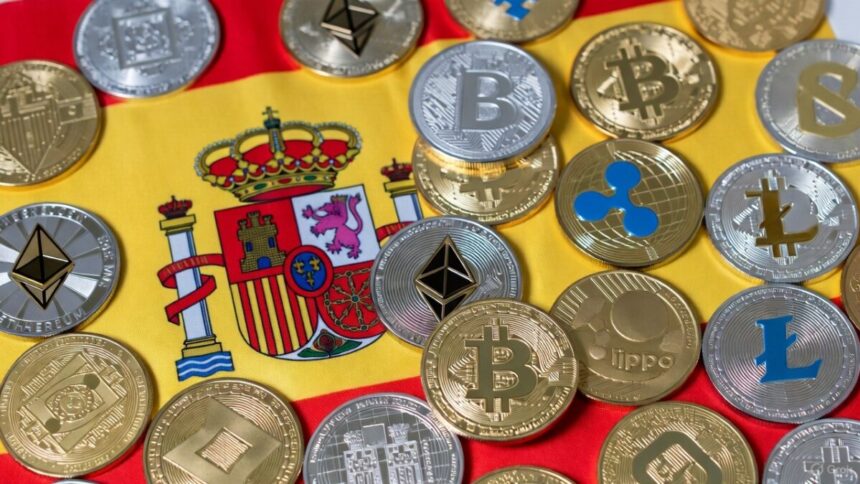
For thousands of crypto users in Spain, the daily routine of buying and selling Bitcoin (BTC) and other cryptocurrencies through regular applications is about to change. This is because on July 1, 2026, the transitional regime of the Cryptocurrency Market Regulation (MiCA) will officially expire, ending the 18-month period during which companies could operate under the pre-registration of the Bank of Spain.
As of that date, crypto asset service providers (CASPs) without the express authorization of the National Securities Market Commission (CNMV) or a valid European passport must immediately cease their activities in the country.
This rule change exposes the operational paradox of decentralized technology. The protocol of the decentralized Bitcoin network remains the same and is outside the scope of national guidelines, but the access and exit points for money, i.e. The gateway connecting cryptocurrencies and the euro is fully integrated into traditional financial boundaries.
Therefore, those who decide to trade fiat currencies within a legal commercial framework must be subject to the same supervisory and compliance standards that apply to banking entities.
Why can 10% of crypto exchanges survive MICA?
This transition to a new regulatory environment has significantly reduced the number of licensed entities on the continent. Richard Fetico, CEO of analytics firm altFINS, highlights the scale of this institutional process when considering data from Europe.
In this regard, CriptoNoticias reports that Tether (USDT), the world’s largest stablecoin issuer, has chosen not to immediately verify this state design. Tether CEO Paolo Ardoino himself has repeatedly warned that the requirements imposed by Europe are very much an “uphill climb”.
Ardoino pointed out that major regulated platforms in the region have started applying operational limits to this asset, USDT, because the requirement to maintain 60% of reserves in bank deposits not only limits operations but also poses systemic risks to the fund itself.
The number 183 CASP includes entities with varying levels of authorization. Of these, only 14 companies have a class 3 license (capital of 150,000 euros). This allows them to store customer funds and operate the exchange, which is the usual model for trading platforms. The remainder have class 1 or 2 licenses and cover non-custodial advisory, brokerage, or trading services.
Behind this mass exit are economic and bureaucratic barriers that are insurmountable for most operators. This is because you obtain a MiCA license from the beginning. start As Fetico pointed out, there is an initial cost of between 50,000 and 100,000 euros just to start the treatment process.
Once achieved, maintain an average structure adapted to it. Regulatory requirements result in recurring costs of between 500,000 and 2 million euros per year.
Adding to this is that the risk of operating outside of this financial funnel is punitive. Fines for ignoring the deadline could reach 5 million euros, or 12.5% of the company’s global revenue. Indeed, the rigidity of the legal framework is already having its first practical impact even before its full implementation, with more than €540 million of sanctions accumulated in the region, according to the report.
“Before MiCA, more than 3,000 crypto companies were registered and operating across the European Union. Today? Only between 170 and 210 have a full MiCA license. “Less than one in 10 will survive the transition period.”
Richard Fetico.
Additionally, the regulation has faced severe criticism within the industry for promoting corporate centralization, which is contrary to the inherent nature of the technology. Industry voices, including Fideum CEO Marcin Sypniewski and Digital Assets Forum (DAF3) speaker Rowan Varrall, warned that the high compliance burden is too much for start-ups to bear.
They say this high-cost ecosystem is forcing market consolidation. Large financial institutions and multinational exchanges will eventually dominate this space.. A collateral risk of this regulatory funnel is regulatory spillover. Plotnikova herself and Zonda Crypto CEO Przemysław Kral point out that there is a real danger that technology companies will leave Europe for jurisdictions with more dynamic and attractive frameworks, such as the Middle East.
Leap from banking to virtual currency custody business
This pressure on digitally native ecosystems is consistent with the complex scenario that international platforms face in order to normalize the situation. Global brands such as Binance, Bitget, MEXC and BingX are assuming this situation in order to adapt to Spain’s new norms, while traditional banks are accelerating their strategic positioning.
Introducing entities such as BBVA, CaixaBank, Cecabank, and Openbank Buying and selling services and direct storage of digital assets within commercial infrastructure.
There is infrastructure logic behind this deployment. This is because under the new regulations, safe custody of funds and separation of assets are mandatory technical pillars for other derivative services.
“The first bank to reach institutional custody can build the rest of the offer,” Mike Schwitala, director of Crypto Finance, a company that provides infrastructure support to these institutions, explained in an email to CriptoNoticias.
“What we are seeing in Spain is exactly what happens in all markets where digital assets have matured: the banks that reach institutional custody first can build out the rest of their offer.” Custody is not the most relevant part of the crypto business for banks. This turns out to be the most relevant, since without it no other services are possible. In Spain, this is already understood by those who first obtained their MiCA license. The question now is what other companies will do before the transition period ends.
Mike Schwitala.
This assimilation into the banking model introduces important guarantees such as forced segregation of accounts. from now on, The law prohibits exchanges from commingling customer funds with company working capital.applies the same protection systems as traditional banks. In this way, even if the provider goes bankrupt, the digital assets are protected and remain the property of the person who purchased them by law.
For this reason, analysts believe that the expiration of the deadline is not just a compliance procedure, but rather an event of market consolidation. Isabella Chase, policy manager for EMEA at TRM Labs, points out that the exit of unregulated competitors will reshape the scenario in favor of companies that were anticipating regulatory investment.
“For already licensed platforms, this represents a moment in market structure. “Once unlicensed competitors are firmly forced out, the competitive dynamics will change, and companies that invested in compliance infrastructure early will see the value of that investment reflected.”
Isabella Chase.
Zero tolerance for unregulated crypto companies
Therefore, there is no room for adaptation. This comes as the European Securities and Markets Authority (ESMA) has reiterated that no extensions or additional grace periods will be granted to unauthorized entities that continue to serve customers in the European Union.
At the local level, The CNMV also maintains strict oversight regarding the promotion of these services.warns that advertising from unregistered platforms will lead to serious administrative sanctions against intermediaries and content creators.
In that sense, the adaptation margin will end for Spanish investors by June 30th. The practical implications of the standard force users to make final financial decisions. This means either moving your funds to a platform authorized under the new European standard, accepting the loss of traceability and control over your private keys in exchange for legal security, or self-managing your digital assets.
If an investor’s priority is to maintain the anonymity and peer-to-peer nature of trading, this last route becomes the only viable path, even if this means assuming all technical responsibility for their own fund only. Although the regulatory framework aims to reduce risk for retail investors, the cost of that protection is the full assimilation of intermediaries into traditional financial surveillance systems.
(Tag to translate) Cryptocurrency


