

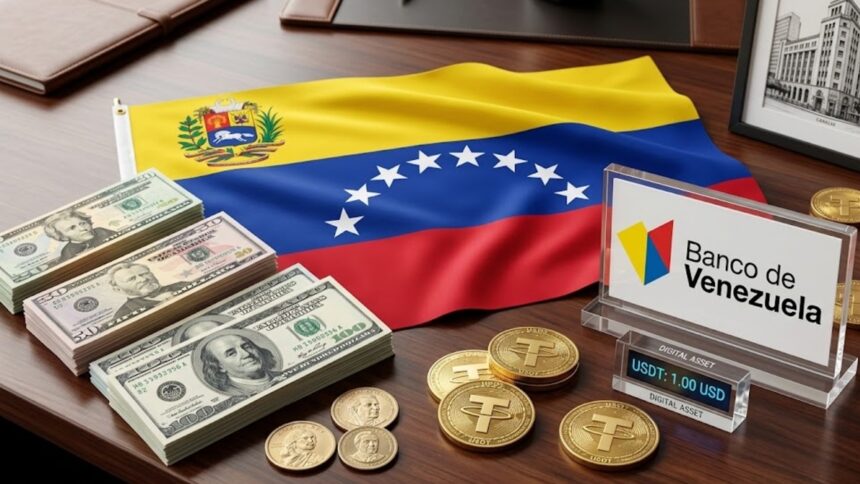
The Central Bank of Venezuela (BCV) is working on the design of measures and mechanisms to facilitate natural and legal persons to buy and sell foreign currency through banks and exchange offices.
This was announced by President Luis Pérez González, responsible for issuers, during a meeting with representatives of public and private banks and the Deputy Ministry of Digital Economy held last Friday, April 24th.
Although the BCV chief did not reveal the details of such a mechanism, he did say that he would continue to encourage transactions in the domestic market to be conducted in bolivars.
“The time has come to start thinking about measures that will make it easier for natural and legal persons to continue to increase their intention to maintain the use of the bolivar,” he said.
According to the banker, Progressing to the “price stabilization stage” In it, he asserts, “By increasing confidence in national currencies, we will strengthen the importance of national currencies in transactions.”
Pérez González said the company is committed to maintaining a “continuous review” of its monetary and exchange rate policy instruments. “And we will make a decision at the time we see fit,” he said.
The announcement of the new approach joins a long list of plans that have sought to regulate the flow of foreign exchange in oil-producing countries. System to date Mainly dependent on currency auctions It is complemented by direct intervention of exchange tables and BCV through public and private banking operations.
This model attempted to leave behind the more restrictive mechanisms that have characterized recent economic history. Among the most notable precedents is the defunct Foreign Exchange Control Board (Cadivi), which centrally vested dollars at fixed interest rates for more than a decade.
Subsequent variants such as Sicad (I and II) and Simadi emerged, systems that introduced staggered auctions and some flexibility, but later converged on Dicom. This is a public-private bidding auction scheme that preceded the relative liberalization of bank exchange desks that began in 2019.
Exchange rate differences have begun to narrow
Regarding exchange rate policy, Mr. Pérez González emphasized that: The difference between official and unofficial exchange rates has narrowed to 29%. This is the result of more active intervention in the market by BCV, with funds injected into national banks so far this year reaching USD 3 billion.
Although he did not mention it, the gap Perez-González mentioned is a result of the dollar established by the BCV auction mechanism and the price of the currency on the open market, which has been referenced through USD Tether (USDT), a stablecoin linked to the dollar, in recent months.
In fact, the average such gap is 29%. As of the end of this report, auction rates average around 510-520 bolivars and USDT prices around 615-625 bolivars.
CriptoNoticias documents that USDT has become part of everyday commerce in Venezuela, as its price on peer-to-peer (P2P) markets serves as a guide to the free price of the North American currency. Companies, especially unofficial ones, apply the self-proclaimed “Binance Rate” to refer to USDT. Therefore, mark the price of the product.
Daniel Arraez, an economist specializing in cryptocurrencies, recalls the Venezuelan market’s adoption of the digital asset USDT. as the main criterion of value He said the 29% gap is “the opportunity cost the market pays for instant liquidity that has no operational constraints and is not subject to scrutiny.”
In a conversation with CriptoNoticias, he explains that USDT is “derived from Venezuelan DNA” and therefore BCV will likely maintain traditional exchange schemes. Meanwhile, the “real economy” continues to function using this digital asset.
“USDT will continue to be a quick and frictionless escape route for the retail commerce public (…) The true indicator of Venezuela’s free market is USDT, and it is the crypto dollar,” he points out.
Between external normalization and the risk of hyperinflation
The head of BCV also reported on the start of the normalization process in relations with international organizations. Perez González confirmed that the country has resumed contact with the International Monetary Fund (IMF), correspondent banks and the US Federal Reserve (FED).
He also noted that the country’s resources are overseas. Audited by an independent company He was hired by the governments of both Venezuela and the United States to ensure impartiality.
The president, who is in charge of the BCV, sounded optimistic, but asserted that “there is reason to believe that the national economy will perform well in the coming quarters.” Also, Believe that inflation will “decline.”
However, today’s economic reality is far from what financial leaders predicted. Economist and business consultant Asdrubal Oliveros warned that inflation data for March was 13%, leading the country in annual volatility of 650%. Towards a hyperinflation scenario.
“It is urgent and compulsory for the authorities to act and present an economic plan that can quickly curb inflation,” Oliveros explained, calling this phenomenon the “main enemy” of Venezuelan people and businesses.
If the president’s announcement in charge of the BCV comes true, it is likely that the country’s economy will improve, but as long as the exchange rate problem and inflation, which are detrimental to Venezuelans, are addressed. Returning to 2018 levelswhen the Caribbean nation faced its worst economic crisis in history. As always, we’ll have to wait and see.
(Tag Translation) Featured


