


Tokenized US funds continue to attract capital from institutional investors as regulated on-chain finance expands beyond early adopters. This pattern emerges because financial institutions still prefer issuers with established liquidity and distribution channels.
As a result of this preference, Arbitrum (ARB) has approximately 12,500 different holder wallets, primarily through Theo. Solana (SOL) has around 8,200 wallets and is primarily supported by Ondo Finance (ONDO) and Etherfuse.
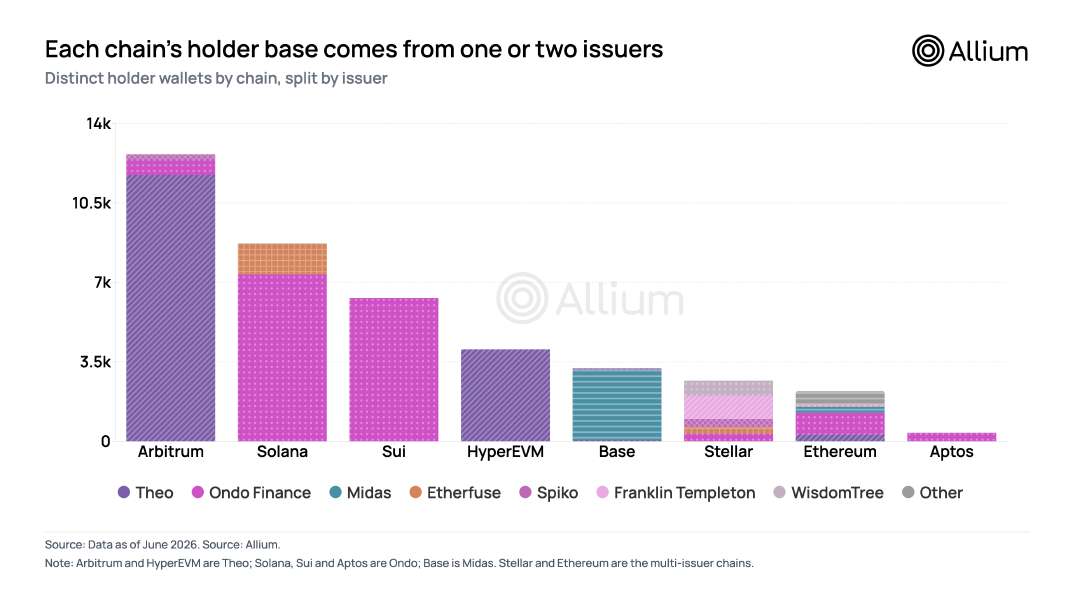
Meanwhile, Sui (SUI) approaches 6,000 holders, reinforcing Ondo’s cross-chain footprint expansion. In addition, HyperEVM and Base will add approximately 4,000 and 3,200 holders, further expanding the institution’s reach.
However, Ethereum (ETH) only hosts around 2,000 holders despite supporting multiple issuers. This suggests that issuer reputation, not just on-chain availability, is a key driver of liquidity, user growth, and future competition across the tokenized fund market.
Tokenized stocks redefine blockchain utility
Institutional momentum is no longer limited to tokenized funds. Market participants are also investing in stocks and expanding their presence on various blockchain platforms.
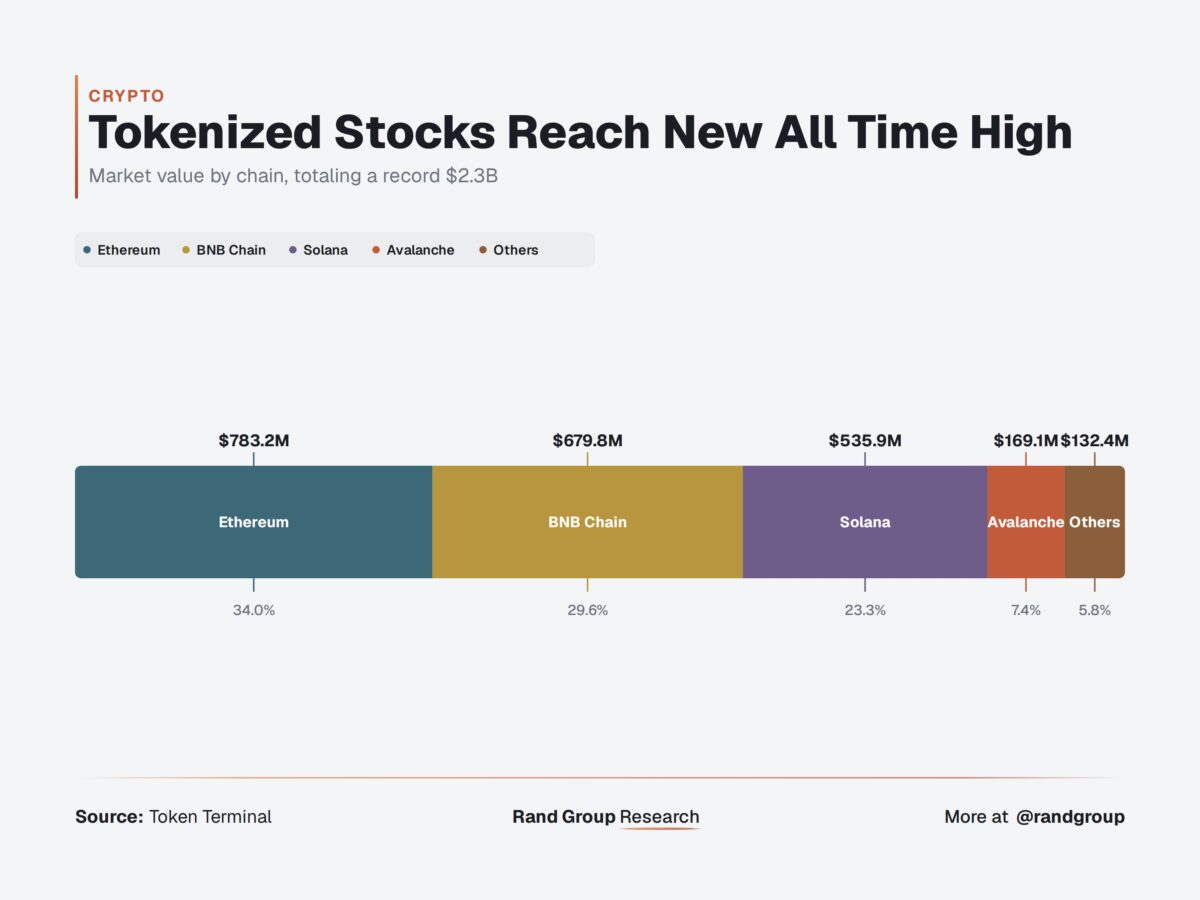
The industry’s market capitalization has reached an all-time high of $2.3 billion, demonstrating the growing interest in on-chain financial products.
Ethereum leads the way with $783.2 million. This represents 34% of the total value and reflects its role as a primary custody layer. BNB Chain follows with $679.8 million, followed by Solana with $535.9 million. However, market value is only part of the story.
Additionally, Solana processes approximately 95% to 97% of tokenized stock transactions. This indicates that execution is increasingly moving away from asset storage.
This divergence suggests that institutions are beginning to separate custody and transaction functions, potentially redefining blockchain leadership by focusing on liquidity, payment efficiency, and user activity rather than just locked value.
Utility emerges as a competitive advantage for blockchain
This shift reflects an industry-wide shift in how blockchain competitors attract institutional investment capital. Investors are increasingly evaluating execution quality and actual economic activity rather than prioritizing TVL alone.
DEX volumes, trading activity, and fee generation are now the primary measures of network utility, replacing passive liquidity as the primary benchmark. Institutional investors continue to support platforms that enable low costs and fast settlements while maintaining regulatory compliant token architectures.
As tokenization expands, networks that achieve stronger capital efficiency and operational resilience are likely to attract greater liquidity and strengthen blockchain’s utility as a key competitive advantage.
Final summary
- Tokenized US funds and tokenized stocks are expanding, indicating increasing institutional adoption of on-chain financial assets.
- Blockchain competitiveness is increasingly defined not only by TVL but also by execution quality, liquidity, and utility.


