

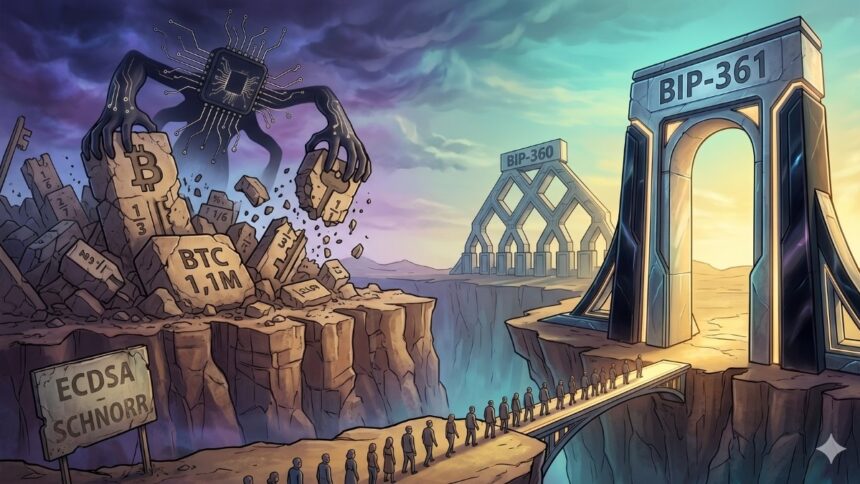
BIP-361 was officially incorporated into the official Bitcoin repository on April 14th and received its identification number. The proposal, led by Casa co-founder and cypherpunk Jameson Ropp, proposes implementing a mechanism through a soft fork that would invalidate Bitcoin’s current cryptographic signatures at a specific date and force users to move their funds to quantum computing-resistant addresses before the threat becomes a reality.
The proposal comes at a time when, according to data from Project Eleven, more than 34% of all Bitcoins in circulation have published their public keys on the blockchain. This includes addresses associated with Satoshi Nakamoto, which have accumulated approximately 1.1 million BTC. A sufficiently powerful quantum computer These public keys can be used to obtain private keys and transfer funds. According to academic estimates cited in the BIP-361 proposal, this scenario could materialize between 2027 and 2030.
This proposal complements BIP-360, published in February 2026, proposing Pay-to-Merkle-Root, a new type of address designed to hide the public key even at the time of payment. While BIP-360 defines where funds should go, BIP-361 establishes deadlines and consequences for not moving.
This initiative was developed with Christian Papathanasiou, Ian Smith, Joe Roth, Steve Weil, and Pierre-Luc Dallaire Demers.
Three phases for an orderly transition
The proposal divides the process into three stages. Phase A lasts approximately three years after activation; Send funds to post-quantum address;Shipping to vulnerable addresses will be blocked. In Phase B, two years after the first phase, nodes will reject transactions that use ECDSA or Schnorr signatures (the signatures currently used by Bitcoin), and unmigrated funds will no longer be accessible. Phase C, which is still under investigation, will explore the possibility of recovering these funds through zero-knowledge proofs that prove ownership of the original seed phrase.
The authors acknowledge that funds from abandoned or lost wallets, such as the wallet allegedly belonging to Satoshi Nakamoto, will be permanently inaccessible after Phase B. The proposal quotes Satoshi himself to explain this. Coins that do not have a valid owner and are not migrated will simply be taken out of circulationthe available supply decreases.
BIP-361 is in draft status and has no effective date.. As with other changes to the Bitcoin protocol, broad consensus is needed between developers, miners, exchanges, and administrators before moving forward. Additions to the repository mark the beginning of a technical discussion, not a conclusion.
(Tag Translation)Bitcoin (BTC)


