


2025 saw both an increase and a sharp decline. However, the past three months have seen a sharp decline, contrary to expectations of an increase.
Bitcoin and altcoins have been keeping investors out of the market in recent months due to poor performance, but 2026 has started with new risk appetite and an upward trend.
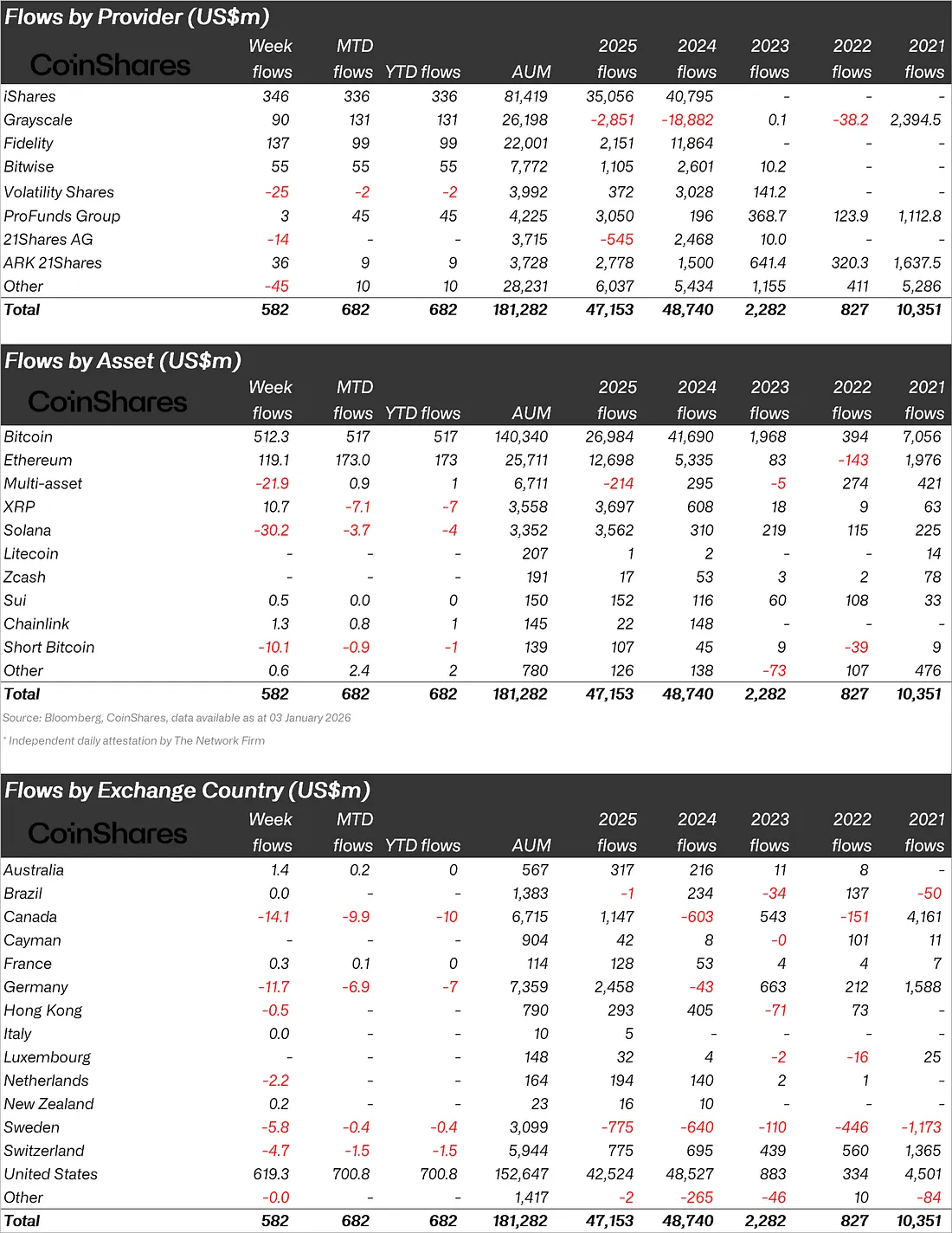
Although predictions for 2026 vary, CoinShares released its crypto report and said it had $582 million in inflows last week.
According to the data, total inflows in 2025 reached $47.2 billion, and interest in some altcoins also increased.
“Global crypto inflows are projected to reach $47.2 billion in 2025, very close to the 2024 record.”
Despite some mid-week swings, 2026 is off to a strong start.
Cryptocurrency products recorded $47.2 billion in inflows globally by the end of 2025. This figure was slightly lower than the $48.7 billion recorded in 2024.
Bitcoin maintains the lead!
When looking at cryptocurrency funds individually, we observed that the majority of inflows were in Bitcoin.
On a weekly basis, Bitcoin received $512.3 million worth of inflows and Ethereum (ETH) received $119.1 million worth of inflows.
Looking at other altcoins, Solana (SOL) experienced outflows of $30.2 million, while XRP saw inflows of $10.7 million and Chainlink (LINK) saw inflows of $1.3 million.
On an annual basis, Bitcoin had $26.9 billion in inflows and Ethereum had $12.7 billion in inflows.
Interest in altcoins also remained high, with XRP receiving $3.7 billion in inflows and Solana receiving $3.6 billion in inflows.
“Bitcoin lost 35% of its value last year, with only $26.9 billion in inflows recorded in 2025.”
The combination of price declines led to an influx of $105 million in short-term Bitcoin investment products throughout 2025.
The biggest gainer was Ethereum, with inflows up 138% year-over-year to $12.7 billion.
XRP and Solana recorded increases of 500% ($3.7 billion) and 1000% ($3.6 billion) respectively in 2025. The remaining altcoins experienced an emotional downturn, with inflows down 30% ($318 million) year-over-year.
Looking at regional capital inflows and outflows, the United States ranked first with an annual inflow of $42.5 billion.
After the United States, Germany received $2.4 billion in inflows, and Canada received $1.14 billion.
In response to these inflows, Sweden saw an outflow of $775 million and Brazil $1 million.
*This is not investment advice.


