

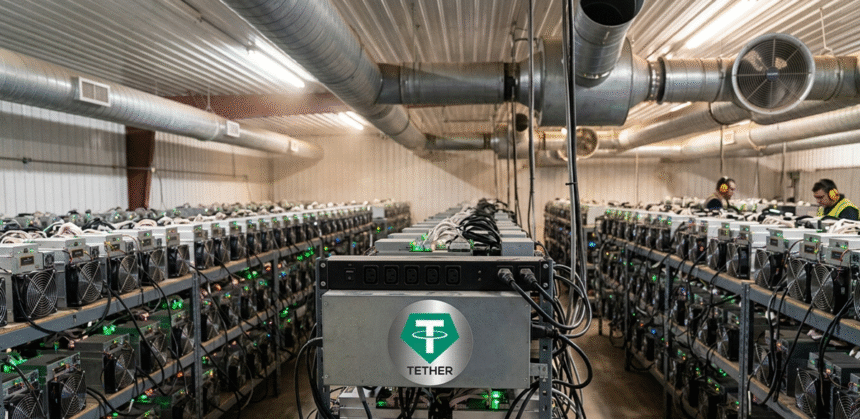
On April 28 of this year, Tether announced the expansion of its computing infrastructure through the development of a new generation Bitcoin mining system featuring a modular and dense design.
This approach represents a change from traditional industry models based on fully assembled and ready-to-use equipment. Rather than relying on closed solutions like this, The company collaborates with technology companies Canaan and ACME Swisstech. Develop a system built from modules of hash board Specially designed for a variety of applications.
These modules are integrated into a proprietary technology architecture that includes control systems, thermal management and software, Tether said in a statement. The result is a more versatile design that improves operator performance. Optimize heat dissipation and upgrade individual components without replacing the entire equipment.
Tether also pointed out that many current mining operations still run on thousands of independent devices, with little interaction between devices, limiting large-scale optimization and wasting the potential of industrial facilities. Faced with this, The company proposes an architecture that separates key components. Computing, power and encapsulation. This split allows each element to be optimized separately, giving you more control over the system depending on each site’s specific conditions.
By combining this design with technologies such as immersion cooling, USDT claims it is possible to reduce energy consumptionincreasing efficiency and increasing operational availability. This type of cooling is becoming increasingly relevant in high-density environments due to its ability to dissipate heat more effectively. Meanwhile, the company added that its systems are specially prepared for this type of cooling, but that it continues to develop alternative heat sources that can be adapted to different environments.
Finally, another important aspect of the design is adjustability. Output can be adjusted as needed, and components can be replaced or upgraded individually.
This announcement is consistent with previous developments in Tether’s research and development space. The company highlighted that it is already working on solutions such as an open source mining SDK.As reported by CriptoNoticias, the tool is designed to give operators more control over hardware operation, energy consumption, and overall facility performance.
This new advancement transfers the same logic to the physical plane. It’s no longer just software for monitoring and management. The company is now betting on a modular system organized around key processing units, aiming to intervene directly in how mining infrastructure is built.


