

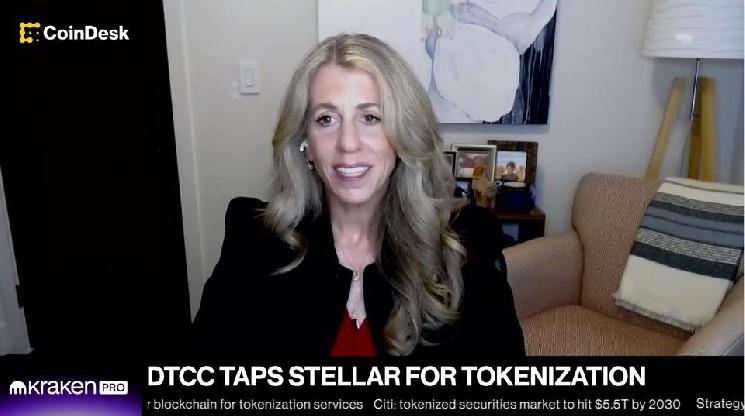
Latest developments: Stellar Development Foundation CEO Denelle Dixon joined CoinDesk’s Public Keys and said Stellar’s selection by DTCC is a testament to its long-standing infrastructure built for institutions.
- Dixon said DTCC recently selected Stellar as the first public blockchain to connect to its upcoming tokenized securities settlement platform.
- Dixon said Stellar surpassed $1 billion in tokenized real-world assets in December and has since grown to about $3 billion in about five months.
- Dixon described the partnership as “the moment Stellar was built” after more than a decade of focus on compliance and institutional requirements.
What this means: Regulatory advances are allowing institutions to move from experimentation to deployment.
- Dixon said the GENIUS Act gives financial institutions confidence that the U.S. government intends to support the industry through a clearer regulatory framework.
- He pointed out that companies such as Franklin Templeton were already building tokenized products before the recent legislation, citing its money market fund in Stellar.
- Dixon said passing the Clarity Act would benefit the industry, but argued that stalling the bill is unlikely to derail tokenization adoption.
See more: Stellar focuses its technology stack on compliance, privacy, and scalability for large financial institutions.
- Dixon said Stellar maintains 99.99.99% uptime and processes billions of transactions each quarter.
- He emphasized that compliance tools are built into the network’s architecture, reducing the need for custom smart contracts to issue assets.
- Stellar is also developing privacy capabilities with configurable models that allow institutions to tailor controls to specific assets and use cases.
Reading between the lines: Huge transaction volumes remain a significant test for blockchain-based financial infrastructure.
- DTCC processed $47 trillion in securities transactions last year, highlighting the scale that traditional market infrastructure already supports.
- Dixon acknowledged that tokenized payment volumes will not reach peak size immediately, but will increase gradually.
- He said maintaining reliability and avoiding network outages are key requirements for institutional deployment.
Wider perspective: Dixon expects tokenized assets to be distributed across multiple public blockchains, rather than being concentrated in a single network.
- She rejected the idea that one blockchain would dominate all institutions’ tokenization activities.
- Instead, Dixon said a few networks are likely to capture most of the real-world asset issuance based on their technological strengths.
- She argued that open public blockchains will eventually perform better than closed alternatives because they evolve rapidly through the participation of global developers.


