


What is Jupiter?
Jupiter is Solana’s primary liquidity aggregator and DeFi infrastructure layer. Traders use this to route swaps across Solana venues instead of manually checking every DEX. The platform also covers limit orders, DCA, PERP, lending, mobile access, wallet/portfolio tools, and developer infrastructure. For our Airdrop-focused readers, this is important because using Jupiter is no longer just one exchange button, but a broader product ecosystem.
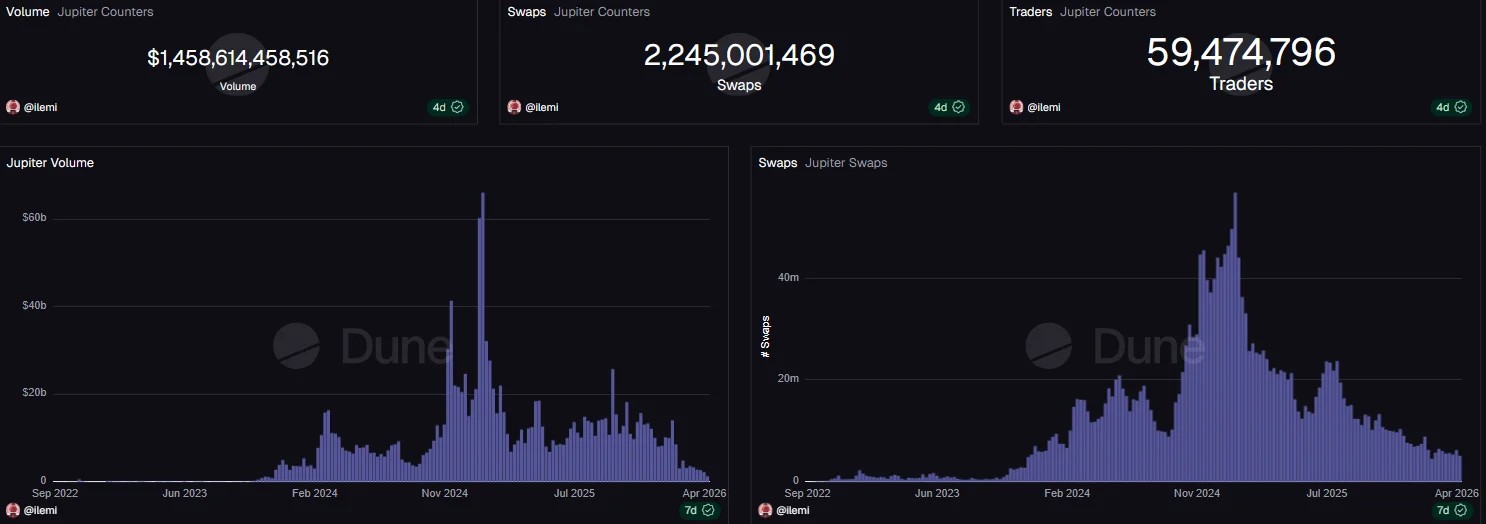
The on-chain footprint is already large. A screenshot of the Dune dashboard provided in this draft shows that Jupiter has a total volume of $1,458,614,458,516, 2,245,001,469 swaps, and 59,474,796 traders.
Is a 2026 airdrop to Jupiter confirmed?
no. As of this April 2026 update, users should not treat the new Jupiter airdrop as confirmed, scheduled, or guaranteed. The key change was Jupiter DAO’s net zero emissions proposal, which proposed postponing Jupuary for the time being and returning $700 million. $JUP Send to community cold multisig while saving a snapshot of usage/stake for future DAO decisions.
Jupiter’s official account later said the net zero emissions vote ended with 75.3% in favor. This simplifies the framework for conservative editing. This is not a guide to live guaranteed airdrops. This is a guide to Jupiter activities that may be worth doing even if future DAO votes bring back rewards, app-specific incentives, ASR-style incentives, or product campaigns.
The net zero emissions vote ended with 75.3% supporting net zero emissions.
Purely new $JUP Emissions are now virtually zero for the foreseeable future. Jupuary is deferred indefinitely, snapshots are saved, and 700M $JUP Back to community cold multisig… pic.twitter.com/d1e7GmEYKd
— Jupiter (@JupiterExchange) February 23, 2026
Why Jupiter’s activities remain important even after Jupiter’s postponement
Realistic theory is narrower than before. $JUP Already in existence, the easiest airdrop period has passed and July 2026 has been postponed. The reason Jupiter’s activity may still be significant is that the DAO proposal stores a snapshot of usage and stake, leaving future use of returned tokens up to future DAO votes. It doesn’t promise rewards, but it doesn’t mean your actual usage history is meaningless.
Jupiter’s unique long-term distribution philosophy also emphasizes actual product use rather than points-only farming. One of the useful official quotes from $JUP Genesis Post says, “We want you to use our products because you love them, not for the points.”
Therefore, the farming angle must be conservative. Don’t spam cheap swaps, don’t create noisy wallet clusters, and don’t buy volatile currencies. $JUP Just chase hypothetical rewards. If a future reward path emerges, a wallet that looks like a regular long-term Jupiter user will be easier to defend than a wallet built specifically for repetitive microtransactions.
How to build a real Jupiter participation profile
Switch through Jupiter like a real Solana user
action: If you actually need to rebalance, do a regular swap through Jupiter. Practical combinations include: $SOL, $USDC, $JUPthe highly liquid Solana ecosystem token, etc., but avoid root patterns that you won’t use in actual trading.
Estimated gas cost: Usually very small at Solana, but priority rates can increase.
realistic time: 5 to 10 minutes each time. Sybil Resistance Tip: A small number of realistic trades usually looks better than repeating the dust route.
Use current Jupiter swap flows, not just old habits
action: Contains Jupiter’s current swap experience and routing surfaces if available. While Jupiter documentation now presents Swap API V2 as one API for swap use cases, Ultra V3 introduced meta aggregation and routing improvements. The main point of the user guide is simple. It’s about using active product experiences instead of outdated flows.
Approximate gas cost: Similar to a regular Solana swap.
Realistic time: About 5 Minutes Sybil Tolerance Tip: Spread out your usage over weeks or months rather than creating bursts of the same activity.

Place an actual limit order
action: Create a limit order that you actually accept, such as a purchase. $SOL Price reduction or small quantity sales $JUP It is located higher up. Avoid fake orders that are far off market price and cancel them immediately.
Approximate gas cost: Set and cancel or settle a small Solana fee.
Realistic time: 5-15 minutes plus wait. Sybil Resistance Tip: Some orders last long enough to appear intentional.
Configure a small DCA root
action: Use Jupiter DCA for positions you already want to build or reduce. weekly $SOL-to-$USDC, $USDC-to-$SOLor $SOL-to-$JUP The schedule is sufficient.
Approximate gas cost: There is a small Solana fee for each setup and run.
Realistic time: Configuration takes 10 minutes, followed by passive monitoring. Sybil Tolerance Tip: Leave the schedule active for multiple intervals.
stake $JUP Vote only if you hold $JUP fit your plans
action: If you’re already interested, stake Jupiter Overview and participate in governance $JUP exposure. Don’t buy volatile tokens just to chase potential rewards.
Approximate gas cost: There is a small Solana fee for staking, voting, and claiming.
Realistic time: It takes 15 minutes to stake, then 2-5 minutes per vote. Sybil Resistance Tip: Avoid splitting small stakes across many wallets.
Use Jupiter Mobile or a browser extension
action: Install the official Jupiter Mobile app or browser extension only through official Jupiter links and connect it to the same wallet you already use. App-specific campaigns may reward users for adopting new channels, but there are no guarantees.
Estimated gas cost: There is no installation fee. Claims or exchanges will still require Solana fees.
Realistic time: 10-15 Minute Sybil Resistance Tip: Use a wallet that already has swap, DCA, order, and governance history.
Please test only if you understand advanced products
action: Only consider Jupiter Perth or financing if you already understand the risks. While these may be important for widespread use of the product, they add liquidation risk, financing payments, borrowing costs, oracle exposure, and smart contract risk.
Approximate gas cost: Although low on-chain, trading losses can dwarf Gas.
Realistic time: At least 20-30 minutes. Sybil Resistance Tip: Small, consistent usage trumps reckless leverage.
Keep your wallet profile consistent
action: Use one or two strong wallets instead of a cluster of weak wallets. Track dates, routes, order IDs, staking actions, votes, complaints, and product tests.
Approximate gas cost: Nothing but transactions.
Realistic time: 30 minutes upfront, 10 minutes per week. Sybil Resistance Tip: Avoid funding many wallets from the same source and performing the same actions in the same order.
Risk rating: 3.5/5
We rate Jupiter Participating Agriculture 3.5 out of 5. Jupiter is the primary Solana application and $JUP Already exists. However, the risk of airdrop confirmation is now higher as July 2026 has been pushed back by the net zero emissions process. New users have not confirmed the issuance of tokens. They are building a wallet history that may or may not be important later.
Sybil’s risk is moderate to high. Jupiter has a large user base, which means Teams and the DAO have strong reasons to separate real users from cheap automation. Simple swap spam probably won’t be enough. Wallet age, root diversity, product mix, staking behavior, voting history, funding links, timing, and transaction realism can all be important.
Smart contracts and products have medium risk. Spot swaps through mature aggregators are less risky than leverage, but users will still be exposed to Solana programs, routed liquidity, token contracts, mobile or extended flows, and in some cases purps and loans. The safest methods are spot swaps, limit orders, DCA, and governance. Treat criminal activities and loans as optional, not mandatory.
Related airdrops within the same ecosystem
Polymarket Pre-Token Airdrop
hyper liquid season 3
conclusion
The master plan is no longer “lock in a Jupurey drop.” It’s all about using Jupiter like a real Solana trader, keeping your activity consistent, adding current swap surfaces, and staking and voting only when: $JUP It already makes sense to expose and avoid noisy wallet clusters. Future reward paths after net-zero voting will likely depend on future DAO decisions. If that happens, the wallets with the strongest case will likely be older, more consistent, more diverse, and more active across products that Jupiter wants users to adopt.


