

quiet legal maneuvering Seizing ownership of over $200 billion in dormant Bitcoin, including Satoshi Nakamoto’s BitcoinI encountered a fundamental flaw.
The Lost Bitcoin Wallet lawsuit in New York now faces direct on-chain evidence that purportedly abandoned addresses were actively transferring billions of dollars in BTC, undermining the plaintiffs’ core legal premise.
The dispute centers on whether dormant Bitcoin addresses can be treated as abandoned assets if the coins are under private key control.
Since two anonymous limited liability companies in Wyoming filed a lost property lawsuit claiming 39,069 inactive Bitcoin addresses, 52 of these specific addresses have transferred approximately 34,335 Bitcoins. At current market valuations, the value of the transferred assets is approximately $2.48 billion.
The Wyoming group, operating under the pseudonym “Noah Do,” framed the case as a lost property lawsuit over Bitcoin under New York state law. The apparent strategy is to secure a default judgment giving them legal ownership of 3.799 million Bitcoins.
In order to comply with the strict jurisdictional and legal requirements of property law, the plaintiffs reportedly valued their claim at an astonishingly low $10.
In reality, the targeted addresses hold hundreds of billions of dollars, including coins mined in the early days of the network that are widely believed to belong to pseudonymous creator Satoshi Nakamoto.
Judge freezes path to uncontested ruling
In late May, the legal strategy hit a serious hurdle when pro-Bitcoin lawyer Ian Cohen filed a court brief challenging the viability of the lawsuit.
Cohen argued that New York’s lost property law does not apply to self-custodial Bitcoin and other digital assets, and that the state does not have jurisdiction over cryptographic keys.
In the realm of blockchain infrastructure, possession of a private key inherently constitutes legal ownership. The brief argued that dormant addresses are not abandoned property, but simply digital savings vehicles that have not been moved.
The intervention produced immediate results. On June 4, New York State Supreme Court Justice Kathy King granted Mr. Cohen a trial and ordered a stay of proceedings to freeze hearings and potential default judgments.
This stay prevents plaintiffs from quietly winning a default victory, an outcome that is highly likely given that the 39,069 anonymous and pseudonymous defendants are unlikely to appear in traditional courts to defend their assets.
On June 18, attorney David Lin, representing plaintiff Noah Do, filed a motion to revoke or reduce the length of the stay. Mr Lin argued that a non-party court should not have the power to stay the proceedings and that the statutory time limit for the defendant to answer should be allowed to expire.
Mr. Cohen issued a sharp rebuttal the next day, pointing out that the suspension was a judicial order initiated by the court itself.
This rebuttal highlighted the inconsistency of the plaintiff’s claims. Mr. Lin cited the defendant’s absence from court as the main reason for lifting the suspension, even though the suspension was implemented precisely to address a gap in opposition.
If the defendants don’t respond, Cohen’s brief will be the only adversarial check before the court considers it the largest attempted property seizure in U.S. history.
$2.48 Billion Wallet Transfer Disputes Abandonment Claim
The most important evidence for this case comes from the public ledger itself. Cohen emphasized that plaintiffs have a duty of good faith to the court, arguing that if an “abandoned” address were to move coins, the entire legal premise would be tampered with.
Galaxy Digital investigated blockchain activity and found that 12,302 Bitcoins were moved across 29 of the targeted addresses shortly after they were officially “offered” in the lawsuit.
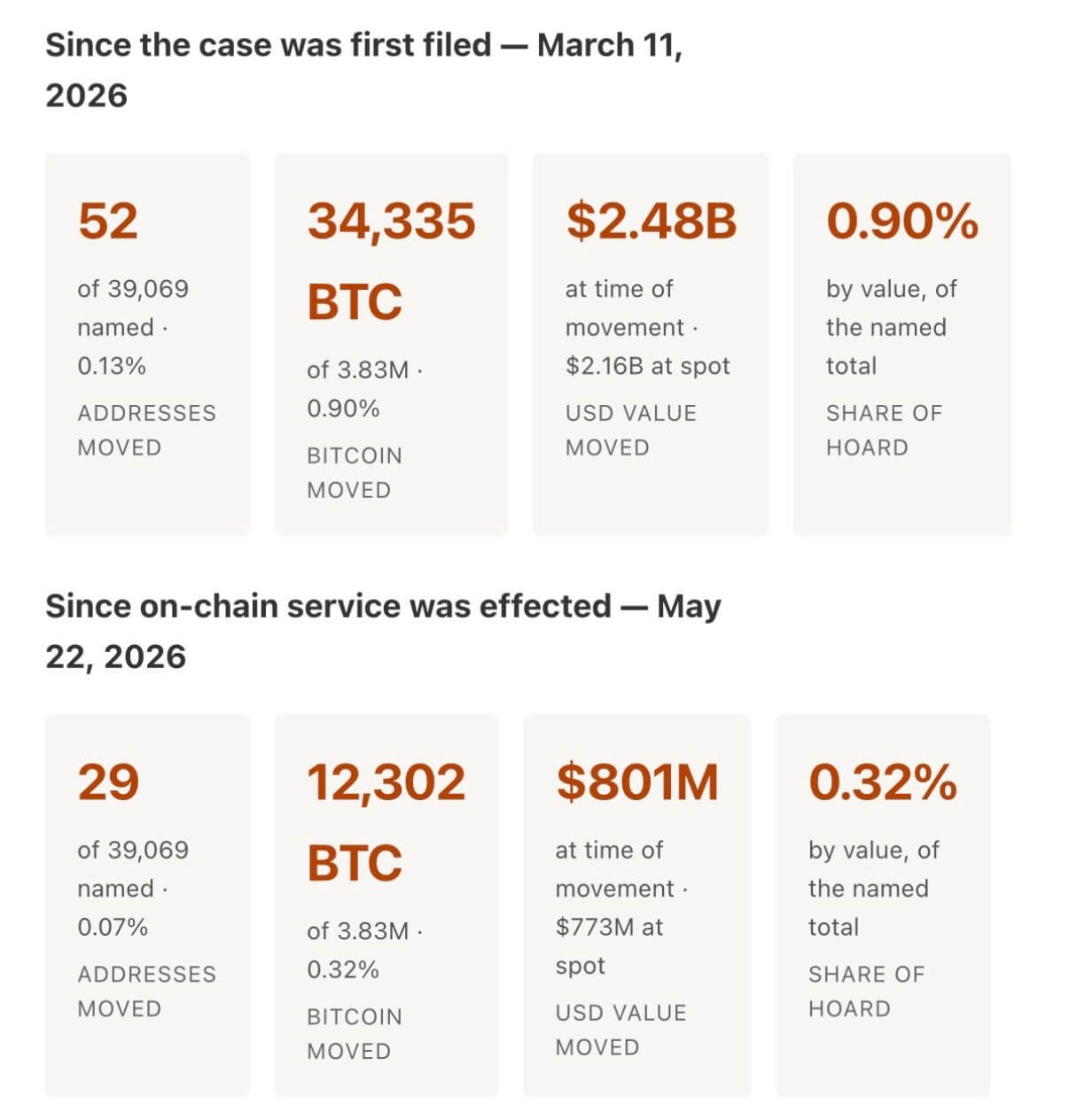
The real-time spending of these assets proves that Plaintiffs’ targeting algorithms were unable to distinguish between abandoned wallets and long-term cold storage.
Market analysts and researchers are beginning to realize the gravity of the incident. Alex Thorne, head of research at Galaxy Digital, emphasized the need for key industry stakeholders to intervene in litigation before a precedent is set.
He pointed out:
“A default judgment against the ‘defendant’ could result in legal ownership of 3.799 million BTC, including coins suspected of belonging to Satoshi.”
Securing ownership of these assets is likely to be the basis for years of active litigation and ownership disputes, he said.
He added that such an outcome could drain the industry of millions of dollars in legal costs and pose a serious overhang risk to the broader crypto market, echoing previous lengthy legal battles over early Bitcoin holdings.
(Tag Translation) Bitcoin


