

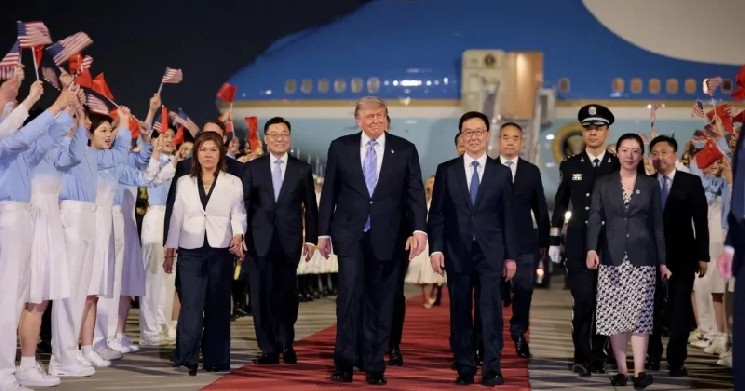
President Donald Trump is heading to Beijing for a face-to-face meeting with Chinese President Xi Jinping. Topics include trade imbalances, technology competition, and flows of fentanyl precursors. But beneath the diplomatic issues lies a quieter conflict that crypto investors need to keep a close eye on.
The United States is actively working on regulating stablecoins. Recent enforcement actions have targeted issuers like Tether, in part in conjunction with broader efforts to crack down on illicit fentanyl-related financial flows. When the US government talks about fentanyl precursors originating from China, it is also talking about the payment rails used in its transactions, and stablecoins are marked as one of them.
China banned most domestic cryptocurrency trading and mining several years ago, effectively shutting down what was once the world’s largest Bitcoin mining ecosystem. The Chinese government has promoted its central bank digital currency, e-CNY (Digital Renminbi), as a state-controlled alternative to decentralized cryptocurrencies, and China’s blockchain efforts continue to expand under intense government scrutiny.
Trump has been skeptical and even negative about Bitcoin and cryptocurrencies in general. However, his administration oversaw a period of significant institutional development in the sector, during which large banks began offering custody services, futures products matured, and the regulatory framework began to take shape.
Mainstream coverage of the summit, including Fox News, has not explicitly linked the agenda to cryptocurrencies. However, structural decisions made around AI export controls, financial oversight, and cross-border payment systems will set the playing field for crypto’s next chapter. The United States has restricted semiconductor exports to China, and China is accelerating domestic semiconductor development.
China’s crypto mining ban has reshaped the global hashrate map, expanding the scope of the activity to include the United States, Kazakhstan, and other countries. If the summit creates friction rather than cooperation, we can expect renewed interest in the theory that stablecoins like USDC serve as a vehicle for dollar hegemony in digital markets, and that Beijing’s e-CNY is a counterbalance to it.


