


The debate over Bitcoin governance is heating up once again, and this time Michael Saylor has joined the conversation with a lengthy critique of BIP 110. Thaler argues that the proposal could fundamentally change the way Bitcoin evolves by introducing consensus rules that limit the transactions currently in effect, rather than focusing on prices and market cycles.
His argument is not that every inscription or non-financial application deserves protection. Instead, Bitcoin’s consensus layer should not be used to determine which legitimate fee-paying transactions are accepted.
Saylor asks about consensus rule changes
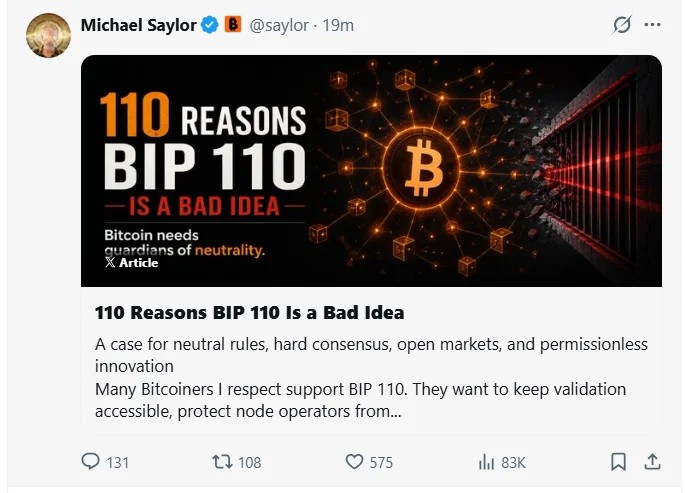
BIP 110, known as Reduced Data Temporary Softfork, proposes to introduce some temporary consensus restrictions for about a year. According to Saylor, the proposal would limit multiple transactions and scripting capabilities upon deployment through a modified activation process that lowers the miner signaling threshold compared to previous Bitcoin soft forks.
While existing UTXOs created prior to activation will be unaffected, Saylor argues that the proposal would remove transaction functionality currently considered valid and establish a precedent that limits future use cases through consensus rather than market forces.
He repeatedly emphasizes that his criticisms are aimed at the proposal itself, not the proponents, and acknowledges that proponents are trying to address real concerns about node costs, transaction efficiency, and Bitcoin’s role as a sound currency.
Neutrality rules and protocol restrictions
A central theme throughout Saylor’s memo is Bitcoin’s neutrality principle. He said Bitcoin cannot distinguish whether transaction data represents an image, an authentication record, a financial settlement, a proof, a contract, or a future application. Because of this limitation, he argues that consensus rules should be content-neutral rather than restricting technical constructs that could serve multiple legitimate purposes.
Saylor also questions whether BIP 110 has sufficiently demonstrated measurable benefits. His memo argues that the proposal does not quantify the expected improvements in decentralization, node costs, payment fees, and network efficiency before recommending changes to consensus.
Instead, he suggests that resource pricing, relay policies, mining policies, pruning, and layer 2 development remain more appropriate mechanisms to manage network resource consumption without changing Bitcoin’s basic consensus rules.
Governance debate attracts attention
The memo also raises concerns about BIP 110’s proposed deployment process, particularly the low signaling threshold and temporary consensus rules.
Michael Saylor argues that protocol changes should only be achieved through overwhelming consensus among developers, miners, node operators, exchanges, companies, custodians, and holders. He cautions that using consensus to block certain categories of valid transactions today could create a governance precedent that restricts other applications in the future.
eventually, Loading profile preview conclude that Bitcoin’s long-term strength comes from neutral rules, permissionless innovation, and broad consensus rather than defining acceptable transaction objectives through protocol changes.


