


Jito Foundation has signed a memorandum of understanding with Korean digital asset management company KODA to explore institutional custody and staking support for JitoSOL in the local market.
The agreement includes outreach to institutional investors and the development of compliant custody and staking pathways, according to Monday’s announcement.
This comes as South Korea’s Financial Services Commission is expected to finalize its digital asset regulatory framework later this year.
The foundation announced in February that it would explore establishing a JitoSOL exchange-traded fund in South Korea in collaboration with Hanwha Asset Management, pending regulatory approval. Marc Liew, Head of APAC at Jito Foundation, told Cointelegraph:
We’re getting a lot of interest from two major camps. They are large financial firms looking to build the next generation of wealth management products and institutional groups interested in the yield-enhancing properties of JitoSOL for their own finances.
KODA provides custody infrastructure including cold storage, MPC-based key management, institutional staking, and $20 million in digital asset insurance. The company is backed by KB Kookmin Bank and other investors and has a registered VASP license and ISMS certification.
“Through KODA’s institutional-grade vault system, the KODA interface allows clients to mint JitoSOL directly from the client. $SOL We have it,” Liu said.
Jito is Solana ($SOL) Network where users stake $SOL In exchange for JitoSOL, a token that can be used across decentralized finance applications. The Jito Foundation supports development, partnerships, and institutional support.
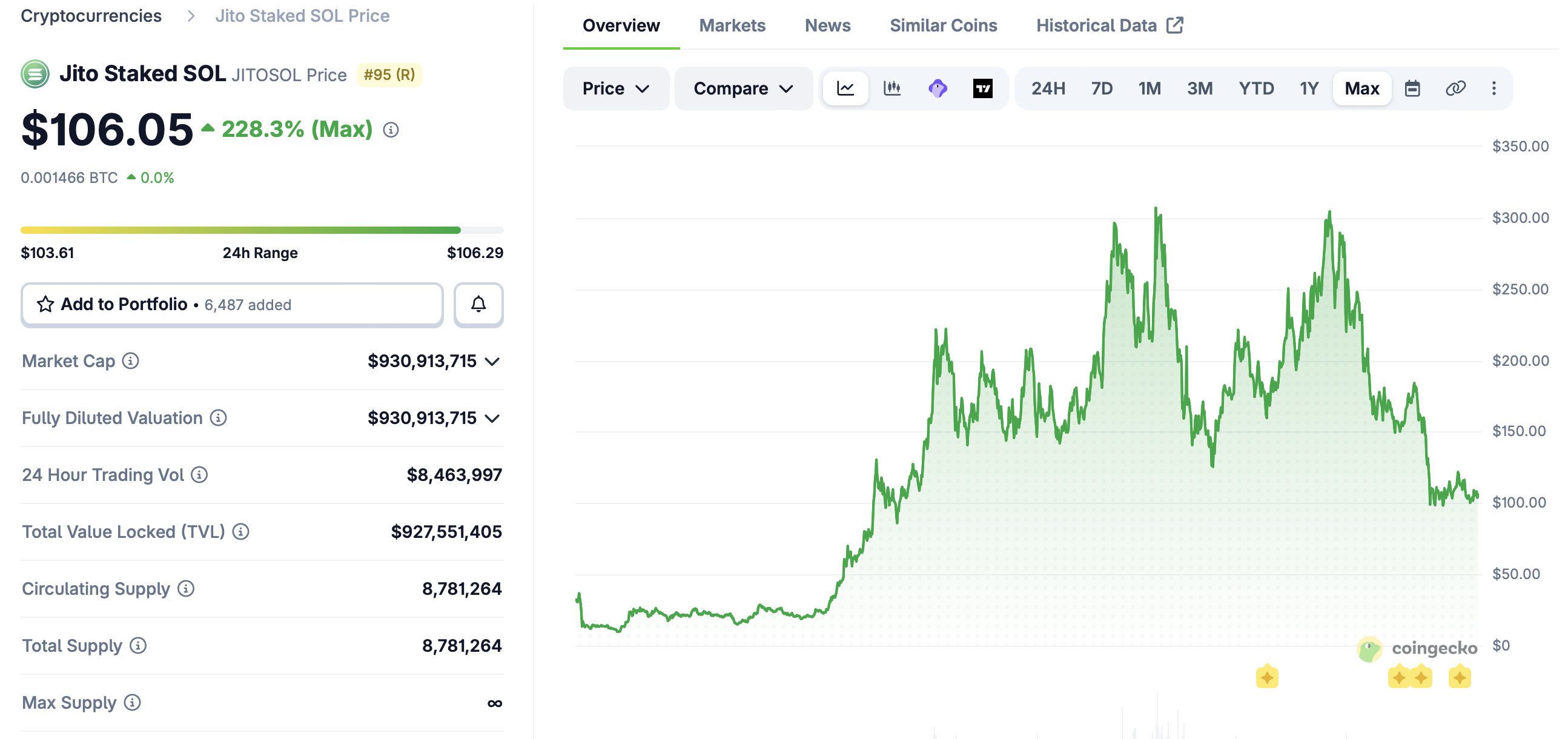
According to CoinGecko data, JitoSOL has a market capitalization of approximately $930 million. The token already has institutional exposure in Europe through a listed product on 21Shares, and custodians such as BitGo and Hex Trust support direct staking from custodial accounts.
Related: Grayscale Debuts Solana ETF, Joins Bitwise $SOL Staking the ETF race
Seoul strengthens control over virtual currency market
South Korean regulators and policymakers are calling for increased regulation of the crypto sector, with a view to a more structured regulatory framework.
The country approved changes to its virtual currency licensing regime in January, tightening requirements for virtual asset service providers and expanding oversight to include major shareholders. In March, policymakers announced a proposal to cap domestic exchanges’ holdings at 20% as part of a broader effort to impose stricter regulations on market structure.
Regulators’ actions accelerated after a payment error that occurred on cryptocurrency exchange Bithumb in early February resulted in a user mistakenly receiving 620,000 Bitcoin (BTC) instead of 620,000 Korean won.
Following the incident, the country’s Financial Services Commission introduced stricter reconciliation requirements between exchanges’ internal ledgers and on-chain balances.
Earlier this month, lawmakers began drafting legislation that would classify stablecoins as foreign exchange payment instruments and require tokenized real-world assets to be backed by assets held in trust.
More recently, the Bank of Korea called for a “circuit breaker” at the currency level and strengthened internal controls, and the Bank of Korea warned that the industry lacks safeguards found in the traditional financial system.
magazine: Should users be allowed to bet on war and death in prediction markets?


