




Bitcoin is trading around $82,000, and a return to price discovery territory will depend on whether ETF buyers continue to absorb supply while macro pressures remain contained.
Here are practical answers to two questions that will shape the rest of 2026. The question is: When will Bitcoin hit a new all-time high? And has the market already bottomed out?
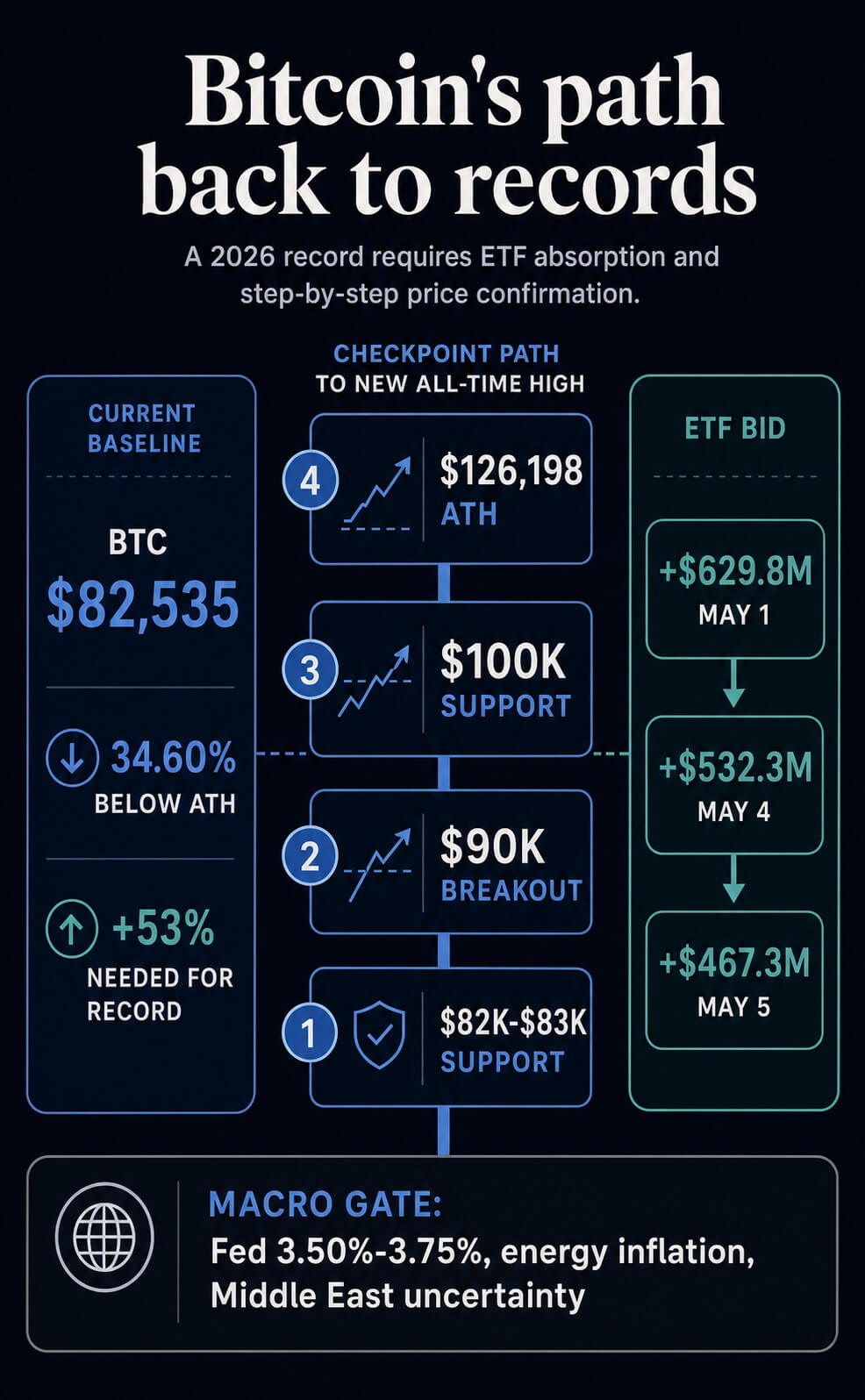
Bitcoin has regained the low $80,000 level and is once again testing whether buyers can build support there. However, according to Bitcoin’s live price, it is still more than 30% below its all-time high of $126,198 on October 6, 2025.
The distance to the peak is the first constraint. Bitcoin would need to rise about 54% from about $82,000 to set a new record.
Spot ETFs are once again seeing inflows of hundreds of millions of dollars a day, but old highs still need to be treated as supply zones to be cleared rather than automatically reached price levels.

The most obvious take is conditional. If Bitcoin first finds support in the $82,000-$83,000 area, clears $90,000, and regains $100,000 while ETF inflows remain positive, Bitcoin could reach a new all-time high in late Q3 or Q4 of 2026.
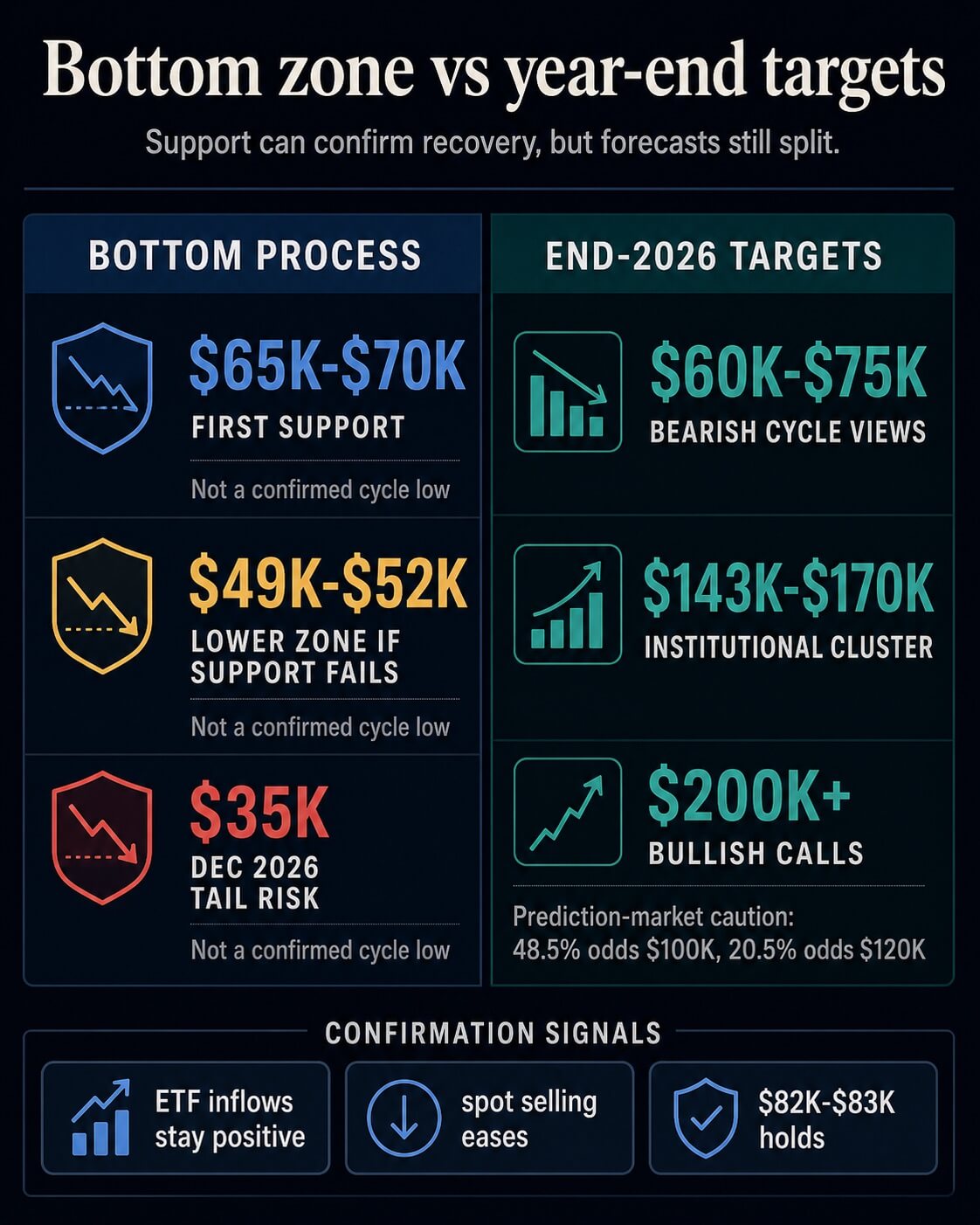
On the other hand, the bottom should be treated as a process rather than a date. The initial support zone for this process is $65,000 to $70,000. If that fails, the downside job will be left alive.
The first barrier is around $80,000.
Immediate testing was below previous records. recent crypto slate Price coverage has set the low $80,000 range as the zone where Bitcoin needs to turn from resistance to support before a trade at $90,000 becomes reliable.
This is consistent with the current market structure. BTC has returned above the psychological $80,000 line, but the move remains within the large overhead supply band created by buyers nearing the 2025 peak.
This is why demand for ETFs continues to trend upward. Net inflows were $629 million on May 1, $532 million on May 4, and $467 million on May 5, according to Farside Investors’ U.S. Spot Bitcoin ETF Flow Sheet.
These flows are demand proxies that help absorb profit-taking from old holders and recent buyers who want to exit near break-even.
The same flow channel also explains why this cycle is difficult to compare with past post-halving years. The ETF market has created a regulated access point for spot exposure.
BlackRock’s iShares Bitcoin Trust remains a deep and liquid wrapper, showing that ETF demand is more than just a trading screen abstraction.
Still, demand for the ETF could weaken quickly if macro pressures build or if holders sell off faster than new money can arrive. So $82,000 to $83,000 is the starting gate.
If we can get a clean hold there, we’ll get $90,000 in the next live test. If it fails, the current rebound will revert to another relief rally within the defensive structure.

The supply side is what keeps the chart from being a simple ETF flow setup. Glassnode’s research in early April listed an overhead supply of $80,000 to $126,000 and approximately 8.4 million BTC in losses.
A bull market needs to prove that new demand is stronger than exit liquidity, as each further move up that range can lead to selling from holders who bought near the top.
Bottom calls require more humility.
On-chain data does not support confidently declaring a bottom price. According to Glassnode’s Week On-chain report from late April, Bitcoin remains capped by the true market average and short-term holder cost basis, while support is centered around $65,000 to $70,000.
That support zone defines the first serious retest in the event of a failed recovery in the low $80,000 range.
Support zones and confirmed cycle lows are another argument. A Glassnode study from early April explained that Bitcoin is experiencing a redistribution rather than a clear upward trend, with overhead supply ranging from $80,000 to $126,000, with losses of approximately 8.4 million BTC.
Therefore, a pullback into the old range could trigger a sell-off from investors who wanted to buy higher and sell higher.
A better answer is that Bitcoin may be building a bottoming structure but has not proven it yet. If the current recovery in the low-$80,000 range fails, the $65,000 to $70,000 area will be the first level to watch.
A successful retest, followed by new ETF inflows and easing of physical selling, would strengthen the view that a tactical bottom has formed.
When that zone is breached, the risk profile changes. While previous Bitcoin bottom analysis had held the lower zone, another cycle model predicted a tougher low near $35,000 in late 2026 if the old post-halving pattern reasserted itself.

While this model remains a tail risk while ETF demand improves, it becomes difficult to ignore if support fails and the flow reverses.
So there are two answers to the bottom question. If $65,000 to $70,000 survives and Bitcoin continues to regain higher cost-based levels, a tactical bottom may already be forming.
The bottom of the cycle will not be confirmed unless the market is able to absorb the overhead supply and maintain higher support through further macro shocks.
This difference affects timing. If the bottom is confirmed by support and ETF demand, Bitcoin will have a wider runway for further gains in the second half of 2026.
If the retest fails, the market will revert to the old cyclical model of capital preservation, deferral of price targets, and final lows near the end of the year.
Recording window depends on liquidity
Once the price target is separated from the trigger, it becomes easier to frame the all-time high question. If liquidity conditions stop working against risk appetite and ETF demand continues to absorb spot supply, Bitcoin can achieve a record even if all macro variables are not in its favor.
The Fed’s April 29 statement left its target range unchanged at 3.50% to 3.75%, citing rising global energy prices and uncertainty in the Middle East as contributing factors to the rise in inflation.
This backdrop gives risk assets less room for frictionless upside. It also explains why Galaxy Digital’s Michael Novogratz told Bloomberg in late April that it would be difficult for Bitcoin to get back to $100,000 without central bank relief.
In this context, the 2026 record remains a possibility, but the burden of proof will depend on the market structure. Bitcoin needs to stay in the low $80,000 range and keep ETF inflows steady enough to absorb the profit taking.
If the short positioning is still heavy, a push through resistance may increase the risk of a squeeze, but it should be treated as a potential acceleration rather than a requirement.
The next visible steps are $90,000 and $100,000, followed by a long rally towards $126,198.
Late Q3 to Q4 is the most defensible period as it gives the market time to do its work. If ETF inflows accelerate and macro data gives the Fed room to sound less restrictive, swifter action will be possible.
A postponement to 2027 becomes more likely if oil-driven inflation drives interest rates higher, the dollar and yields weigh on risk assets, or spot ETFs return to sustained outflows.
Therefore, timing calls should be tied to checklists, not calendar boxes. A record attempt would require support between $82,000 and $83,000, a clean break at $90,000, proof that $100,000 can be support, and absorption by the ETF to survive the risk-off session.
Without these factors, a year-end bullish target remains a likely outcome rather than the market’s baseline scenario.
Prediction and positioning are different
CoinGecko’s April forecast aggregate shows a wide spread with a bearish cycle outlook around $60,000 to $75,000, an institutional-style target around $143,000 to $170,000, and a bullish call above $200,000.
Bitwise’s 2026 outlook goes further into the structure, arguing that Bitcoin could break its four-year cycle and reach new all-time highs as demand for ETFs outstrips new supply.
Prediction market pricing is less enthusiastic. CoinGecko’s prediction market page shows 48.5% odds of Bitcoin reaching $100,000 by the end of the year and 20.5% odds of reaching $120,000.
These numbers do not disprove the analyst’s target cluster, but they do show that traders are not yet treating the $150,000-$200,000 base case.
| question | bass lead | confirmation signal | Main risks |
|---|---|---|---|
| New all-time high | Late 3rd quarter to 4th quarter of 2026 is reasonable, but with some conditions. | BTC holds $82,000-83,000, settled $90,000, collected $100,000, ETF inflows remain positive | Macro pressures and holder selling prevent movement below $100,000 |
| market bottom price | Bottoming process, not a confirmed low | $65,000-$70,000 survives retest, physical selling eases | Breaking this zone will restart the downside model in the second half of 2026. |
| Consensus at the end of 2026 | Prominent analysts are targeting a cluster around $150,000, while bulls are pushing it above $200,000. | ETF demand continues to absorb supply, improving macro environment | Prediction market odds remain far below bullish theoretical targets |
Bitcoin has entered a measurable confirmation phase. ETF inflows have repaired the bull market, but it’s not done yet.
On-chain data still points to indirect supply, macro policy is not yet a clear tailwind, and market implied odds remain below banks and asset managers’ target charts.
For now, if Bitcoin stays in the low $80,000s and continues absorbing supply through the ETF channel, it has a good chance of hitting new all-time highs by the end of 2026. Although the bottom has not been confirmed, the next significant test lies around the $65,000 to $70,000 area.
Prominent analysts’ targets are centered around around $150,000 at the end of 2026, but the market still wants evidence before estimating that outcome as the primary path.
(Tag translation) Bitcoin


