


Colombian President Gustavo Petro has stressed that the future of Bitcoin mining must be environmentally friendly, with countries rich in green energy such as Paraguay and Venezuela attracting investment in the Bitcoin mining sector. He also warned about the impact of using fossil fuels to power this activity.
Important points:
- Colombia’s Gustavo Petro has warned that fossil fuel-powered Bitcoin mining risks global climate collapse.
- Paraguay has the world’s fourth-highest hashrate, while Venezuela has halted mining due to a nine-year peak energy crisis.
- Petro wants three Caribbean cities to mine Bitcoin, but the 2026 Hashrate Index report excludes Colombia.
President Petro highlights energy extraction potential in Venezuela and Paraguay
Cryptocurrency mining as a global activity has attracted the attention of world leaders, who are giving their opinions on what the future holds for these activities.
Controversial Colombian leader Gustavo Petro reiterated on social media the need for green resources to power these energy-intensive activities.
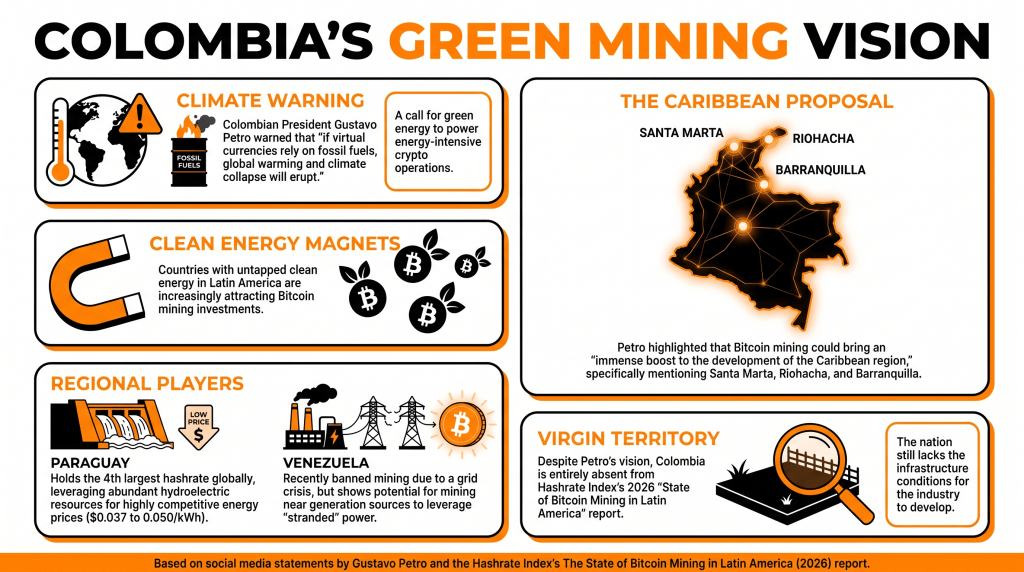
Peter warned that “If cryptocurrencies depend on fossil fuels, there will be global warming and climate collapse.”
He also emphasized that countries with untapped clean energy resources, such as Venezuela and Paraguay, are attracting investment in Bitcoin mining. Paraguay has the fourth-largest hashrate in the world, behind powers such as the United States, Russia and China, while Venezuela is not even in the top ten.
Paraguay leverages the rich hydropower resources of the Iguazu Dam, one of the largest in the world, and offers highly competitive energy prices ranging from $0.037 to $0.050/kWh.
Venezuela recently banned Bitcoin mining as the government faces an energy crisis and demand soars to a nine-year peak. Still, the report shows that mining operations near energy sources can tap into electricity that cannot be transported due to lack of infrastructure.
“Bitcoin mining is a method that allows individuals to accumulate Bitcoin through virtual transactions using powerful computers. This also applies to Santa Marta, Riohacha and Barranquilla… This represents a major boost to the development of the Caribbean region.” Peter concluded.
Hashrate Index’s “State of Bitcoin Mining in Latin America (2026)” report focuses on mining developments in Paraguay, Brazil, Bolivia, Argentina, Venezuela, and El Salvador, but does not mention Colombia. This means that this country is a frontier for Bitcoin mining, and the conditions for the industry to develop are not yet in place.


