

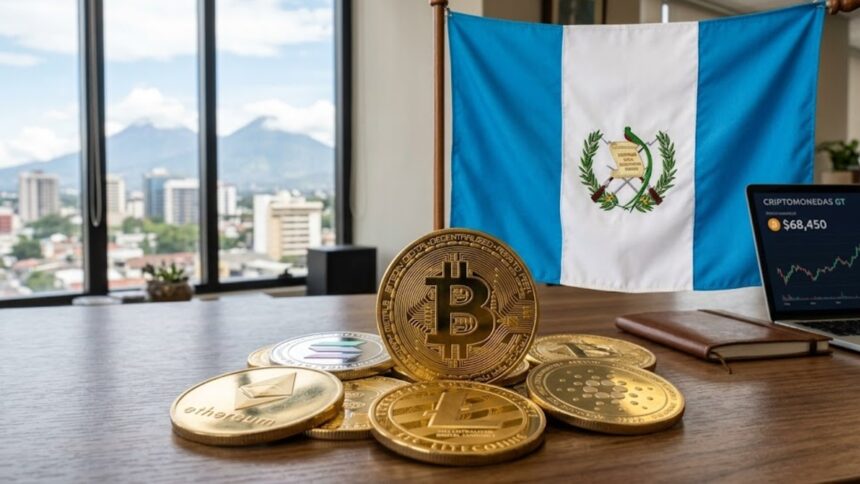
The Congress of the Republic of Guatemala has approved the Comprehensive Law for the Prevention and Suppression of Money Laundering or Other Assets and the Financing of Terrorism (identified as Decree 15-2026).
The new regulation, first presented in September 2025, updates a 25-year-old legal framework and explicitly includes a cryptocurrency sector under direct state supervision for the first time in the Central American country’s history.
Exchange platforms, custodians and virtual asset service providers These are considered mandatory subjects before the Special Verification Authority (IVE).
The law repeals previous legislation enacted in 2001 and 2005 aimed at unifying financial management policies and following the recommendations of the Financial Action Task Force (FATF).
This decision is in response to the obsolescence of previous legal tools in the face of current market dynamics. and the emergence of new digital assets in the global economy. With this, Guatemalan authorities seek to strengthen the country’s international confidence among investors and the correspondent banking system.
The Decree, which is still awaiting formal publication and the development of technical regulations, defines the precautionary approach as moving from traditional banking to all economic activities. Virtual asset service providers (PSAVs) need to adapt their operations Has the same management responsibilities as a bank and other regulated entities.
According to legislative documents reviewed by CriptoNoticias, the regulations will regulate certain activities within the cryptocurrency ecosystem, including exchange, storage, transfer, issuance of virtual assets, and management of trading platforms.
Testing and identity verification (KYC) required by authorities will be strictly enforced To prevent money laundering and terrorist financingTherefore, we do not predict or guarantee that you will automatically obtain a commercial license for operation.
Regulated providers must register with the Banking Supervision Authority through a special verification body. Failure to comply with this registration will result in administrative sanctions ranging from $500 to $500,000. It depends on the severity of the failure.
Companies in the crypto sector will be forced to adopt a risk-based approach. This includes developing a prevention manual that includes financial crime mitigation policies, appointing a compliance officer from senior management, and conducting regular internal and external audits as required by the FATF.
Another important point of this bill is that Prohibition of anonymity in the trading of digital assets. Platforms must apply strict due diligence or know-your-customer policies, which require identifying and verifying the identity of users and end-beneficiaries through trusted sources before establishing commercial relationships.
Similarly, regulations require tighter controls when processing operations using technology that makes it difficult to trace funds.
When it comes to reporting, crypto companies report anomalous transactions that lack a clear economic or legal basis directly to the IVE through suspicious transaction reports. Similarly, there is a requirement to maintain daily records and regularly report cash transactions exceeding $10,000 or local currency equivalent.
Guatemala’s new law aimed at mitigating money laundering and dealing with virtual currencies has destroyed Initiative 6538, which sought to regulate the use of Bitcoin (BTC) and other digital assets in the country, as this media reported. In fact, information about this bill is no longer available on the transparency portal of the Guatemalan Congress.
Adaptation to Decree 15-2026 has sparked debate in the business environment as it significantly increases operating and compliance costs for companies that have previously operated outside the surveillance radar under FATF standards. It defines the finer points and technical thresholds that govern the day-to-day operations of digital asset providers. Once the executive branch issues supplemental regulations.
(Translate tag) Anti-money laundering (AML)


