


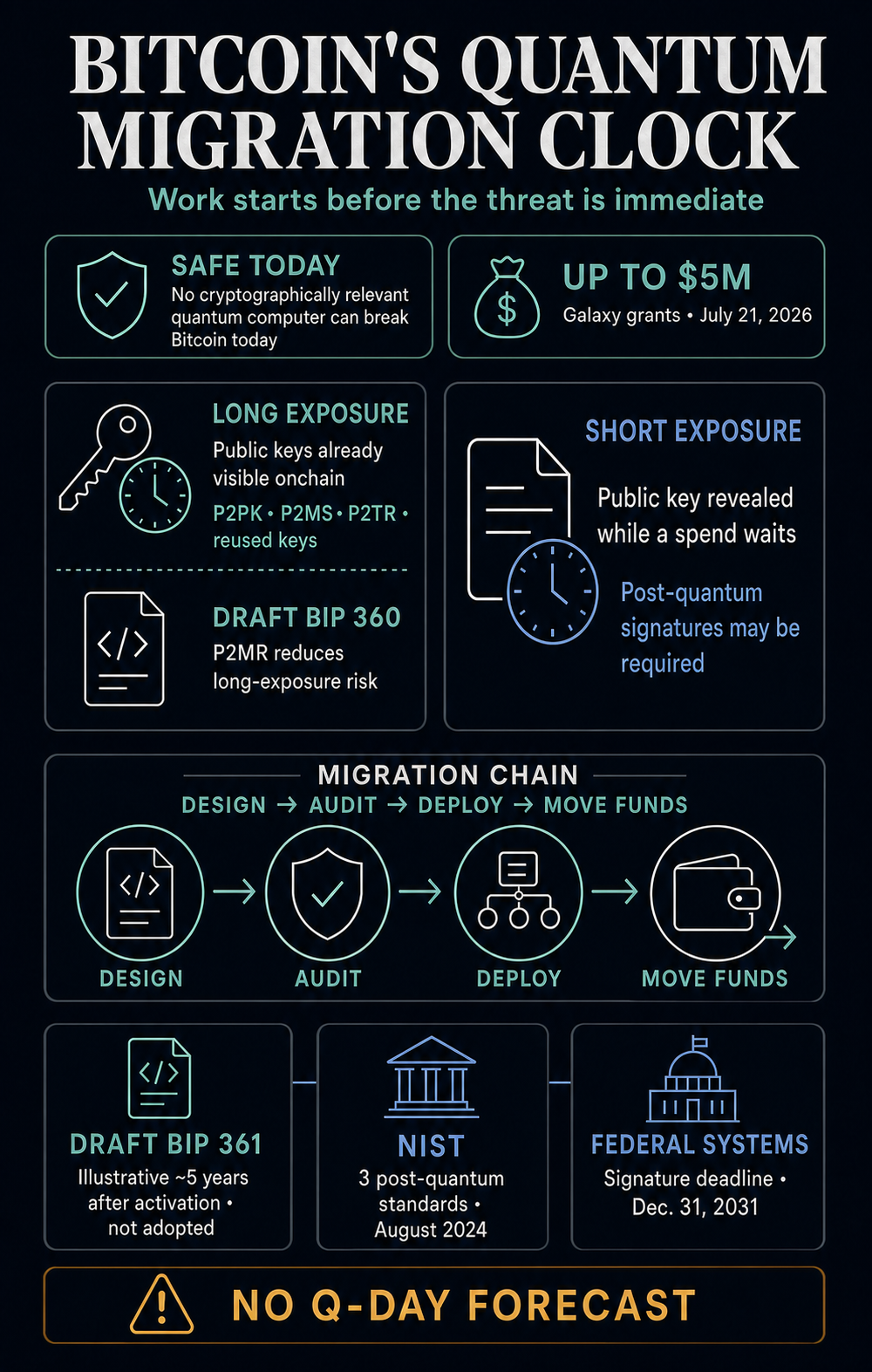
Galaxy Digital on July 21 pledged up to $5 million to help Bitcoin prepare for the quantum era. This initiative will help developers reach key milestones while supporting research and the Quantum Advisory Board.
Quantum computers are currently unable to break through Bitcoin’s unique security, but this program aims to move forward with the transition before that threat becomes a reality.
This effort targets several links in the migration chain: review of quantum-resistant transaction proposals, integration of post-quantized signatures, formal security audits, and software and institutional migration tools.
Funding could accelerate these workstreams, but Bitcoin’s decentralized governance requires developers, miners, node operators, wallets, exchanges, custodians, and users to coordinate upgrades, which Galaxy says could take years to design, test, and deploy.
There are two windows for technical risk. A sufficiently powerful quantum computer can use Scholl’s algorithm to recover the private key from the published elliptic curve public key and forge a valid signature. Keys already exposed on-chain give attackers a long grace period. Most Bitcoin spends expose the public key while the transaction waits in a memory pool, reducing time for faster attacks.

The BIP 360 draft identifies public key payments, bare multi-signatures, and tap root outputs among those that have been publicly available for a long time. Address reuse, extended public keys, and wallet descriptors can also reveal vulnerable material. Hash-protected output hides the public key until expenditure or other disclosure.
BIP 360 uses a soft fork to add new Pay-to-Merkle-Root outputs. The vulnerability, known as P2MR, removes Taproot’s key path, limiting long-term exposure and leaving room for stronger signature schemes later.
This proposal is still in draft and only covers the first exposure window. Post-quantum signatures may be required to defend transactions after the key appears in the memory pool.

So while Galaxy’s grant program could help review code and transition research into migration tools, funding cannot select the final design of Bitcoin or schedule its implementation.
The second proposal, BIP 361, addresses operational scale. The draft Information BIP relies on a yet-to-be-specified post-quantum signature proposal and depicts a two-stage transition approximately five years after activation. That timeline is one scenario, not an adopted roadmap.
Even after a design is chosen, the network will still require review of proposals and signatures, audits, wallet and node releases, institutional upgrades, and ownership transitions. Users need time to move funds to a protected output while keeping their existing signatures safe and available for use. Each dependency makes last-minute responses difficult.

A broader encryption program is already working with a multi-year horizon. NIST completed three post-quantum standards in August 2024, including two for digital signatures, encouraging early integration as the transition will take time. Executive Order 14412 directs the Office of Management and Budget to require certain federal systems to use post-quantum signatures by December 31, 2031.
These federal regulations only cover government systems and do not predict when quantum hardware will arrive. But they illustrate why the Galaxy is getting an early start. Bitcoin still requires a thoroughly considered signature design, broad community consensus, and sufficient time for users to move their funds, so research and tools cannot wait until a threat approaches.
(Tag translation) Bitcoin


