

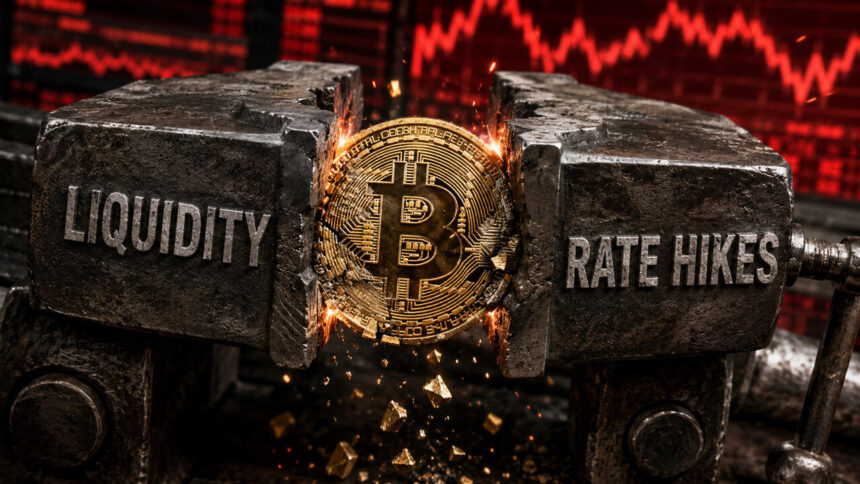


The Federal Reserve’s April meeting minutes released on Wednesday failed to bring the good news Bitcoin traders had been hoping for for most of this year. Most policymakers said some degree of policy tightening would likely be appropriate if inflation remained above the central bank’s 2% target, contrary to the rate cuts that markets had expected.
The committee kept interest rates unchanged at 3.50% to 3.75%, but four members dissented, adding to the growing number of voices calling for the Fed’s most divisive meeting since 1992 to remove language suggesting a rate cut.
At the beginning of the year, futures traders were pricing in at least two rate cuts by the end of the year, making further hikes nearly impossible. As of May 20, CME FedWatch indicated a 54.1% chance of a rate hike by December, with only a 1.5% chance of any easing. This is a complete reversal of the expected direction of monetary policy, and for Bitcoin, these two things have completely different outcomes.
Bitcoin will trade on Fed liquidity before it trades on ideology
Bitcoin’s sensitivity to Fed policy is ultimately one of liquidity.
If the Fed is expected to cut rates, money will become cheaper, yields will fall, the dollar will weaken, and investors will be more willing to hold risky and volatile assets (including Bitcoin). If the Fed is expected to raise rates, the opposite will happen across all channels simultaneously. Bitcoin’s price now depends almost entirely on risk appetite and liquidity conditions shaped by Fed policy. This is why BTC can move depending on the direction of interest rate expectations, even if the Fed hasn’t actually done anything yet.
This change was mainly caused by the situation in Iran. The conflict caused energy prices to rise sharply, with most inflation measures above 3%, and policymakers who had been trying to guard against supply-side shocks found themselves less willing to do so as the conflict dragged on.
CPI in April was 3.8%, well above the Fed’s target of 2%. Several participants at the April meeting wanted the moderation bias language removed from the official statement. It may sound like a technical detail, but markets always see it as a meaningful signal about policy direction.
Incoming chair Kevin Warsh will succeed Jerome Powell, and the committee is already being repositioned around a more hawkish center of gravity. If markets price in a more aggressive stance from the Fed, the dollar will tend to appreciate as higher U.S. interest rates make dollar-denominated assets more attractive relative to other currencies.
A strong dollar will tighten financial conditions globally, putting pressure on assets priced in dollars, including Bitcoin. The 10-year U.S. Treasury yield hit a 12-month high of 4.54% on May 15, making non-yielding assets like Bitcoin a tough sell for institutional investors who can earn nearly 5% on virtually volatile Treasuries.
The size of the ETF market only makes this worse. Before the emergence of spot Bitcoin ETFs, BTC’s macro sensitivity was buffered to some extent by the crypto-native infrastructure. But now Bitcoin is traded within the same brokerage accounts as stock and bond funds, allowing institutional investors to reduce their exposure using the same tools they use to reduce other risk positions. During the week of May 15, tensions in Iran pushed oil prices above $110, pushed U.S. Treasury yields to new cyclical highs, raised the odds of a Fed rate hike, and caused a nearly $1 billion outflow for Bitcoin ETFs, halting six consecutive weeks of inflows. Coinbase analysts noted that sustained expansion of Bitcoin’s price range will likely require either a clear improvement in system-wide liquidity or a decisive downward trend in inflation. According to the minutes, neither is currently visible.
Policy victory hits a macro wall
Although it is easy to confuse a delayed rate cut with a potential rate hike, they represent very different environments. Even if the rate cut is delayed, it means the Fed’s next big move will eventually ease liquidity. The market was usually able to price that in, with Bitcoin finding a rough equilibrium between $76,000 and $83,000. With markets pricing in the possibility of a real rate hike, it means the next big surprise could come from the tightening side, which is a more difficult setup for any risk asset to trade.
The most relevant historical precedent here is the 2022 rate hike cycle. Bitcoin fell from about $69,000 to $15,500 as the Federal Reserve raised its benchmark interest rate from near zero to over 5%. Now the starting conditions are different and that particular trajectory is not the base case. The 25 basis point rate hike is already partially priced in, so the move itself should not be a big shock.
A more dangerous scenario is a sustained hawkish stance, a dot plot showing rising interest rates through 2027, or an inflation sequence that continues to give policymakers reason to delay policy change.
What makes this year particularly complicated is that Bitcoin has made credible bullish claims regarding regulatory developments this year, including a friendlier SEC stance, advances in stablecoin legislation, and improved institutional infrastructure.
The problem, as igcurrencynews’s macro coverage has noted throughout the year, is that regulatory tailwinds and liquidity headwinds can blow at the same time, with liquidity tending to win in the short term.
Even if Bitcoin goes along with Washington, it could still lose out on interest rate trading. As of May 20th, it was hovering around $77,300, which is about 38.7% below the October 2025 ATH. The Fed minutes did not include an actual interest rate hike that would damage Bitcoin’s setup. They just confirmed that the next big policy surprise is more likely to come from the hawk side than the dovish side.
The rate-cutting trade that defined Bitcoin’s macro outlook at the beginning of the year has so far been replaced by something much more difficult to build on.
(Tag to translate) Bitcoin


