

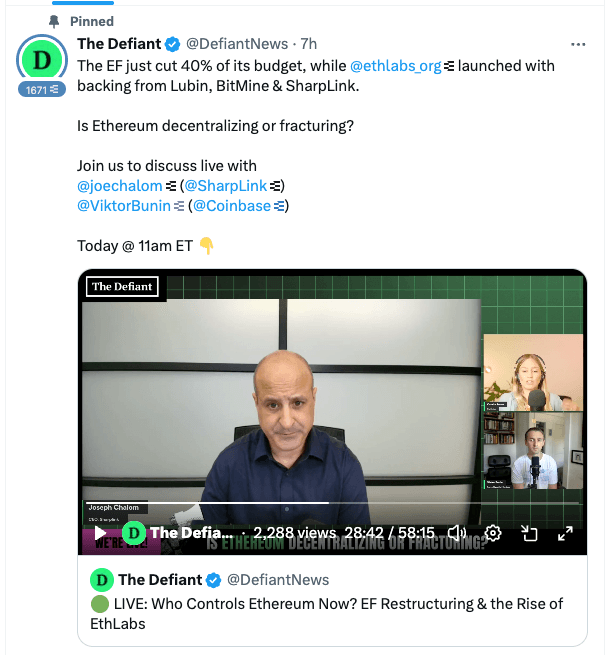
Ethlabs, a new Ethereum lab backed by the network’s two largest corporate owners, launched this week with the pitch to complement the Ethereum Foundation.
The company’s own funders acknowledge that Ethlabs will also compete because it is “fighting to win.”
“I think they will be complementary,” Joseph Chalom, chief executive of Sharplink and a longtime former BlackRock executive, said of Eslab and the foundation on a livestream hosted by Defiant this week. He added that the two will “in some ways overlap” “over time” and that the “deepest talent” will be concentrated at Ethlabs.
where obligations are met
There is some overlap in what each group plans to do. The foundation this week reorganized into five units, including a protocol layer focused on scaling and enhancing Ethereum’s base layer, and an institutional layer aimed at enterprise adoption. Ethlabs describes its efforts in much the same terms: faster payments, cross-chain interoperability, and accommodating organized and AI-driven activities. Both evoke reliable neutrality and resistance to censorship.
Victor Bunin, a protocol specialist at Coinbase and listed as an Ethlabs contributor, said this competition is built into the way Ethereum distributes code.
“There is a natural competition between every EIP and every effort that goes into it,” he said, using the abbreviation for Ethereum Improvement Proposal. He said each network upgrade includes limited changes, meaning independent groups will compete for the same slots.
The launch is the clearest sign yet that Ethereum is betting on a fragmented, multi-organizational development model. This is a deliberate contrast to competing blockchains such as Solana, where a single foundation drives the roadmap, funding, and marketing. Supporters argue that dispersing activities among independent groups will make Ethereum harder to capture and censor. The risk is that coordination will be slower and more complex, with multiple well-funded teams moving in different directions around a fixed upgrade schedule. For a network worth about $194 billion, the open question is which model will work better for institutions currently moving on-chain.
bet on many hands
Not everyone building Ethlabs is convinced that the model is correct. Despite supporting the institute, Bunin said he would prefer a single organization that worked closely with users.
“I actually don’t like this structure,” he says. He called the foundation’s retreat from the network’s most pressing issues “a bit of a blunder” and argued that EF chose to work on what users wanted rather than what they wanted.
Mr Chalom defended the piecemeal approach. He likened this to Winston Churchill’s description of democracy as the least bad system. That is, it is imperfect and difficult to adjust, but is genuinely censorship-proof and impossible for a single political party to override. He claimed that Ethereum has been running without downtime since its launch in 2015, a record that more centralized chains cannot claim.
Countless big supporters
The structural debate rests on the issue of money. Trent Van Epps, who was coordinating the Ethereum Foundation’s core development until April, warned last week that the network’s core development would face a funding shortfall within three to nine months due to the combination of the foundation’s financial cuts and the expiration of a four-year customer funding program. He estimated core development costs at approximately $30 million per year.
BitMine chairman Tom Lee, whose company is now the anchor of Ethlab, dismissed the warnings, calling the possibility of a crisis “zero chance” and insisting that profit-seeking corporate interests, not foundations, would be in charge of Ethereum’s future. Lee was obviously referring to Ethlabs.
This week the tightening has tightened. The foundation announced it would cut its 2026 budget by about 40% and cut 54 jobs, or about 20% of its staff. Co-founder Vitalik Buterin said the cuts were a deliberate move to an endowment model, reducing annual spending from about 15% of the state treasury to 5% by 2030.
$ETH It has fallen about 3% in the past 24 hours, lowering Bitcoin’s 2.6% decline and trading about 67% below its August 2025 record, according to CoinGecko.
Against this background, Ethlabs emerges with strong support. Bitmine Immersion Technologies, holding approximately 5.7 million $ETHSharplink has approximately 876,000 $ETHfixed the funds with Rubin. Neither the institute nor its supporters have disclosed the total amount of Ethlabs’ funding. The only public figure is the contributor wallet eth-labs.eth listed on Ethlabs, which holds about 49 wallets. $ETHwhich is about $80,000 as of this week.
When asked for an amount of $1, Mr. Chalom refused to respond.
“Trust us on this,” he said, describing “multi-year funding” raised in part from staking rewards from backers. $ETH Some of it comes from private donations. “This is not here to fund five people for a year,” he said. He said Ethlabs will operate as a nonprofit organization and undergo an annual external audit, with the findings made public.
“If you can’t audit it, you can’t trust it,” he said.
“Adjustment” or capture?
This funding model raises questions that the foundation’s structure was built to avoid. Whether the backers themselves are large or not. $ETH Owners were able to proceed with development for their own benefit. Interests are closely linked. Mr. Rubin, himself an E-Slab anchor, is chairman of Sharplink, and Mr. Chalom previously led digital assets at BlackRock, whose iShares Ethereum Trust is the largest spot in the United States.$ETH Fund.
Chalom said the design prevents capture. He said supporters hold observer seats and can verify how money is spent, but cannot direct investigations, fix governance or block spending. Board seats will be rotated among independent members, Sharplink and Bitmine chairman Tom Lee will not be a member of the board, and subsidies will be managed externally. “This is the opposite of a conflict of interest,” he said. “It’s a coincidence of interests.”
Bunin argued that capture would be unrealistic in any case. Proposals that clearly favor one party “aren’t even going to pass the sniff test” with client teams and the broader community, he said.
The deeper tension is one that Ethereum has grappled with before. $ETH Assets are not always the best fit for a protocol. The decision to push activity to the Layer 2 network lowered rates and dampened rate burn. $ETH It’s the same as the rare “ultrasonic” money. Daily baselayer fees, which once reached nearly $30 million, have reached single-digit millions of dollars for much of 2026. Chalom and Bunin both said that Ethereum needs to win as a network before the token becomes widespread, and that Ethlab will continue to prioritize adoption and expansion over short-term value capture, the same path the foundation has followed.
Foundation retreats
Ethlabs is the most notable result of extensive work at the Foundation. At least eight executives, including both co-executive directors, have resigned this year. Tomasz Stanczak stepped down in February and Xiaowei Wang resigned this month, effectively leaving board member Bastian Aue as the company’s sole executive director. A directive the foundation announced in March reorganized the foundation from being the primary custodian of Ethereum to one of multiple custodians, and this week’s reorganization divided the foundation into five divisions and reduced the privacy and scaling lab.
Rubin described the change as a move toward multiple “steward nodes” that share responsibility for the network. Chalom said Ethlabs is the first of several private sector initiatives to be announced “in the coming weeks.”
first test
The first real tests will take place on Ethereum’s next major upgrade, Gramsterdam, which is currently in final testnet preparation and targeted for the second half of this year. It focuses on changes to the way blocks are built and run, base layer scaling work that both the Foundation and Ethlabs claim as a priority, and the first place the roadmap fills a finite upgrade queue.


