


Ethereum ($ETH) Whale participation sharply weakened as large-scale trading activity decreased across the network.
Ann ×post According to a report by a prominent market analyst, whale trades have fallen by 86.6%, from 2,194 trades recorded on June 5 to just 294 trades at the latest reading.
This decline highlighted a significant decline in high-value transfers and suggested that major holders were moving away from active network participation.
While decline has surfaced, Ethereum The deceleration has been particularly pronounced as it trades near a key recovery zone.
A high number of deals often reflects increased engagement from institutional and high-net-worth investors. However, a recent study showed that these participants were much less active.
While a decrease in whale activity does not automatically indicate selling pressure, it does reflect a decline in confidence among key market participants.
Leverage has cooled, but bullish bets on Ethereum remain
Derivatives trading activity has weakened, although traders continue to favor long positions.
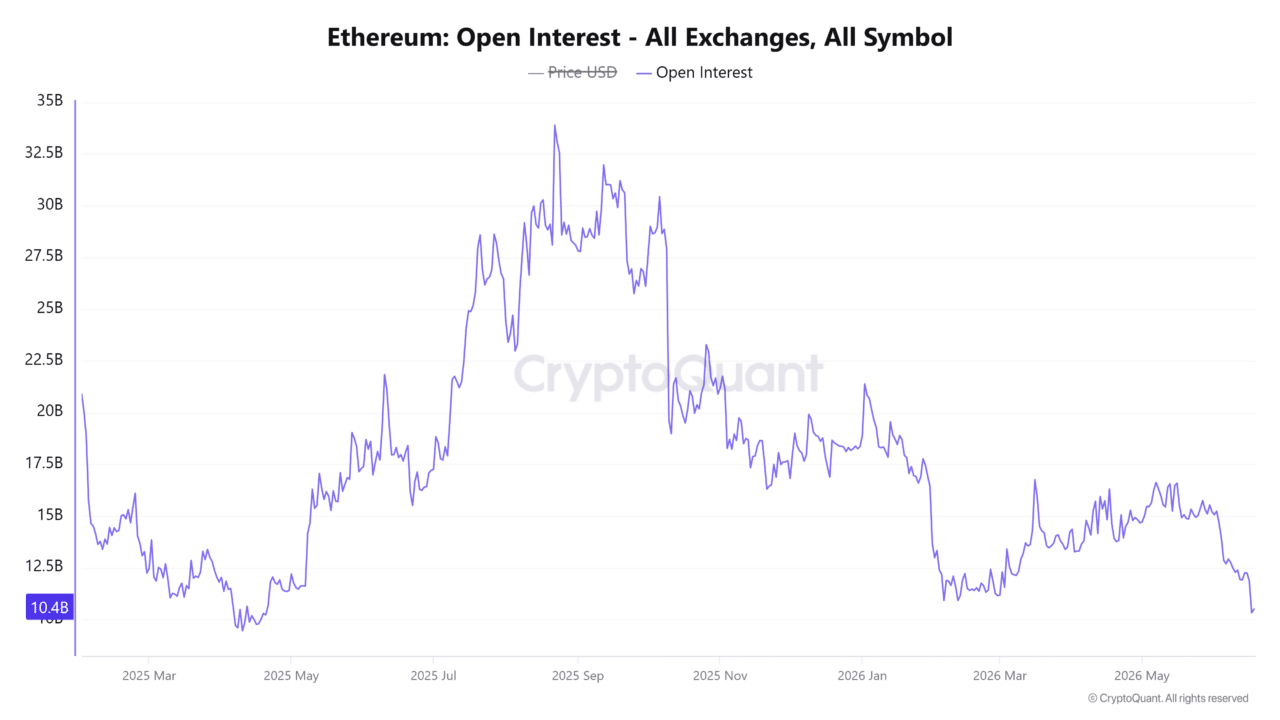
Open interest decreased by 11.45% to $10.4 billion, indicating market participants reduced active positions and removed capital from the futures market.
Funding rates moved in the opposite direction, with the indicator rising 34.71% to 0.01278, indicating that long traders continue to pay a premium to maintain their exposure.
This divergence suggests that bullish sentiment continues despite the decline in overall participation.
Such a structure reflected selective optimism rather than broad market confidence.
Although there were fewer active traders, those who remained in the market continued to prefer upside exposure.
Nevertheless, the decline in open interest indicated that conviction was not expanding along with funding rates.
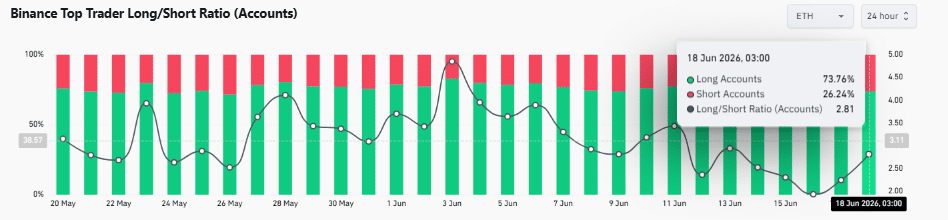
Binance bulls remained strong
Binance’s top traders remained extremely bullish despite weak participation in the rest of the market.
The long/short ratio of Binance’s top traders was 2.81, with long accounts accounting for 73.76% of positions, while short accounts accounted for 26.24%.
The numbers showed that despite reduced whale activity and reduced open interest, experienced traders have not given up on their bullish outlook.
Instead, they continued to position towards higher prices, suggesting they are confident in Ethereum’s ability to sustain the recovery.
However, intensive bullish positioning also brought risks.
If sentiment is heavily biased in one direction, unexpected weakness can cause a position to unwind.
Still, current positioning suggests traders view the recent weakness as a temporary setback rather than the start of a broader decline.
Ethereum tests resistance as MACD strengthens
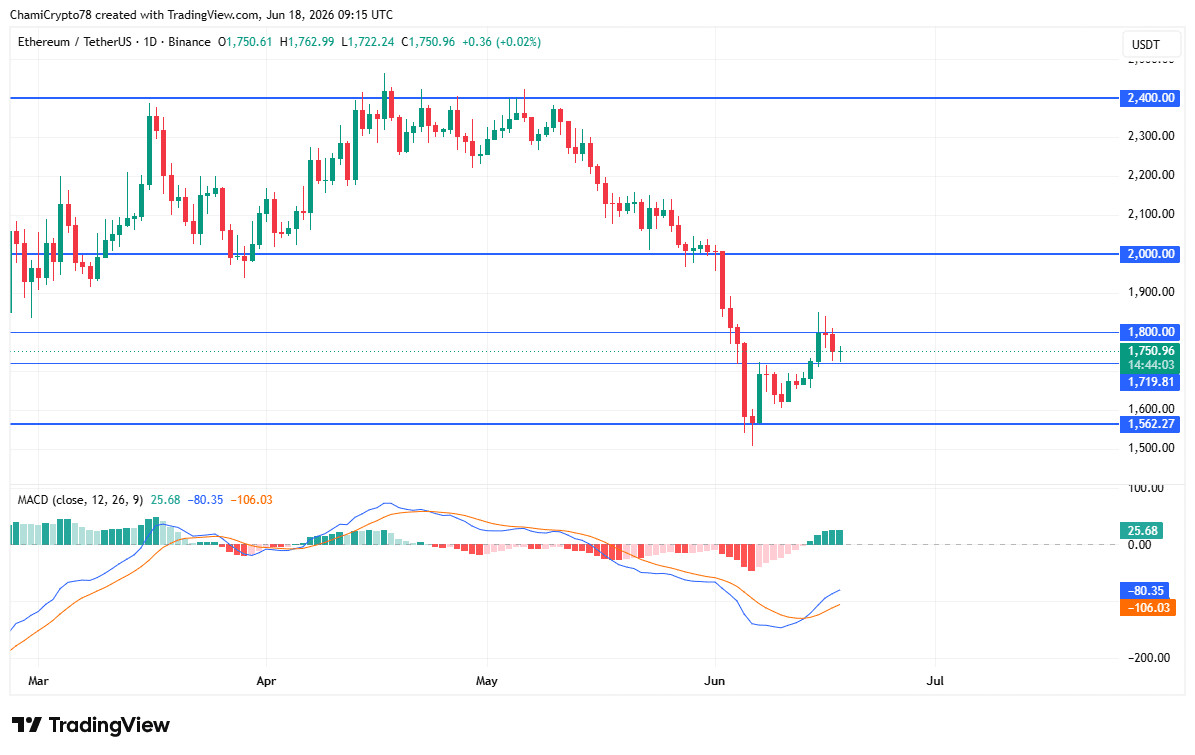
Ethereum tested a key area of resistance after recovering from the June selloff. What is shown on the daily chart is $ETH After rebounding from support near $1,562, the price is trading near $1,750.
Prices briefly pushed towards the $1,800 resistance, but encountered selling pressure and declined.
Technical indicators improved throughout the recovery period. The MACD maintained a bullish crossover and the MACD line remained above the signal line.
Additionally, the green histogram bar has expanded, indicating increased buying power compared to previous sessions.
$ETH is also above the $1,720 support zone, contributing to maintaining the short-term recovery structure.
Nevertheless, the asset still fell below the important $1,800 resistance level. That barrier continued to serve as the most important obstacle for buyers.
if $ETH If the price breaks above $1,800 and sustains, buyers could target the next major resistance level near $2,000.
However, failure to regain that level could prompt a retest of the support near $1,720 and possibly $1,562.
Final summary
- Although whale activity and open interest decreased, bullish traders’ positions continued to rise.
- $ETH Although above key support, $1,800 continued to limit recovery progress.


