


A recent discussion shared by analyst Leo Lanza examined the relationship between Ethereum’s valuation and its total collateralization alongside a comparative market data chart that tracks Ethereum’s fully diluted market cap and ecosystem TVL from 2016 to 2026.
The commentary focused on how valuation dynamics change when large amounts of capital are secured on-chain.
Discussion on reputation and security dynamics
In his post, Leo Lanza compared assets under management (AUM) in traditional finance and total value collateral (TVS) in blockchain systems, noting that the conditions may be similar in terms of assets managed or collateralized.
The distinctions outlined in the discussion centered on structural differences in security models. In the example provided, we mentioned how asset managers such as BlackRock are able to manage trillions of dollars of assets under management relative to their market capitalizations because the safety of these assets does not directly depend on the valuation of a company’s native stock.
In this post, we extended this comparison to Ethereum and argued that the proof-of-stake design ties network security and Ethereum together. $ETH Control of the network is tied to acquiring stake, which increases its value.
A hypothetical scenario was presented in which there was a large disparity between $ETH Market capitalization and ecosystem TVS may create economic incentives for acquisition-based control. In the discussion, we described this as a recursive relationship between protected value and token valuation.
Comparison data of market capitalization and TVL
The attached chart referenced in the discussion tracks Ethereum’s fully diluted market cap relative to the total value locked across ecosystem applications.
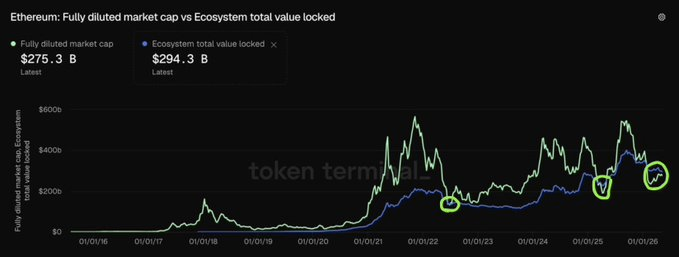
As of the latest measurements, Ethereum’s fully diluted market capitalization is approximately $275.3 billion, with a reported TVL of approximately $294.3 billion. This data shows the periods during which TVL temporarily exceeds or converges with market capitalization during various market cycles.
Historical datasets show that both indicators expanded during the 2021-2022 cycle, followed by a contraction phase and subsequent recovery trend. Several periods of convergence were also observed, with the total value of the locked Ethereum ecosystem approaching or briefly exceeding the network’s fully diluted market capitalization.
According to the discussion, Ethereum’s proof-of-stake model improves network security. $ETH This means that networks can become economically more vulnerable if the value secured across the ecosystem increases significantly faster than before. $ETHmarket capitalization.
Related: Ethena’s Seraphim Czecker says ‘Ethereum is dead’ and outlines plans to bring $10 billion TVL


