



Ethereum is consolidating between $2,200 and $2,400 as the market looks for catalysts or structural support that would force a decisive break in either direction. Prices are holding steady, but not rising. CryptoOnchain analysis, which tracks on-chain flows on Binance, identified a series of capital movements from May 10th to May 12th, suggesting that something much more deliberate than routine market activity was happening behind the scenes.
The sequence began on May 10, when Binance recorded its largest net Ethereum inflow in the past six months, with 225,558 ETH deposited in a single day. In isolation, exchange deposits of that size are typically interpreted as a precursor to a sale. This means that large holders move their coins towards venues where they can be exchanged for other assets or cash. The alarm that reading causes is real and historically justified.
The one that arrived two days later has a different interpretation. On May 12th, Binance recorded an extreme stablecoin outflow of $1.32 billion, with a simultaneous outflow of capital from the exchange in the opposite direction. Large companies weren’t just depositing ETH and preparing to sell it. They were simultaneously taking purchasing power away from the exchanges.
CryptoOnchain identifies the combination as a structural takeover, a whale-scale portfolio rebalancing event rather than a simple distribution. Analysis is being built to understand what large-scale participants were actually doing in these flows.
The spot market is in turmoil. Derivatives market is surprisingly calm
CryptoOnchain analysis identifies differences that make the current Ethereum setup structurally abnormal. While the spot market has been processing massive ETH inflows and stablecoin outflows over the past few days, Binance’s derivatives market has been quietly moving in a constructive direction that could not have been predicted by spot activity alone.
Binance’s Ethereum funding rate has decisively reversed from negative territory at -0.007 in early May to positive at +0.004. Changes in direction are more important than scale. The continued negative funding reflected months of bearish confidence in derivatives. A positive reversal indicates that long positions have become dominant in the perpetual market. At the same time, open interest expanded by approximately 13%. Rather than simply existing positions being maintained, new positions are being added as confidence returns.

The detail that makes this derivatives situation truly significant is the clearing data. Despite increased leverage and open interest, liquidations remain 99.6% below the three-month average and hover around absolute zero. Increasing leverage without liquidation describes a market where participants adding to positions are doing so with sufficient collateral and confidence that adverse price movements will not trigger cascading events.
The dual narrative the report identifies is an honest synthesis of both signals. The spot market is actively rotating, with large amounts of capital moving in both directions simultaneously. Derivatives markets are building with increasing confidence, albeit cautiously. This combination suggests maturity rather than speculation. The risks that the analysis holds are external. Local leverage built on improving sentiment can absorb internal pressures, but sudden macroeconomic shocks come from outside the entire structure.
Ethereum trading is on an important long-term axis as multi-year support continues
Ethereum is trading near $2,250 on the weekly chart, consolidating directly around a historically significant price point that has repeatedly served as both support and resistance throughout the current cycle. This structure reflects a situation in which neither bulls nor bears have complete control over momentum, and the market is caught between recovery and continuation risk.
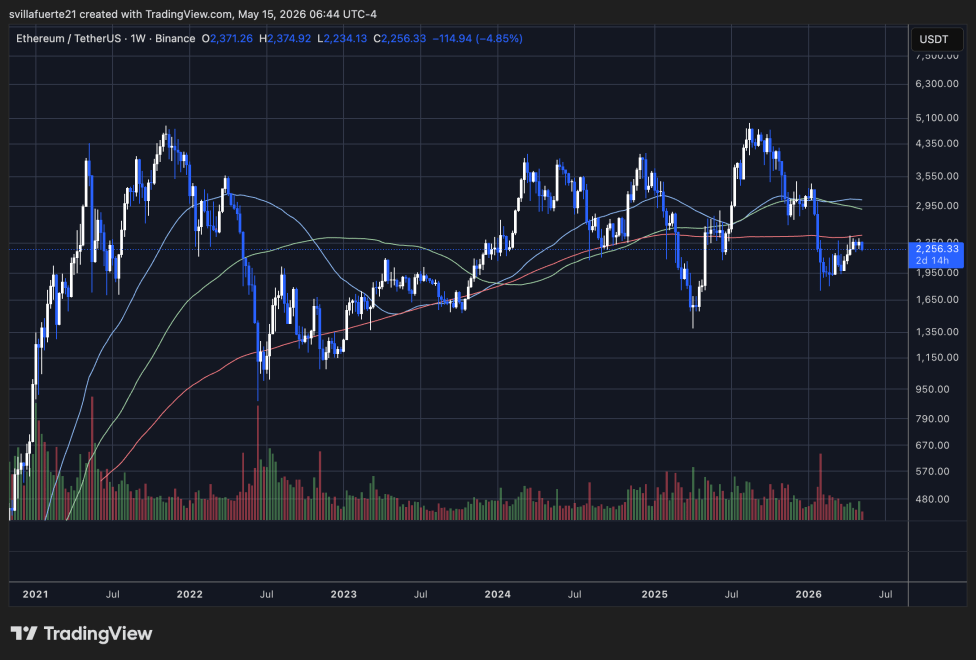
This chart shows ETH recovering from a sharp correction following a rejection from the $4,000-$4,500 area in late 2025. After briefly losing the $2,000 level earlier this year, buyers managed to stabilize the price above a key long-term support zone near the weekly 200 moving average. This recovery averted a more severe structural collapse and returned Ethereum to the broader range of consolidation that has defined much of the past two years.
However, upside momentum remains limited. Ethereum continues to trade below the declining long-term moving averages, specifically the weekly 100 and 50 moving averages, and has now converged around the $2,400 to $3,000 area, continuing to act as overhead resistance. The repeated inability to regain these levels, despite improvements in the macrostructure, reflects the persistent hesitance of market participants.
Volume has also decreased significantly compared to the capitulation phases seen in previous declines, suggesting that active distribution is calming down. For now, Ethereum is still stuck in a compression phase, which could determine the direction of the next big cycle move.
Featured image from ChatGPT, chart from TradingView.com
editing process for is focused on providing thoroughly researched, accurate, and unbiased content. We adhere to strict sourcing standards, and each page is carefully reviewed by our team of top technology experts and experienced editors. This process ensures the integrity, relevance, and value of your content to your readers.


