

ethereum news
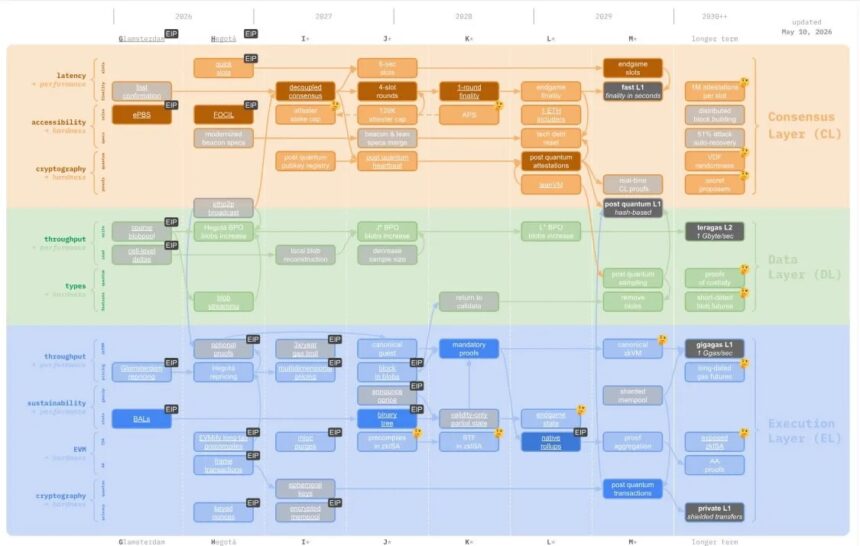
The Ethereum Foundation has cleared several technical milestones for the upcoming Gramsterdam upgrade. These include a gas limit floor of 200 million (more than three times the current cap of nearly 60 million), which is a credible target after the upgrade. The developers also finalized EIP-8037. This increases the cost of state creation operations to make state growth more manageable when larger blocks are rolled out. Enshrined Proposer-Builder Separation (ePBS) is now more stable, less dependent on external relays, and builder/verifier separation is built into the protocol rules. Originally planned for June, Gramsterdam now appears to be set for the third quarter of 2026, with the development net already existing on the public Ethereum blockchain.
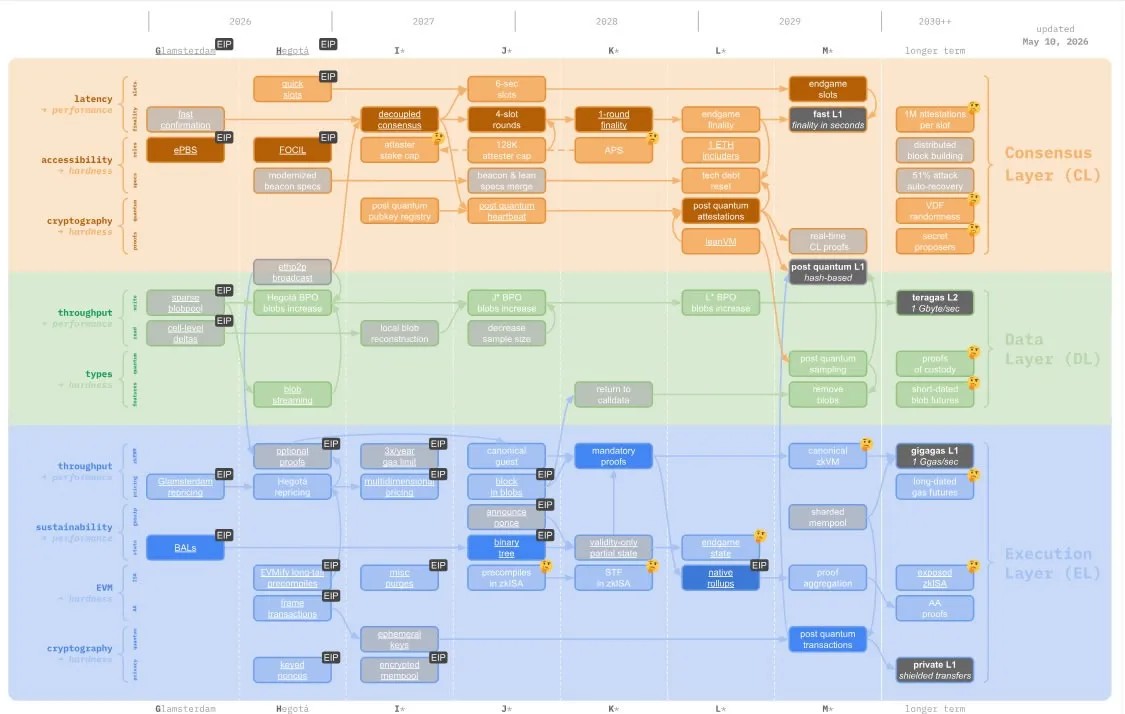
The Foundation also confirmed a change in leadership within the Protocol Cluster, naming Will Corcoran, Kev Wedderburn, and Fredrick as the new triumvirate of core developers. Long-time researchers Barnabe Mononot and Tim Beiko are leaving, while Alex Stokes will take a leave of absence, marking one of the most significant changes within the organization in years. This realignment will take place in parallel with the continued scoping of Hegota, the upcoming upgrades to Gramsterdam, and ongoing work on Strawmap’s quantum resistance roadmap. Analysts view this transition as a deliberate generational handover aimed at funding Ethereum’s research pipeline and keeping it on track through the next two major hard forks.
Binding Arbitration Board Governance Vote Begins to Transfer Approximately $71 Million in Disputed Ether – 30,765 $ETH — was copied to a wallet controlled by Aave LLC following the Kelp DAO exploit last month. The Constitutional Arbitration Improvements Proposal would implement Justice Margaret Garnett’s recent order allowing on-chain movement of the Security Council from its fixed address, provided that existing injunction notices remain in place. Even if approved, the funds will be subject to strict legal restrictions and cannot be transferred or deployed without further court permission. This vote represents one of the first cases in which on-chain governance mechanisms have been used to enforce a US court order.
The unusual conflict has drawn crypto governance directly into the US court system. The forensics company has publicly attributed the Kelp DAO breach to North Korea’s Lazarus Group, a claim cited by an attorney representing a family that holds approximately $877 million in outstanding terrorism judgments against North Korea. These creditors argue that frozen ether could finally satisfy long-standing court rulings if the funds are deemed to be linked to North Korea. Aave counters that the assets belong to the DeFi users affected by the exploit, not the attackers who temporarily took control of the users. This case currently serves as a test for how courts will treat DAO-managed assets.
After weeks of aggressive accumulation, financial firm Bitmine Immersion Technologies slowed its pace of Ether purchases, earning $26,659. $ETH Despite adding more than 100,000 per week last week, Chairman Tom Lee confirmed that the company remains committed to owning 5% of Ether’s circulating supply of 120.7 million yen by the end of the year, although that goal is now set for the end of 2026 rather than mid-July. Bitcoin holdings reached 5.21 million $ETH Total holdings in virtual currency and cash are $13.4 billion. This slowdown comes as Ethereum has fluctuated between $2,274 and $2,411 over the past week, well below its August 2025 high.
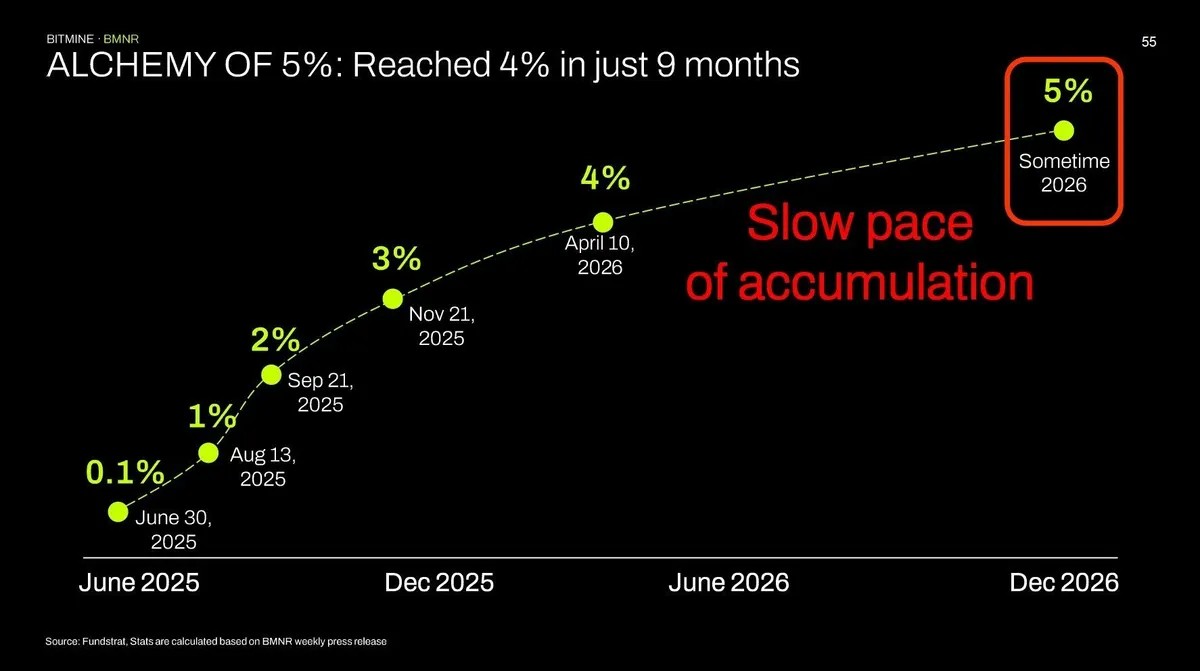
Bitmine plans to stake its entire stash of Ether, with its position already exceeding 4.7 million tokens and projected to generate annual rewards of around $352 million once fully deployed. Lee argued that this strategy effectively removes available supply from circulation, with Bitmine alone taking 4.3% of Ether out of circulation after June 30, 2025, contributing to what he called a disinflationary supply curve. Over 38 million $ETH Validator participation staked across the network continues to increase despite stable price trends. While the model reflects the accumulation of corporate Bitcoin treasuries, the yields are stratified, creating a structurally different supply and demand landscape for the second-largest altcoin by market capitalization.
Ether was trading 1.69% lower on the day at around $2,290.7, with the market flat as buyers and sellers held positions. The RSI of 49.73 is in the neutral midrange and the MACD is reading bearish, confirming a lack of confidence in the immediate direction. The initial support of $2,266 is very important. A clean break risks a fall towards the $2,201 or even deeper $2,147 zone. On the upside, $2,315 is the upper limit of any recovery attempt, with $2,383 and $2,424 being the next resistance steps. Bulls need a daily close above $2,315 along with an RSI recovery of 55 to override the bearish MACD. Failure to hold $2,266 will definitely shift the bias to the negative.


