

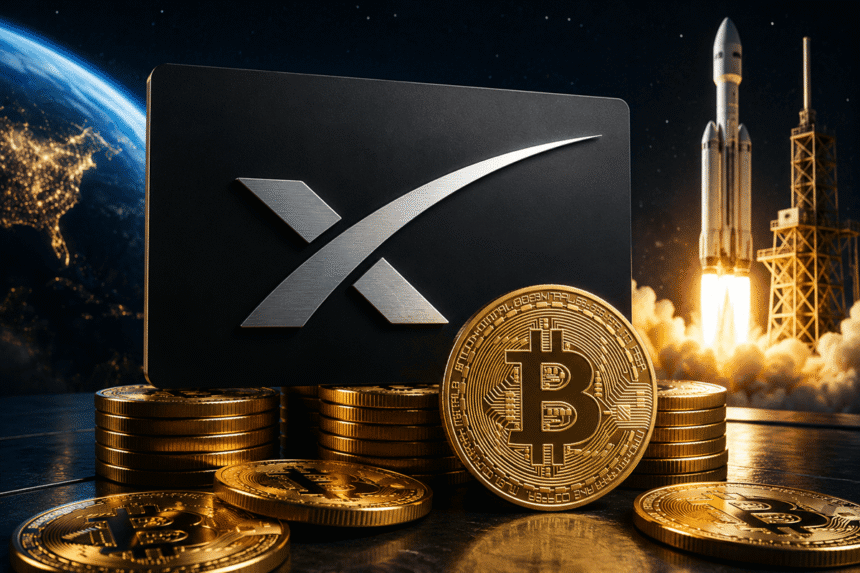
SpaceX, the aerospace technology company founded by Elon Musk, has officially confirmed its plans to go public after filing Form S-1, a financial statement that companies must file before going public, with the U.S. Securities and Exchange Commission (SEC). But beyond the company’s anticipated IPO, one of the data that has garnered the most attention is the huge Bitcoin reserves it maintains, currently 18,712 BTC worth more than $1.45 billion.
According to the presentation, The company owns 18,712 Bitcoins, which were originally acquired for approximately US$661 million. This means the average cost per coin is close to 35,000 USD. At the time of writing this note, the trading price of Bitcoin was over USD 77,000, and these reserves had effectively doubled, making them worth over USD 1.45 billion.
Bitcoin purchases began in 2021 and occurred roughly in parallel with a $1.5 billion investment. Manufactured by Tesla in the same year. Since then, both companies have made some adjustments to their positions. Tesla sold a significant portion of its holdings in 2022, while SpaceX temporarily reduced its holdings to just over 6,000 BTC, according to a report from Arcam Intelligence. Still, the new SEC filing confirms that the company’s exposure to digital assets remains huge.
This presentation gave us, for the first time, an inside look at one of the world’s most valuable private companies. The S-1 serves as a complete picture of a company’s financial health. It reveals income, losses, legal risks, share structure, growth plans, and strategic bets to attract investors. In SpaceX’s case, the document also made clear that the company can no longer be defined solely as a rocket company.
SpaceX was born 24 years ago with the idea of reducing the cost of space launches through reusable rockets. but, S-1 marks even more ambitious transformation. Today, the company operates as a technology conglomerate that combines aerospace operations, satellite internet through Starlink, artificial intelligence, and significant exposure to the cryptocurrency market.
Holds over 18,000 Bitcoins, SpaceX would position itself as the seventh largest BTC holder in the world. It’s even further than Coinbase. Only companies like Michael Saylor’s Strategy Inc. maintain significantly larger reserves.
The revelation also shows how Bitcoin is becoming increasingly integrated into American corporate finance. For many technology companies, keeping BTC on their balance sheets represents a long-term bet against inflation and a way to diversify their finances. However, this strategy also has risks. Due to accounting standards applicable to public companies, wild fluctuations in Bitcoin prices can cause fluctuations in quarterly results.
Biggest IPO in history?
This document shows the scale SpaceX has reached beyond Bitcoin. The company reported revenue will reach $18.7 billion in 2025, up from $14 billion in 2024, primarily due to Starlink and space launch contracts. Additionally, he claimed to have identified a $28.5 trillion potential market, which he described as “the largest addressable and viable market in human history.”
SpaceX also highlighted advances in artificial intelligence and integrated this field into its future growth path. Combination of space, communications, AI and digital assets Reinforces the idea that the company is becoming a technology conglomerate It has multiple strategic divisions and is very different from the aerospace companies that started in the early 2000s.
This IPO could be the largest in history. The market report estimates that SpaceX is seeking a valuation close to USD 1.75 trillion, with scenarios suggesting it could reach USD 2 trillion.. Once completed, the company will instantly join Apple, Microsoft and Nvidia among the most valuable publicly traded companies on the planet, and surpass Saudi Aramco in terms of stock market debuts.
SpaceX’s IPO could also impact the market. If companies like OpenAI and Anthropic launch their own initial public offerings at a similar time, investors could move money away from Bitcoin and other risky assets into these big tech IPOs, squeezing liquidity in digital markets.


