


Alejandro Grisanti, head of EcoAnalytica, has proposed issuing a domestic USD stablecoin as part of a series of measures to lift Venezuela’s currency restrictions. This system will complement the current auction system and allow excluded sectors to receive dollars via blockchain rails.
Important points:
- Ecoanalitica is proposing a stablecoin to solve the local dollar shortage in order to facilitate future banking consolidation in Venezuela.
- With rapid adoption starting in 2025 and bypassing central banks, stablecoins will become essential to the future of dollar access for small and medium-sized businesses.
- In October, Connexus, the research and development arm that processes 40% of remittances, announced its work on a stablecoin payment system.
EcoAnalytica proposes Venezuelan stablecoin to solve dollar problem
Venezuela’s economy faces headwinds due to currency controls and the exclusion of small and medium-sized businesses from the dollar quota system, but cryptocurrencies could be part of the solution to these problems.
In a recent note, Alejandro Grisanti, founder and CEO of economic consulting firm EcoAnalytica, highlighted the benefits of stablecoin issuance to help fix the dollar distribution problem caused by the introduction of an auction system that allows for different exchange rates for the dollar.
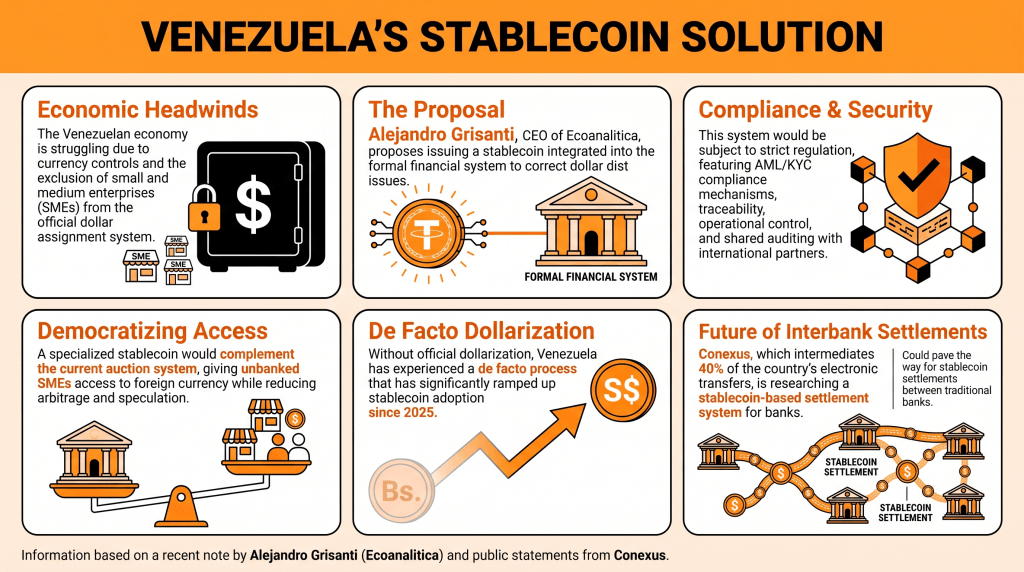
Grisanti’s offer “Implementation of systems based on stablecoins integrated into formal financial systems is subject to strict regulation and has AML/KYC compliance mechanisms.” Additionally, restrictions were placed on cash imports to allow small and medium-sized businesses without bank accounts in the United States to operate in dollars in the local market.
Grisanti’s proposal suggests issuing a dollar stablecoin specifically designed for the country, featuring traceability, operational controls, and shared auditing with international partners.
For him, such a system would complement the current auction system, which uses private and state-owned banks as sales agents, democratize assets into foreign currency for excluded systems, reduce the attractiveness of arbitrage and speculation, and strengthen the transparency of the foreign exchange trading system.
Although there is no official dollarization, the Venezuelan economy has been undergoing a de facto dollarization process since 2025 that has accelerated the adoption of stablecoins, with exchange rates much higher than the official rate set by the Venezuelan Central Bank. If adopted, Grisanti’s proposal could pre-empt the inclusion of stablecoins as part of banking transaction systems, potentially enabling stablecoin payments between banks.
In October, Rodolfo Gaspari, president of Conexus, which brokers 40% of domestic electronic funds transfers, said stablecoin-based payment systems were in the early stages of research and development. Despite this, no news regarding this system has been shared since then.


