

Kevin Warsh is expected to chair his first Federal Open Market Committee (FOMC) meeting on June 16-17, 2026, after the Senate Banking Committee passed a vote on April 29 and futures and prediction markets put the probability of interest rates on hold at more than 93%.
Important points:
- Kevin Warsh passed the Senate Banking Committee’s vote of 13-11 on April 29th to replace Powell as Fed Chairman in May 2026.
- Polymarket traders are pricing in a 96% chance that the Fed will leave interest rates unchanged at its June 17th FOMC meeting.
- Warsh has hinted at rate cuts tied to AI productivity gains, but 3.3% inflation could limit options in June.
Even though Kevin Warsh takes over as Fed Chairman, the market is still pricing in June interest rates unchanged at over 93%.
On the same day Warsh’s removal was confirmed, Jerome Powell presided over his final FOMC meeting as chairman. His term as Fed chair expires on May 15, 2026. The committee approved Warsh’s nomination on a party-line vote of 13-11, sending his confirmation to the full Senate for a final vote expected in early May.
Powell has stepped down as chairman, but remains on the board until 2028. Whether he will remain on the board alongside Warsh is an open question, and prediction market participants on Kalsi say it could influence interest rate decisions in June.
Warsh suggested what he called a “regime change” approach. He pointed out that improved productivity through artificial intelligence (AI) is a buffer against inflation. He has hinted at lower interest rates in public statements. But with inflation above 3% and geopolitical tensions pushing up energy prices, his first real test will be forging a consensus among the other 11 voting members.
The Fed this week kept the federal funds rate unchanged at 350 to 375 basis points at its April 29 meeting, last chaired by Powell. This unchanged rate is now the baseline that Warsh will inherit when he takes over.
Warsh is a leading candidate for U.S. President Donald Trump, and there is some speculation that he could change the current direction, but the market remains unconvinced that a June cut in the federal funds rate is on the table.
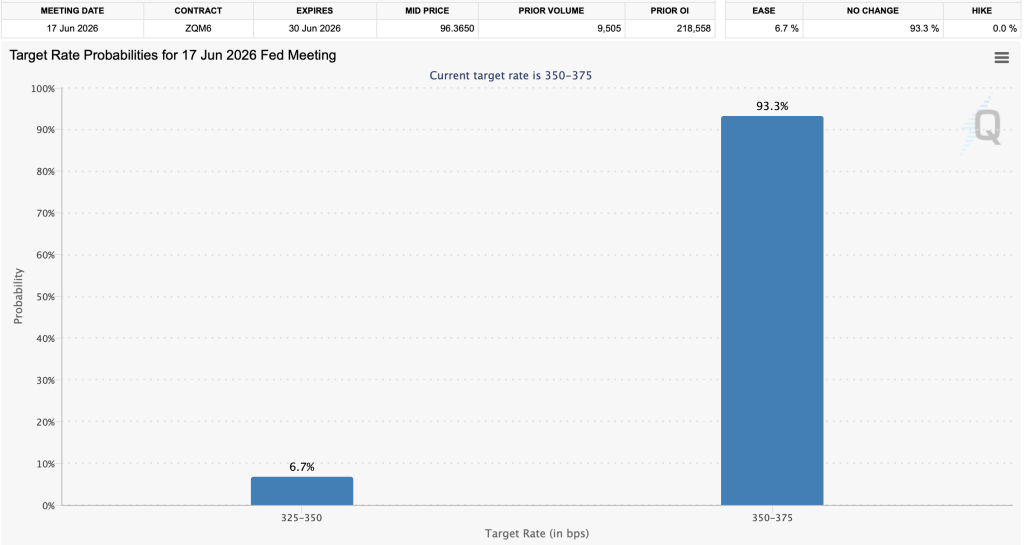
For example, the CME Fedwatch Tool puts the probability of no changes at the June 17th meeting at 93.3%. Futures traders expect a 6.7% chance of a rate cut of between 325 and 350 basis points. The probability of an interest rate hike is 0.0%. The likelihood of a rate cut has increased slightly from 4.0% last month, but the consensus in favor of a rate cut remains strong.
Polymarket had total trading volume of approximately $16.48 million as of May 3, 2026 due to the June Fed decision event. The “no change” outcome is 96% likely and costs 96 cents. A 25 basis point decline is 3.6%, a 25 basis point increase is 1.1%, and both larger moves carry less than 1%.
Polymarket participants cited the CPI value of 3.3% in March 2026 and the stability of the labor market as the main factors for maintaining consensus. These two data points keep the Fed steady.
Kalsi traders have expressed similar conviction. The price of a “Fed Maintenance Rate” contract on that platform is 95 cents, reflecting a 95% probability of no change. The probability of a rate cut of 25 basis points is 6%, and the probability of a rate cut of more than 25 basis points is 2%. A separate contract that tracks whether the federal funds rate will stay above 3.25% has a confidence level of 98%.
The total amount of bets placed on the prediction marketplace Kalsi Market amounted to $3,461,005. Looking at the price history, we saw sharp fluctuations from January to March, with “maintain” and “reduce” odds frequently intersecting. Hold expectations have been on a steady upward trend since April.
The Karshi market will close at 1:59 pm (ET) on June 17th, just before the official announcement. By then, Mr. Warsh will have chaired his first policy meeting and made some of the first decisions of a Fed chairman. Traders on both platforms are already placing bets on whether he will break out of the current 350-375 basis point range in June or hold Powell’s line.


