


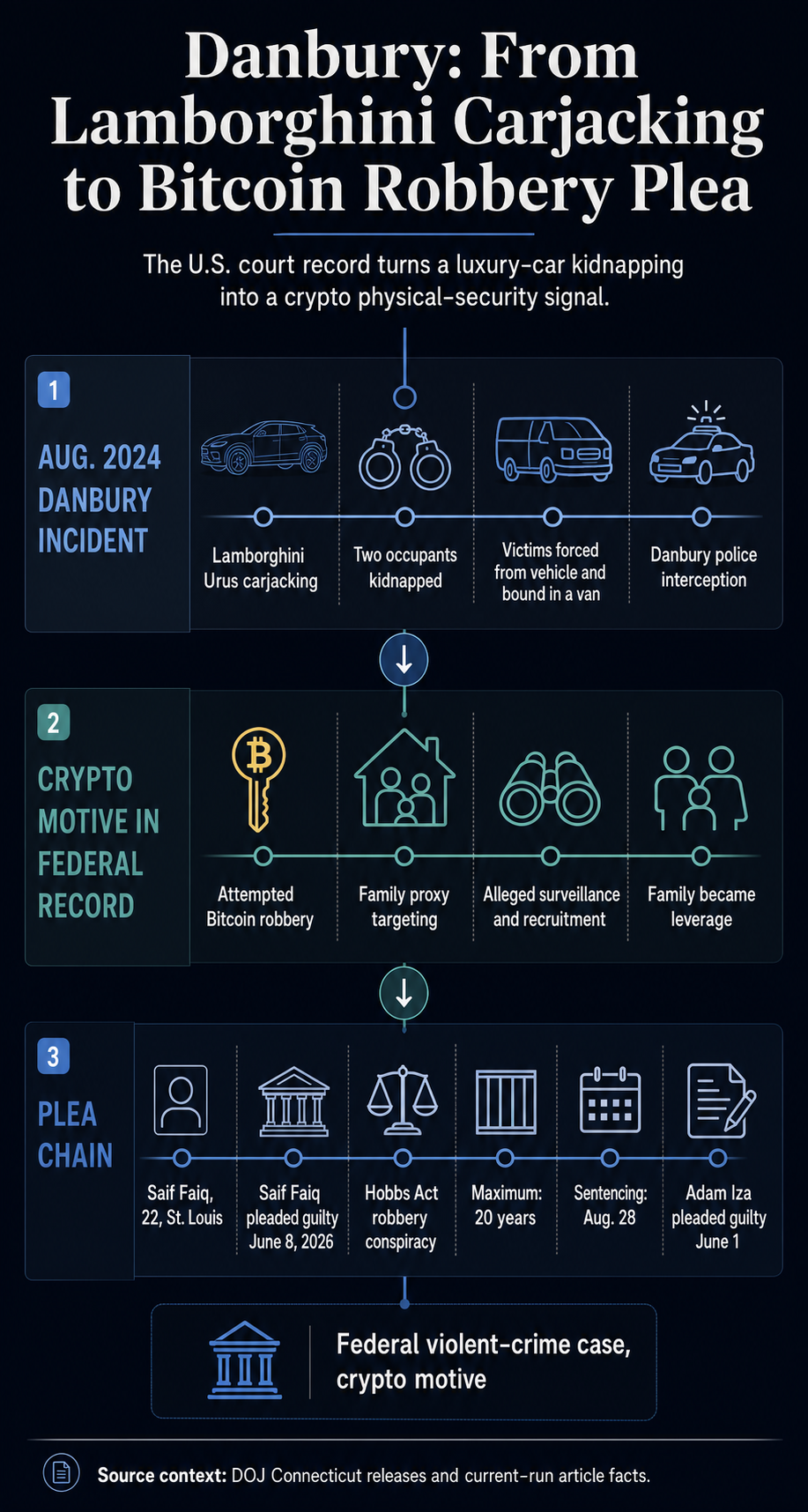
A Missouri man has pleaded guilty in Hartford federal court to attempted theft of Bitcoin, carjacking of a Lamborghini Urus and conspiracy to commit robbery in connection with the kidnapping of two people in Danbury, Connecticut.
Saif Faik, 22, of St. Louis, pleaded guilty on June 8 to conspiracy to commit obstruction of commerce by robbery. Prosecutors said the case stemmed from an August 2024 scheme to steal Bitcoin from a family involved in a separate theft involving hundreds of millions of dollars in BTC.
The crime carries a statutory maximum penalty of 20 years in prison, and Fike is scheduled to be sentenced on August 28th.
Prosecutors said the kidnapping victims were the parents of individuals who participated in the Bitcoin theft, and that Fike helped recruit participants, coordinate with Adam Isa, and conduct surveillance of the victims.
The Danbury incident is another example of the increasing physical threats surrounding crypto assets. Prosecutors tied the plea to allegations that he used relatives, surveillance, luxury cars and human labor to reach the bitcoins.
Previous igcurrencynews reporting has shown a significant increase in private information disclosure and family targeting in France. Danbury’s records show similar threats are now surfacing in a U.S. federal lawsuit.
US Court Records Against Physical Cryptocurrency Threat
In September 2024, prosecutors charged six Florida residents after Danbury police responded to a carjacking and kidnapping incident involving a Lamborghini Urus. The victims were forcibly removed from their cars and tied up in a van before police apprehended the alleged kidnappers, the statement said.
A June 2026 announcement from the Department of Justice said six other people charged in connection with the carjacking and kidnapping all pleaded guilty.
Fike is not the only coordinator whose case has reached the plea bargaining stage. Adam Isa, identified by the Justice Department as Fike’s brother, pleaded guilty on June 1 to the same Hobbs Act robbery conspiracy charge in connection with the attempted Bitcoin robbery and the Danbury kidnapping.
Prosecutors said Isa communicated with some of the kidnappers through cellphones and encrypted messaging apps, directing logistics and providing funds.
The federal case centers on allegations of well-known violent crimes, including recruitment, financing, surveillance, carjacking, kidnapping, and robbery conspiracy. The cryptographic link stems from an alleged attempt to force access to Bitcoin through someone close to the alleged holder.
The petition adds physical coercion related to cryptocurrencies to a U.S. federal violent crime case.
For holders, the practical caveat is straightforward. Once access to Bitcoin is recognized, family, vehicle, address, and public property signals can become part of a criminal target list.
The same pressure points appear throughout the broader record of wrench attacks.
The details of the Lamborghini are important because they are a visible signal of wealth in a case that prosecutors are now linking to an attempted Bitcoin heist.
In that context, familiar images of luxury become security warnings about assumptions, proximity, and access.
The target of the attack is a person
Security researchers use the term wrench attack to describe physical coercion that forces a victim to provide a password, private key, or access to digital assets.
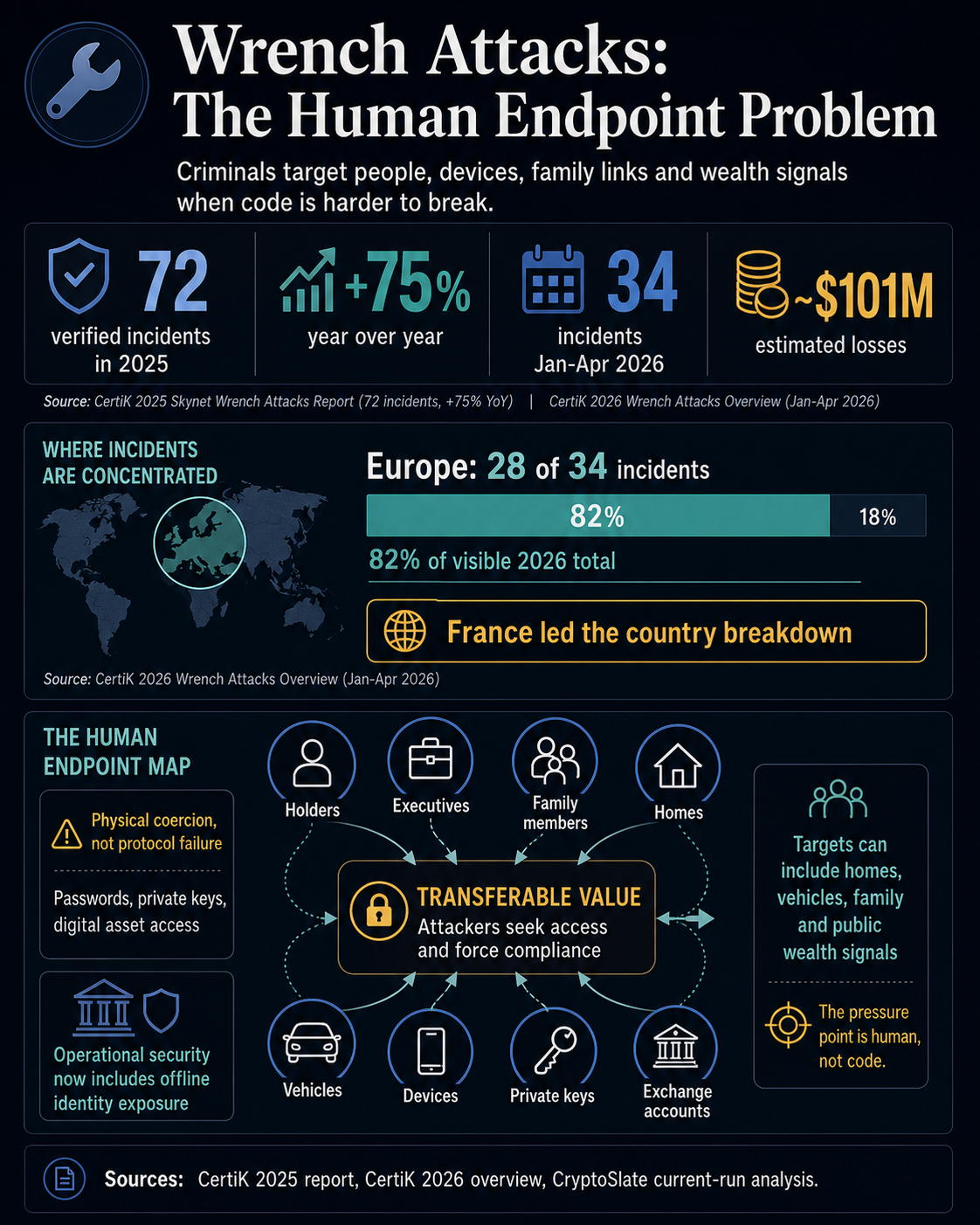
CertiK’s 2025 Skynet Wrench Attacks Report describes this category as attacks against human endpoints and recorded 72 confirmed incidents in 2025, an increase of 75% from the previous year.
This distinction is important for Bitcoin holders because protocol security and personal security are different issues. Bitcoins can be difficult to capture through code, but they are still vulnerable to people who appear to be controlling them.
Hardware wallets, seed phrases, exchange accounts, mobile devices, or family members can become pressure points if an attacker determines they have transferable value.
In the Danbury incident, the alleged target route was through a relative. The Justice Department has not said that the kidnapping victims themselves stole the bitcoins.
They said they were the parents of individuals involved in the theft of hundreds of millions of dollars in Bitcoin. Therefore, this case is not only a robbery case, but also an agent-targeting case.
The pattern unfolding in France indicates that this is a broader physical security issue. Previous reports in March said that crypto holders in France were being violently targeted beyond insiders and executives, with targets shifting from visible founders and relatives of crypto actors to individuals and households.

Previous coverage of the failed French home invasion linked this trend to systematic target selection, exposure of executives, and identity data.

The Danbury case brought that pattern to U.S. courts. The visible signal was a Lamborghini. The alleged influence point was family. The intended asset was Bitcoin.
The targeted route passed through a person who could be put under pressure.
Danbury shows how family proxies can become part of a cryptographic crime record. France shows what happens when similar targets are repeated frequently and public security guidance, government action, and holder protection are restructured.

Europe remains the most clearly concentrated
Apart from Danbury’s plea, available data shows that the current epicenter of wrench attacks is Europe.
According to CertiK’s 2026 Wrench Attack Overview, 34 confirmed incidents were recorded from January to April, with estimated losses of approximately $101 million.
Europe accounted for 28 of the 34 cases, or 82% of the visible total, with France leading the country breakdown.
igcurrencynews’s May overview of wrench attacks reached the same general conclusion. In other words, the wave of physical extortion is accelerating, and the clearest concentration remains in Europe, particularly France.

The Danbury case shows how the same targeting model can be problematic for U.S. courts and prosecutors.
Court records show how the physical security issues of virtual currencies affect the enforcement of ordinary violent crimes. This includes recruitment, travel arrangements, surveillance, family targeting, luxury cars, and attempts to reach Bitcoin using human power.
For holders and businesses, operational security now includes phishing, wallet exfiltration, exchange compromise, smart contract abuse, and physical disclosure of identities, home addresses, devices, and relatives.
The next legal signal is sentencing. Mr. Fike’s hearing on August 28 will show how federal courts will treat his admitted role in the conspiracy.
More broadly, notable cases are those linking crypto assets to relatives, homes, cars, public profiles, and other offline identifiers. There, the French-focused security trend could become a broader law enforcement issue, one U.S. document at a time.
(Tag Translation) Bitcoin


