

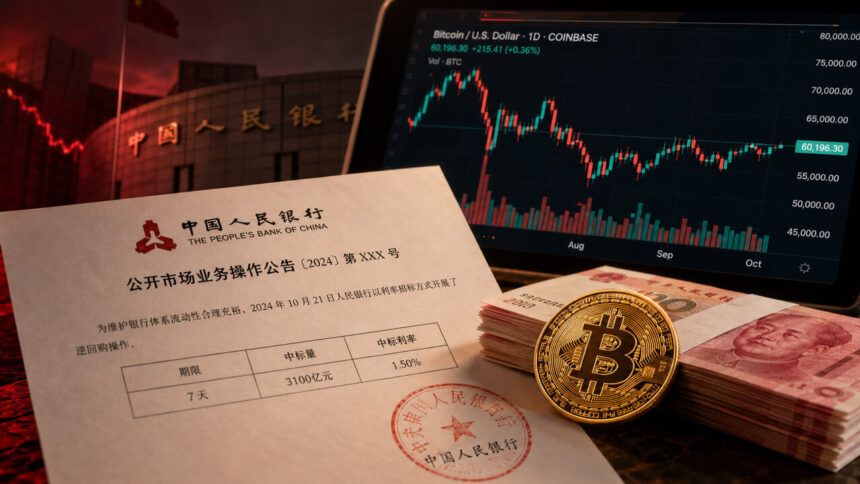
On June 29, the People’s Bank of China gave Bitcoin traders a new measure of liquidity by opening an overnight reverse repo channel worth 300 billion yuan (approximately $44.1 billion).
The signal arrives as BTC is about to stabilize around $60,000. You can see the tool up and running in just one operation. Repeated use will tell traders whether the PBOC is building a recurring liquidity valve that can change the landscape of risk assets.
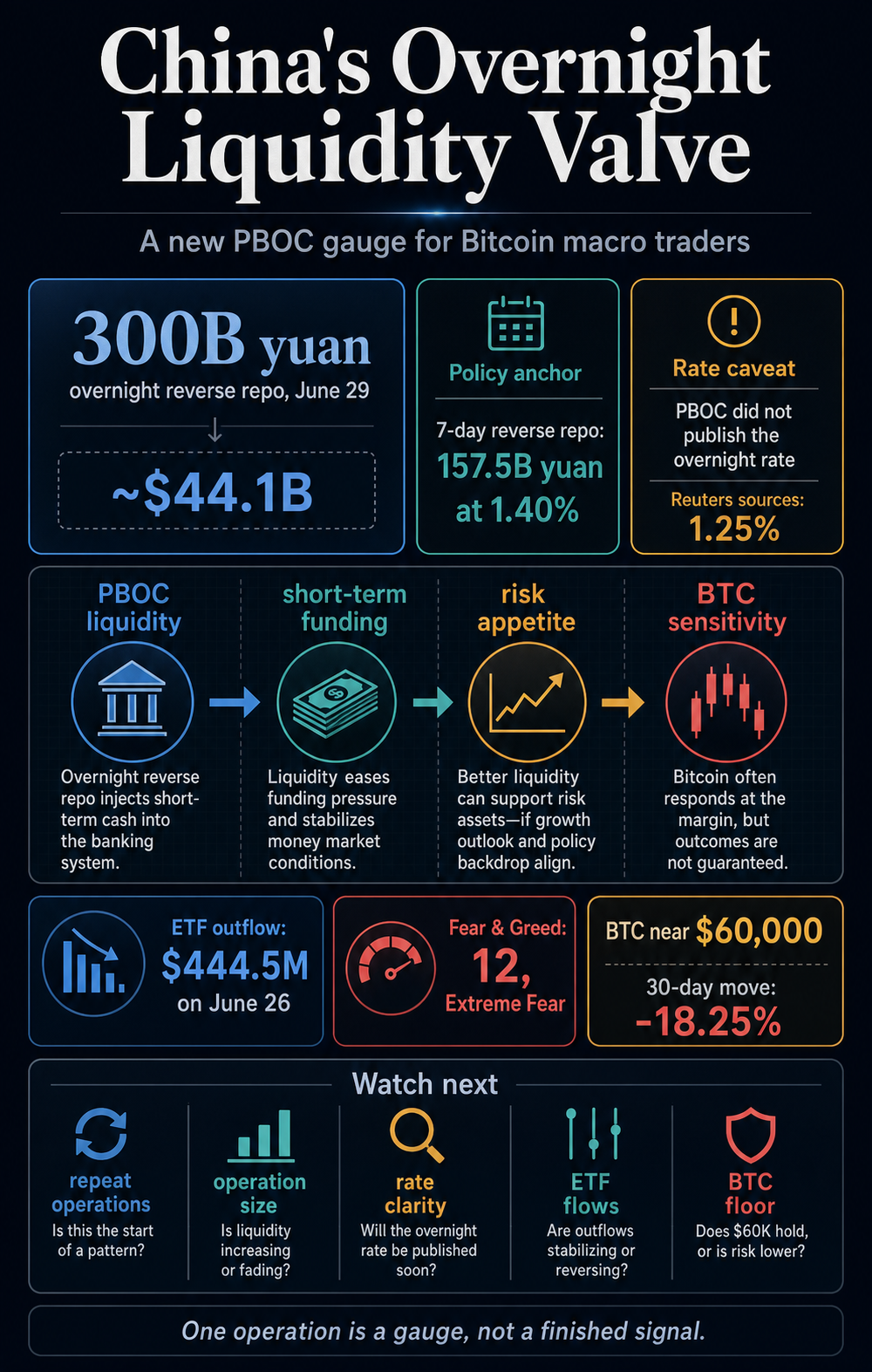
The People’s Bank of China announced on June 29 that it had conducted an overnight reverse repo of 300 billion yuan and a 7-day reverse repo of 157.5 billion yuan at an interest rate of 1.40%. In today’s terms, overnight operations are worth about $44.1 billion.
This is relevant to Bitcoin, as this operation translates changes in policy frameworks into daily financial market indicators. If the central bank continues to use overnight reverse repos, traders will have a more direct view of how aggressively China is resolving short-term funding stress.
If this operation turns out to be a one-time month-end adjustment, there will be less reason for the market to treat it as a permanent tailwind.
China’s new overnight tools are useful for macro traders, but no single liquidity maneuver could reverse Bitcoin’s risk background. BTC was trading at $60,042 on igcurrencynews on June 29 after falling 18.25% in 30 days, but demand and sentiment for the ETF remained weak enough to keep traders protected.
A new valve in China’s money market
The People’s Bank of China pre-announced that it will add overnight reverse repo operations on June 29 and June 30 to better meet the short-term liquidity needs of the banking system using fixed-rate quantitative auction operations.
The macro value reflects the daily liquidity valve usage and injection size by the People’s Bank. From a central bank’s perspective, overnight operations can quickly add cash, show where funding pressures are building, and reveal how much liquidity central banks are prepared to provide on the front end of money markets.
The People’s Bank of China’s June 29 official notice confirmed the amount, but did not disclose the overnight interest rate. According to a report by Reuters, sources familiar with the matter expect the initial overnight reverse repo rate to be 1.25%. The Business Times reported that analysts see the withholding of official interest rates as a way to avoid diluting the role of seven-day reverse repos as a key policy signal.
This fits into the broader framework outlined by People’s Bank of China Governor Pan Gongsheng. In remarks carried by the Bank for International Settlements, Governor Pan explained that the seven-day reverse repo rate is the main policy rate, with an interest rate corridor surrounding it, with overnight repo and reverse repo operations added as needed.
For traders, the variables are now concrete, including whether China will add liquidity, how often it will repeat the operation, what its size will be, and whether market funding conditions will react.
| people’s bank variable | what has changed | Why BTC traders follow this | caveat |
|---|---|---|---|
| Overnight reverse repo size | 300 billion yuan on June 29th | Indicates the amount of instant cash added to the short-term funding market | A single operation does not prove that the relaxation cycle is permanent. |
| Operating frequency | June 29th and June 30th were pre-announced dates | With repeated use, this tool becomes a cleaner daily liquidity gauge | Month-end funding requirements may explain some of this movement |
| rate signal | The central bank does not publish overnight interest rates. 1.25%, according to Reuters sources. | This rate could indicate how the new tool will position against the 7-day policy rate. | In the absence of official disclosure, traders rely on speculation and source reporting |
| 7 day reverse repo | 157.5 trillion yuan (1.40%) | Continues to be the main policy rate anchor for China’s money market | The overnight tool should be read in conjunction with the policy rate framework. |
Why Bitcoin traders are paying attention now
Bitcoin has a long history of reacting to global liquidity conditions, but the relationship is rarely mechanical. Liquidity helps risk assets when it reduces funding stress, improves leverage conditions, and redirects investor appetite for high-beta trades.
BTC moves could also fail if domestic credit demand is weak, the dollar tightens, ETF outflows continue, or traders decide the movement is too small to change their positions.
That’s why China’s indicators sit alongside other market inputs, rather than on top of them. In the first operation, the trader is given a concrete number.

The next few operations will show whether the People’s Bank of China is simply smoothing out short-term funds or is building a repeatable liquidity valve near the front end of the curve.
Bitcoin’s unique settings make that distinction even more important. igcurrencynews’s market page showed BTC’s dominance at 58.1% on June 29, while the Bitcoin page showed a steep 30-day decline and price concentrating around the psychological $60,000 level.

Markets under such conditions become more sensitive to marginal liquidity. That’s because traders are already debating whether the selling pressure has dried up or whether it is still feeding on weak demand.
ETF flows further increase its vulnerability, while China’s liquidity problems take a backseat. Pharcyde Investors showed net outflows of $444.5 million from its US Spot Bitcoin ETF on June 26th.
Alternative.me’s Crypto Fear and Greed Index had a live reading of 12, or extreme fear, as of June 29th. igcurrencynews’s crypto sentiment analysis is slightly negative at 38/100.
These numbers explain why traders are looking for macro offsets. Whether China can supply it remains unclear.
The practical question is whether the new overnight activity from the People’s Bank of China will be paralleled by improving ETF flows, calming sentiment, or Bitcoin’s resilience.
Durable signals require repetition. A single 300 billion yuan operation lets traders know the tool is up and running. Repeated injections of this magnitude, or large-scale operations during times of tight funding, would be difficult to dismiss as a calendar-driven liquidity adjustment.
If the PBOC continues to keep the official overnight rate on hold, the market will speculate on its level based on reporting from Reuters sources, money market pricing, and its relationship to seven-day reverse repos.
With more clarity on rates, traders will be able to determine whether the overnight valve is just an operational plumbing measure or a more aggressive effort to drive short-term funding costs.
Transmission remains hard filtered. If cash remains within the domestic funding market, or if broader risk appetite remains low, China could add liquidity even if Bitcoin does not rise immediately.
This operation is better understood as a liquidity gauge rather than a direct catalyst for Bitcoin. China’s new overnight tool could impact BTC if used repeatedly to coincide with easing funding stress and restoring risk demand.
Recent coverage of igcurrencynews adds context. Previous analyzes have independently linked PBOC liquidity, the debt-liquidity gap, ETF pressure, and Bitcoin’s sensitivity to the macro environment.
China’s central bank is now offering traders a shorter-term indicator to compare Bitcoin’s price movements.
The risk for Bitcoin bulls is to mistake the new gauge for a completed signal. The People’s Bank of China’s June 29 operation creates a new reference point for global liquidity.
ETF outflows, weak market conditions, and Bitcoin’s 30-day selloff remain on the horizon.
The market now has a clearer order to follow. The upcoming People’s Bank of China’s overnight reverse repo will indicate whether the operation will be extended beyond June 30.
If the scale of the operation is close to or exceeds 300 billion yuan, it will be more important than a quick withdrawal. More clarity on the overnight rate compared to the 7-day policy rate would help traders distinguish between routine plumbing and stronger funding support.
If these parts start moving together, China’s overnight reverse repos could become a useful macro indicator for Bitcoin traders. If the two diverge, the first operation will look less like a bullish catalyst and more like another reminder that liquidity only impacts BTC when risk appetite is actually reached.
(Tag translation) Bitcoin


