


tradias, an institutional-grade infrastructure and cryptocurrency trading engine, joins Bitgo Prime’s liquidity network as an official liquidity provider, expanding institutions’ access to digital asset execution across global markets.
Important points:
- European provider tradias joined Bitgo Prime’s liquidity network on April 13, 2026, expanding access to cryptocurrency execution for institutional investors globally.
- Bitgo (NYSE:BTGO) is trading around $9.47, about 47% below its January 2026 IPO price of $18.00.
- The merger of tradias and Boerse Stuttgart Digital, pending regulatory approval, could reshape Europe’s crypto infrastructure in 2026.
Bitgo Expands Prime Liquidity Network
The move connects regulated crypto asset service provider tradias to Bitgo Prime’s single-access aggregation platform, linking institutional clients with exchanges, market makers, and counterparties around the world. Bitgo Prime consolidates that access and helps clients achieve competitive pricing and cleaner execution across digital asset pairs.
Bitgo’s announcement details that tradias brings established market-making experience to the network. The Frankfurt-based company operates as a regulated investment firm and crypto asset service provider, covering over 150 cryptocurrencies for institutional investors. Its infrastructure currently powers crypto trading for Europe’s top banks and brokers, delivering transactions to more than 14 million Europeans through bank-integrated channels.
Bitgo CEO and co-founder Mike Belshe said the expansion strengthens financial institutions’ expectations for execution quality. “With the addition of Tradia, we continue to improve access to higher quality liquidity while maintaining the regulatory and security standards our customers demand,” said Belshe.
Christopher Beck, founder of tradias, said the partnership will expand the company’s reach beyond the European market. “Joining Bitgo Prime’s liquidity network gives us the opportunity to extend that mission globally and provide our clients with access to tighter spreads and better execution within both regulated frameworks,” Beck said.
Both companies operate under authorized regulatory structures. Bitgo has received custodial approvals from the OCC through Bitgo Bank & Trust in NA and from BaFin in Germany through Bitgo Europe GmbH. Customer assets are stored in isolated cold storage warehouses and insured up to $250 million. Monday’s release details that tradias adheres to the compliance standards of comparable institutions on the European side.
This partnership adds depth to Bitgo Prime as the parent company navigates the post-IPO market landscape. Bitgo Holdings, Inc. (NYSE: BTGO) was listed on the New York Stock Exchange on January 22, 2026 at a price of $18 per share, raising approximately $212.8 million. The stock opened at $22.43, hit an intraday high of $24.50, and closed at $18.49.
Since then, the stock price has fallen significantly. BTGO was trading around $9.38 as of 11:28 a.m. ET Monday afternoon, down about 47% from its IPO price. The stock hit a 52-week low of $7.25 around March 30, 2026, and then stabilized in a range of $8 to $9 until early April.
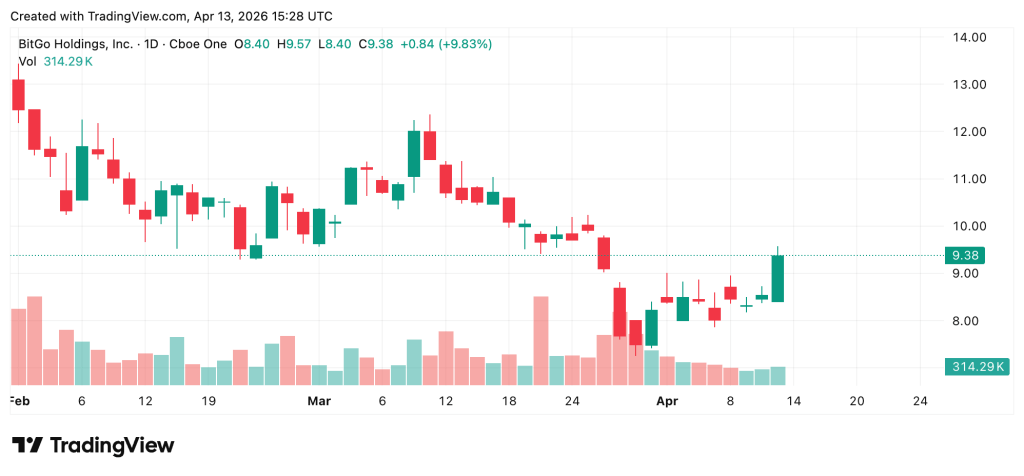
Despite the stock price decline, Bitgo reported fiscal 2025 revenue of approximately $16.2 billion, an increase of 424% year over year, driven by digital asset custody, trading, and related services. The company posted a net loss of approximately $14.8 million over the subsequent 12 months, partially due to valuation pressure on its Bitcoin holdings.
Wall Street analysts generally maintain a positive outlook. The average 12-month price target is around $14.58, representing about 54% upside from current levels. Mizuho has reiterated its Outperform rating with a target of $14 as of April 1, 2026.
European provider tradias is also undergoing its own structural changes. In February 2026, tradias and Boerse Stuttgart Digital announced plans to merge, pending regulatory approval, to form a regulated European crypto infrastructure provider.
The Bitgo Prime integration will add regulated European counterparties to the network as both companies position themselves for broader institutional demand in the digital asset market.


