

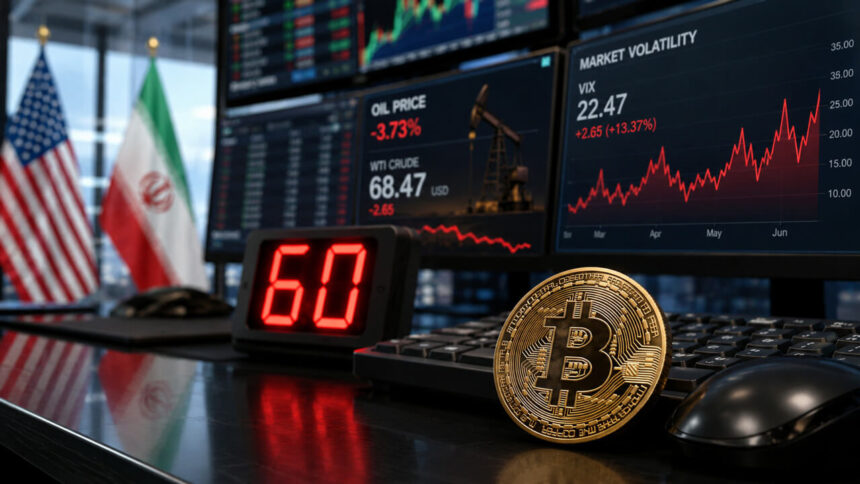
Iran’s foreign minister said negotiations with the United States would begin on the same day the two countries signed the memorandum of understanding, and that there would then be a 60-day grace period to resolve the nuclear issue and secure sanctions relief.
Bitcoin reacted to the framework itself, a memorandum of understanding that was signed before the tough terms were finalized. Brent crude fell about 5% to $78.96 and WTI to $76.05, both near three-month lows, as traders priced in the reopening of the Strait of Hormuz and a recovery in Iranian oil exports.
According to the U.S. Energy Information Administration, the Strait of Hormuz carried about 20% of global oil and petroleum product consumption and more than a quarter of global seaborne oil trade from 2024 to early 2025.
The solid reduction in the probability of a disruption there removes one of the market’s more obvious tail risks, and that removal alone explains the drop in oil that day. The memorandum also allows Iran to begin selling oil and fuel under newly issued exemptions, potentially adding short-term supplies that could keep prices low if shipments do move.
| things that will improve immediately | Items that remain unresolved after 60 days |
|---|---|
| Strait of Hormuz disruption unlikely | final nuclear conditions |
| Brent fell about 5% to $78.96 | Complete Sanctions Relief Schedule |
| WTI settles at $76.05 | Verification and inspection system |
| Iranian oil and fuel exemption begins | Permanent normalization of Iranian exports |
| Immediate inflation shock risk declines | Will low oil prices last long enough to influence Fed policy? |
| Risk assets become a catalyst for relief | Whether the MOU constitutes a final settlement |
What frameworks leave unresolved
The first phase of the Foreign Minister’s own schedule covers de-escalation measures already underway.
In the second phase, 60 days after the MOU is signed, negotiators will address the nuclear issue and a timeline for sanctions relief, the two issues that have the greatest impact on Iran’s long-term oil access and economic return.
The proposed $300 billion recovery fund will only become operational once a final agreement is signed, and the current MOU only provides for the planning stage.
CIA Director John Ratcliffe and other US officials remain skeptical that Iran will make the nuclear concessions needed for a final deal. The market has priced in the immediate energy shock without factoring in the final outcome, as the negotiations that will cause the energy shock have not yet taken place.
Bitcoin is downstream of all variables Despite the chaos Hormuz’s terror brought about; There is no direct exposure to Iranian crude oil itself.
Nearly 70% of economists polled by Reuters expect the Fed to keep interest rates at 3.50% to 3.75% through the end of 2026, and none of the economists surveyed expected a rate cut at its June 16-17 meeting.
A 5% drop in oil prices in one session would only marginally shift the inflation debate, but it would take months of sustained declines in energy prices to move the Fed’s already-held policy.
The chain that Bitcoin actually needs starts with sustained escalation. This would normalize oil flows over a 60-day period, ease inflationary pressures, soften the Fed’s stance and ease liquidity conditions that are pushing risk assets broadly higher.
| step | market variables | Relevance to Bitcoin |
|---|---|---|
| Memorandum of understanding concluded | Declining geopolitical risk premium | Instant relief bidding for risky assets |
| Hormuz disruption risk decreases | Reduced oil tail risk | Inflation shock is less likely |
| Iranian exports normalize | Crude oil supply improves | Sustained pressure on oil prices |
| oil remains low | Easing inflation expectations | The Fed has more room to ease |
| Fed tone shift | Real yield/easing dollar pressure | Improved liquidity background |
| Improving liquidity | Increased risk appetite | Bitcoin has strong macro tailwinds |
The June 16 announcement begins the chain, and each remaining link will depend on negotiators translating the framework into concrete, permanent terms over the next two months.
All updates over the next 60 days will have pricing power for the same trade. News about uranium enrichment levels, sanctions lifting timelines, Hormuz shipments, Iranian export data, inspection requirements, Congressional reaction in Washington, etc. each could change the price of oil and, with it, the macro context for Bitcoin.
The market has translated Iran risk into a series of checkpoints over two months, with the deadline itself acting as a forcing event that could swing the market significantly in either direction depending on what negotiators present by then.
When time runs out, there are two paths.
Negotiators have 60 days to reach a final agreement that codifies sanctions relief and normalizes Iranian oil exports on a durable basis, keeping oil prices structurally low as supplies return to the market in earnest.
Inflation expectations have eased enough to soften the Fed’s tone, real yields are trending lower, and the liquidity backdrop supporting Bitcoin and other high-beta assets is improving on a fundamental basis. Under this path, the rally that begins becomes the first leg of a longer move.
| scenario | what happens | Impact on oil/inflation | Impact of Bitcoin |
|---|---|---|---|
| Final deal completed | Nuclear deal, sanctions relief and export normalization agreed within 60 days | Crude oil risk premiums remain low. inflationary pressures eased | Relief rallies could become broader macro rallies |
| Negotiations drag on or stall | Nuclear restrictions, verification and sanctions order remains unresolved | Reconstruction of the oil risk premium. Supply channels remain tight | Bitcoin returns relief profits |
| partial extension | De-escalation is on hold, but final terms are deferred. | Crude oil stabilizes, but uncertainty remains | BTC trades from headline to headline |
| failure risk | Negotiations failed or Hormuz/shipping unrest recurs? | oil spike. Inflation concerns return | BTC will be sold along with risk assets |
In other cases, 60 days pass without producing the transparency that the market is pricing in. Iran and the United States continue to hold talks, but issues such as limits on uranium enrichment, verification regimes and the order in which sanctions should be eased are proving more difficult to resolve than the initial measures to ease tensions.
With transit through Hormuz only partially normalized, the risk premium for oil has been restructured, and the Fed’s interest rate path remains as it was already set in the June poll, not driven by a framework that did not translate into a final settlement.
Bitcoin regained some or all of its recent rescue gains as the macro variables justifying the rally returned to pre-MOU levels and traders who had treated the announcement as a clean detente story realized they were trading on the deadline.
What negotiators offer before the 60-day deadline expires will be more decisive about Bitcoin trade with Iran than the announcement itself.
While this framework reduced the likelihood of an immediate oil shock, it was a smaller accomplishment than proving that Bitcoin has entered a macro regime with low inflation and easy liquidity.
If that evidence arrives, it will depend on whether the memorandum turns into a settlement within the next two months, and until then, all the information that leaks from the negotiating table carries the weight of an unresolved deal.
(Tag translation) Bitcoin


