




Bitcoin was created as a response to the type of debt-driven financial turmoil currently sweeping the global bond markets. The original theory was that as governments borrowed recklessly and devalued their currencies, hard money assets would absorb the resulting demand.
What the paper leaves open is that a debt spiral could tighten financial conditions and suppress speculative assets before the hard money argument plays out.
In 2026, the long-term narrative and short-term mechanics are moving in opposite directions. To understand why, you need to spend a few minutes looking at the most important numbers in global finance today.
On May 20th, the 30-year US Treasury yield reached 5.18%. The May 13 auction of $25 billion in new 30-year bonds sold for 5.046%, marking the first time since 2007 that investors received 5% on long-term bonds, amid rising energy prices and growing expectations that inflation may persist longer than the market expected.
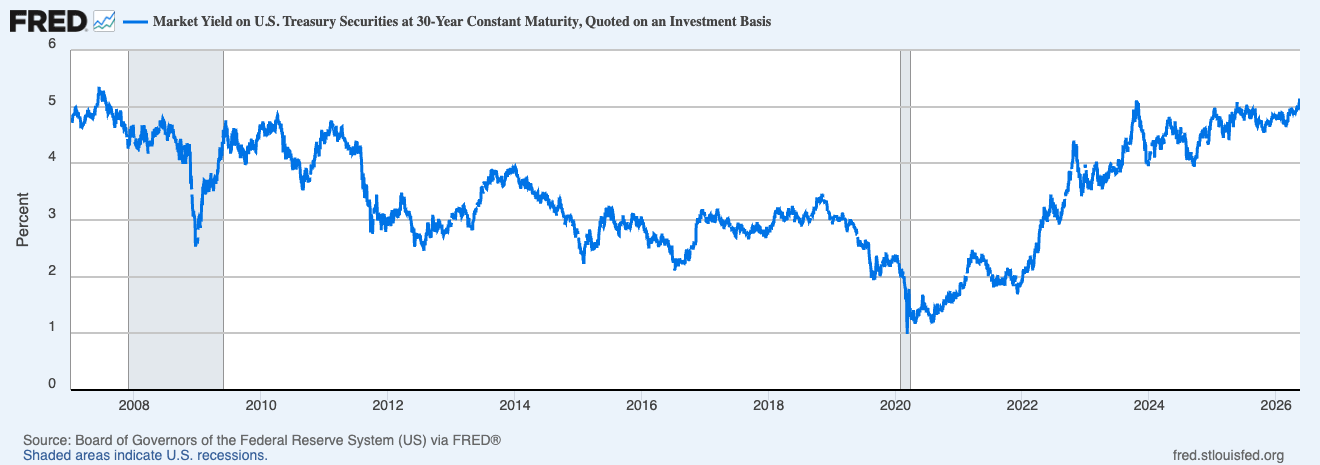
The last time yields were at this level, Bear Stearns was still a concern and quantitative easing was still a theoretical concept. What has happened in the market since then (the post-2008 era of subdued interest rates, central bank asset purchases, near-zero borrowing costs) assumed that yields would eventually fall and stay there, but current repricing challenges that assumption across the curve.
America borrows money to pay interest on borrowed money.
The inflationary factors behind this move are well documented. U.S. Treasury yields rose as investors weighed the impact of soaring energy prices due to the Iran war, with WTI crude oil settling above $106 a barrel and Brent rising to $114.44.
Energy is a real factor, but the deeper structural force (and the more durable one) is the huge amount of US government debt that will have to be refinanced and issued to markets that are already reassessing inflation risks. The U.S. Treasury will likely borrow more than $2 trillion by the end of the fiscal year, and the Office of Management and Budget projects the fiscal year 2026 deficit will be $2.06 trillion, higher than the Congressional Budget Office expected.
To finance this borrowing, the Treasury Department paid nearly $530 billion in interest between October 2025 and March 2026, more than $88 billion per month, roughly equal to the combined spending of the Department of Defense and Department of Education.
This problem has its own implications. Interest payments on the national debt increased 6.1% year-over-year through the sixth month of fiscal year 2026, making it the second-largest spending category in the federal budget and outpacing every budget category except Social Security. CBO projects these annual costs to increase from $1 trillion in 2026 to $2.1 trillion by 2036.
Meanwhile, Treasury’s own borrowing calendar maintains upward momentum over the long term, with $189 billion expected in the second quarter and $671 billion in the third, meaning the shelf life of the bond decline extends far beyond Iran’s individual headlines.
This is what the bond market is actually pricing in. Weak external demand, huge supply, and an inflationary backdrop that gives the Federal Reserve little room to maneuver. Futures markets now put the probability that the Fed will raise rates by December at more than 44%, a significant change from expectations for multiple rate cuts at the beginning of the year. Barclays has moved the Fed’s expected first rate cut to March 2027. Interest rate cuts, which crypto markets have treated as a reliable tailwind for most of 2024 and 2025, are now actively off the price change table.
How the Treasury Auction Moved Bitcoin
Bitcoin’s fall below $80,000 last week shows how quickly the bond market has regained control of crypto trading, even after lawmakers passed one of the industry’s most closely watched regulatory bills.
The CLARITY Act was expected to create a lasting positive atmosphere across the cryptocurrency market.
Instead, the US Spot Bitcoin ETF recorded weekly outflows of around 14,000 BTC, ending a six-week streak of inflows, as soaring inflation statistics forced the market to reassess its risk exposure. Binance’s spot net trading volume fell from about $50 million to $6.5 million, and Coinbase’s from $30 million to $5.7 million.
This is a direct transmission mechanism. An institutional investor who can now take 5% of a 30-year Treasury with a guarantee has to make different decisions than someone who was operating at a 3.5% yield two years ago. Rising government bond yields raise the opportunity cost of holding volatile, non-yielding assets like BTC, and institutional buyers become more selective as government bonds offer a stronger return profile.
Tokenized U.S. Treasuries hit a record $15.35 billion in on-chain market value, up nearly 70% since the beginning of the year, as yield-sensitive capital finds a home in a combination of crypto infrastructure and bond market returns.
This is a structural consequence of the ETF era that igcurrencynews has been tracking. Bitcoin is now integrated into traditional portfolio allocation frameworks. This means that Bitcoin responds to the same macro inputs as other risk assets. Before the advent of ETFs, cryptocurrencies traded primarily based on their own internal dynamics driven by altcoin rotation, on-chain metrics, and retail sentiment.
Currently, government bond auctions that bid 20 basis points above expectations can move Bitcoin faster than any on-chain development. As igcurrencynews pointed out in late April, Bitcoin’s recovery is predicated on new capital inflows from institutional investors and the assumption that liquidity conditions will not tighten again. And if U.S. Treasuries choose a direction before that assumption is tested, the bond market could drive Bitcoin’s next move independent of any crypto-specific catalysts.
This is where the strategy becomes even more complex. JPMorgan estimated in early May that if Strategies maintains its current purchasing pace, it could buy around $30 billion in Bitcoin by 2026, a number that would be one of the most powerful structural forces in Bitcoin demand, along with ETF flows and miner supply.
Complicating matters is that Strategies’ capital structure, which relies on issued and preferred stock to fund Bitcoin purchases, is experiencing rising operating costs as yields rise and system-wide borrowing costs increase. The more yields rise, the more the flywheel becomes dependent on investors’ sustained appetite for a model that converts yield demand into BTC demand.
The contradiction on which Bitcoin was built
Even under short-term pressures, there are long-term arguments here worth holding. The shift from a traditional safe haven to Bitcoin, seen as an alternative store of value, reflects the fiat currency devaluation narrative gaining new momentum as fiscal deficits widen and central bank balance sheets remain structurally large.
As concerns about sovereign debt sustainability mount and US borrowing rates become impossible to ignore, the long-cycle argument for Bitcoin as a financial hedge is likely to grow along with it.
In the short term, 5% Treasury yields are a headwind. Financial conditions will tighten, the opportunity cost of speculative positions will rise, and the marginal liquidity that has historically fueled Bitcoin’s big gains will dry up.
But looking at the longer term, the fiscal conditions that generate these yields, with budget deficits projected to rise from 5.8% of GDP in 2026 to 6.7% in 2036, and net interest payments increasing annually relative to the size of the economy, are precisely the conditions that make a hard-money, supply-fixed asset like Bitcoin attractive to a growing number of institutional holders.
For years, the cryptocurrency market has been fixated on the Federal Reserve, monitoring interest rate decisions and dot plots as key macro inputs. What 2026 makes clear is that the Fed’s room to maneuver is increasingly limited by bond markets pricing in something more durable than a temporary spike in inflation.
The next stage of Bitcoin’s trajectory will depend less on what decisions central banks make and more on whether global bond investors are starting to lose patience with U.S. government bonds. So if you go all the way back to this, this is exactly the scenario that Bitcoin was designed to last.
(Tag to translate) Bitcoin


