


Bitcoin’s prolonged decline has forced crypto companies to cut staff, automate more work, and abandon expansion plans that characterized the last bull market. At the same time, it has also created one of the most takeover periods in the industry.
Cryptocurrency mergers and acquisitions reached $7.23 billion in the second quarter of 2026, up from $2.14 billion in the first three months of this year.
Over the past two quarters, total capital deployed through transactions was $9.37 billion. CryptoRank data put the broad-based surge in the first half of the year at 26x year-on-year, highlighting how trading activity accelerated rapidly despite weakening spot market conditions.
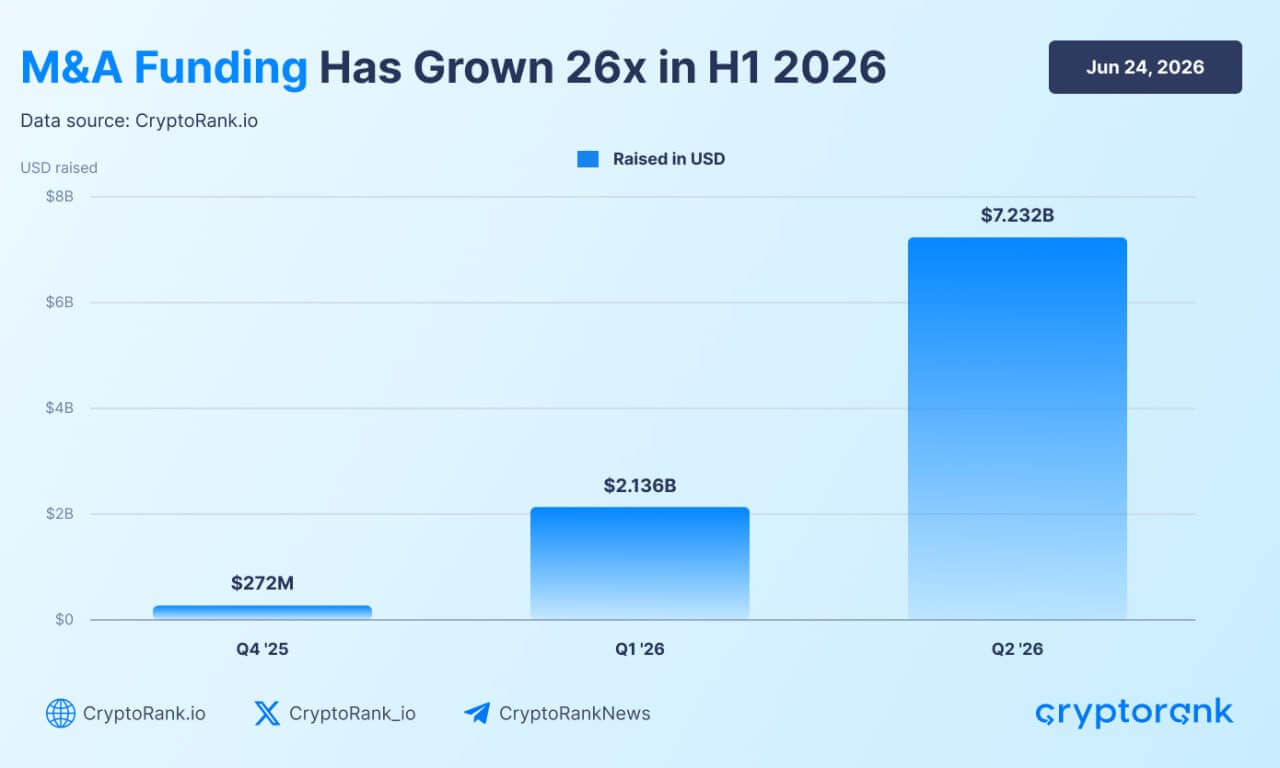
The acceleration comes as Bitcoin trades near its lowest level in nearly two years and some of the industry’s biggest employers continue to cut jobs.
This divergence shows where capital is moving during recessions, as companies reduce spending on broad hiring and speculative growth.
Instead, traditional financial institutions, banks, card networks, trading houses, and well-capitalized crypto businesses are purchasing payment systems, regulatory licenses, custodian operations, and market infrastructure that can take years to build internally.
The result was a bear market that weakened many cryptocurrency companies without eliminating institutional demand for the technology.
Traditional finance fuels wave of crypto infrastructure acquisitions
Traditional financial institutions are opting to purchase fully developed digital asset infrastructure rather than building compliance and technology systems from scratch, fueling a wave of cryptocurrency acquisitions.
Banks, payment processors, and financial technology companies are aggressively targeting startups that already have custody solutions, payment rails, and regulatory approvals.
This buying spree is largely driven by global policy stabilization. The European Union’s Market for Cryptoassets (MiCA) framework has established uniform licensing standards, and ongoing stablecoin legislation in the US is giving major companies the confidence to make long-term bets.
Legal and advisory experts point to this policy support as a major catalyst. According to Architect Partners’ Q1 Cryptocurrency M&A Funding Report, the banking and securities industries are fully embracing blockchain, repositioning blockchain technology as a foundational layer of traditional financial markets.
Mastercard’s $1.8 billion acquisition of stablecoin company BVNK is a prime example. The acquisition enabled the card network to immediately secure the technology and licenses needed to process stablecoin payments, bypassing years of internal development.
Other Wall Street heavyweights are also gaining strategic footing through targeted investments. Intercontinental Exchange is backed by prediction platform Polymarket, Citadel Securities, which invested in brokerage firm Alpaca, and market maker Keylock, which is backed by Standard Chartered’s venture arm.
Asset management companies are also conducting outright acquisitions to capture demand from institutional investors. Franklin Templeton, which manages $1.7 trillion in assets, recently launched a dedicated digital asset division called Franklin Crypto.
The move was completed with the acquisition of 250 Digital, which absorbed the firm’s investment team and liquid crypto strategies previously managed under CoinFund, providing actively managed cryptocurrency products directly to Franklin Templeton’s global client base.
Private capital generally strongly supports companies that connect blockchain to the broader financial system. Q1 funding data showed a clear preference for stablecoin utilities such as foreign exchange, corporate payments, and cross-border payments over speculative crypto-native projects.
In this environment, regulatory credentials act as a major competitive moat. target Companies with broker-dealer capabilities, federal bank charters, or registered investment advisor status, such as Alpaca, Anchorage, and Superstate, attract stronger buyer interest because they provide acquirers with: Immediate legal permission to operate.
While traditional finance flexes its balance sheet, blockchain networks are quietly emerging as a new class of aggressive buyers.
Historically, Layer 1 and Layer 2 networks relied on independent developers to build applications on-chain. These networks, now facing intense competition for users, are purchasing direct-to-consumer applications.
Polygon’s recent acquisitions of Coinme and Sequence highlight this axis. By purchasing payment access and wallet infrastructure, blockchain has ensured a unique end-to-end user experience and fixed transaction volumes, demonstrating that technical capabilities alone are no longer enough to maintain market share.
Cryptocurrency-related job cuts will become more serious as AI and compliance reshape the workforce
The pace of corporate acquisitions stands in sharp contrast to the continued contraction of the digital asset labor market.
According to June 2026 data compiled by Tiger Research, there are currently only 2,932 active jobs in this industry worldwide.

This number is a shadow of the aggressive recruiting efforts seen in 2021 and early 2022, when trading platforms, decentralized finance protocols, and NFT markets were all expanding headcount at the same time.
The hiring recession, which began during the 2022 market downturn and accelerated after FTX’s collapse, has seen the number of job openings drop by about 40% across North America and Europe. The market has not yet recovered to its previous heights.
In fact, layoffs continued steadily through the first half of this year. Major platforms such as Gemini, Coinbase, Kraken, Algorand, Crypto.com, and most recently the Ethereum Foundation have launched new reduction rounds.
Executives cited weak token valuations, broader macroeconomic pressures, and reduced operational efficiency due to artificial intelligence as factors for the downsizing. For context, Coinbase has clearly framed its restructuring as a transition to an “AI-native” operating model.
This technological shift is also evident in recruitment data. The proportion of crypto job listings that require AI proficiency more than doubled in one year, jumping from 23% in early 2025 to more than 53% by March 2026.
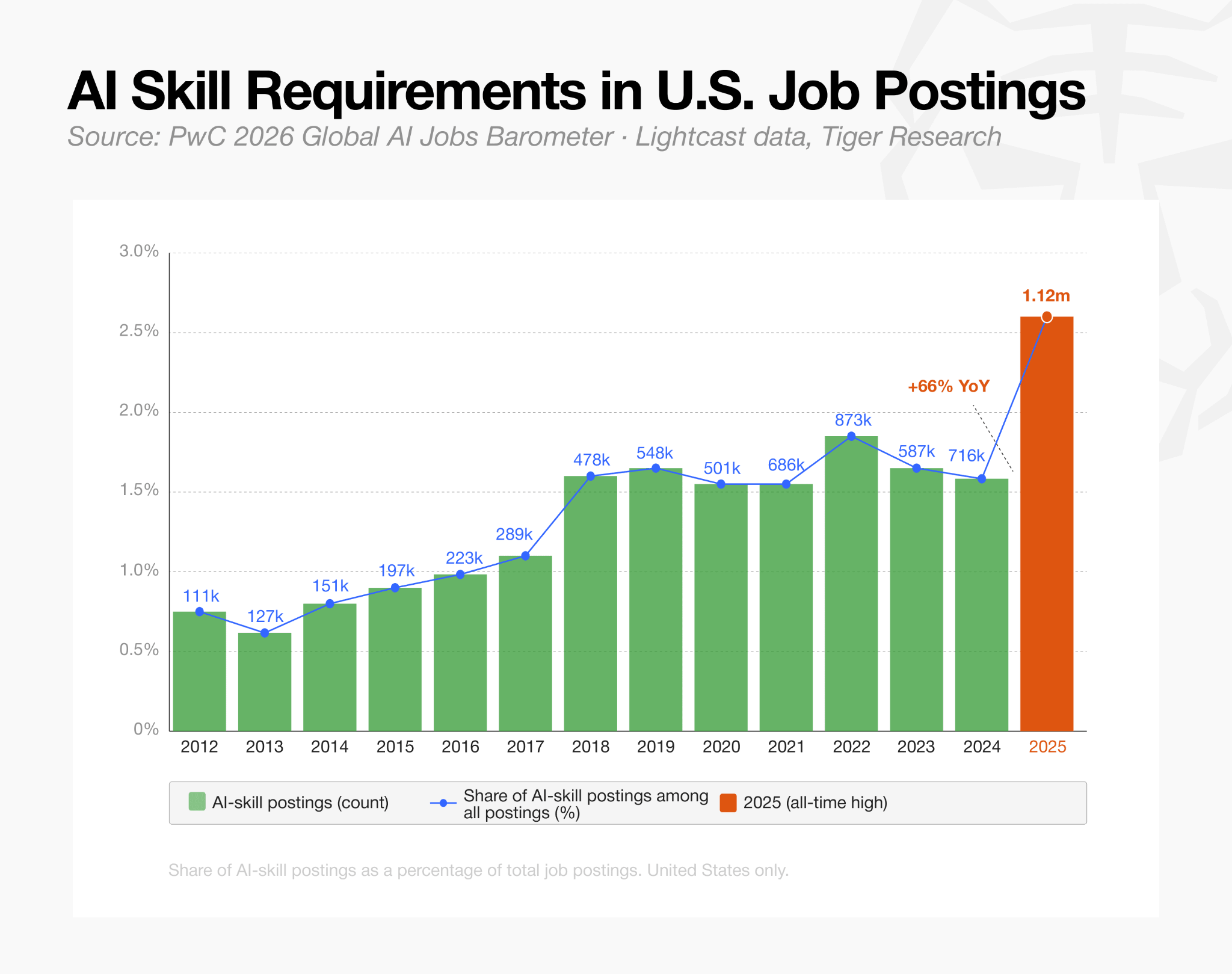
Although overall employment remains depressed, the composition of the workforce is fundamentally changing. Companies are not implementing blanket hiring freezes. Rather, we are actively narrowing our focus to technical and regulatory expertise.
According to Tiger Research, approximately 34% of active job openings are for engineering roles, while legal and compliance positions account for approximately 10%. This shift is more pronounced on centralized exchanges, where compliance-related positions account for 16% of job openings and outnumber sales and business development positions by more than 2-to-1.
This shows that these companies are prioritizing the staff needed to secure licenses, manage risk, and maintain core infrastructure while reducing spending on marketing and community growth.
Furthermore, the limited adoption that does exist is highly concentrated within a small number of leading companies, rather than being dispersed across early-stage startups. Centralized exchanges generate almost a third of all open positions.
The stablecoin and payments sector is also a bigger part, but its activities are quite centralized. Tether and Ripple alone account for over 80% of the list in that category.
Ultimately, this data paints a picture of targeted corporate restructuring and defensiveness rather than an industry-wide labor market resurgence.
Cryptocurrency companies in financial trouble become acquisition targets
Blockworks’ recent acquisition of Messerli perfectly encapsulates the intersection of widespread layoffs and accelerating consolidation.
Cryptocurrency analytics firm Blockworks acquired the analytics provider for about $10 million, a steep drop from its valuation of $300 million after a capital increase in 2022. Prior to the sale, the research firm had endured three separate rounds of job cuts starting in 2023.
This deep discount highlights the harsh reality check facing digital asset startups that rely on venture capital, advertising, or subscription models.
Shrinking runway and sluggish revenue generation are forcing small and medium-sized businesses to the negotiating table, allowing well-capitalized buyers to absorb specialized talent, proprietary data, and distribution at a fraction of previous private market valuations.
Industry analysts expect these financial pressures to soon spill over into the digital asset treasury sector. Throughout 2025, a number of publicly traded financial institutions successfully raised capital by trading at a premium compared to their crypto reserves.
However, due to a combination of low token prices and poor stock performance, many of these vehicles are worth less than their underlying holdings. This discount significantly limits the ability to issue additional shares to accumulate more tokens.
Galaxy Digital researchers suggest that a business combination offers a viable path forward for these companies. A well-positioned treasury firm like Michael Saylor Strategy could acquire peers at a discount and consolidate their balance sheets while simultaneously targeting revenue-generating operating businesses and reducing their reliance solely on rising token prices.
Meanwhile, the M&A wave, supported by a mature legal framework, may eventually involve decentralized and autonomous organizations as well.
Recent legislative developments, such as Wyoming’s Unincorporated Nonprofit Association (DUNA) structure, have given DAOs recognized legal mechanisms to hold off-chain assets and intellectual property.
Clearer governance and ownership will make it easier for protocol treasuries to pursue acquisitions of complementary software projects and dedicated development teams.
Nevertheless, these decentralized mergers remain highly experimental compared to the traditional compliance-driven acquisitions that dominate the current market cycle.
Capital is still available but has become selective
Cryptocurrency trading activity is approaching $10 billion in the first half of 2026, but capital allocation is becoming more selective.
A notable exception to this strictly institutional focus is the prediction market sector. Event betting platforms have been vying for mainstream dominance and garnering huge funding.
For context, Kalsi is reportedly negotiating a funding round valuing the federally regulated exchange at $40 billion. This is almost double the previous $22 billion price tag. As competition for prediction market supremacy intensifies, polymarkets are absorbing significant support as well.
But beyond predictions, the venture’s thesis has narrowed dramatically. Capital is overwhelmingly flowing into businesses that bridge the gap between digital assets and the traditional financial system.
Tokenization companies and institutional trading houses are securing big checks to tout sustainable, insulated revenue models that charge banks, brokerages and asset managers for regulated services rather than relying on the fickle retail crypto traders. Superstate recently closed an $82.5 million round to expand its blockchain-based securities issuance, giving Alpaca a dominant position in tokenized US equity and exchange-traded fund settlement.
This funding trajectory shows investors are shifting their bets from conceptual tokenization trials to actual regulated financial products.
Obviously, pure decentralized finance protocols and experimental base layer blockchains were completely missing from this quarter’s mega-rounds.
This selective venture capital deployment reflects broader M&A trends. Liquidity exists, but it is ring-fenced for startups that boast regulatory licenses, institutional distribution channels, and tangible utility to traditional finance.
The bear market has effectively pruned the industry, forcing weak models to consolidate or lay off staff, while heavily rewarding infrastructure providers built to survive the crypto winter.
(Tag Translation) Bitcoin


