


Bitcoin is trading around $65,978, below the $69,000 level that Glassnode treats as the average cost standard for short-term holders, and whether this disconnect can be resolved will be decided at the Federal Reserve Board meeting on July 28th and 29th.
The number of employees in June increased by only 57,000 people, the unemployment rate remained at 4.2%, and the revisions reduced the number of employees in April and May by a combined 74,000 people.
Core CPI was flat month-over-month, slowing to an annualized rate of 2.6%, giving traders reason to expect Fed easing, with headline exposure to energy costs at a 3.5% annualized rate.
Brent crude oil futures settled around $94 this week, hitting an intraday high of $95.47. The 10-year Treasury yield rose to about 4.67%, and the 30-year Treasury yield was above 5% for the 11th time in a row, the longest period since May.
Market pricing for a July rate hike ranges from roughly 25% to 33%, with one CME-based reading putting odds at 33.7%, up from 25.7% a day earlier.
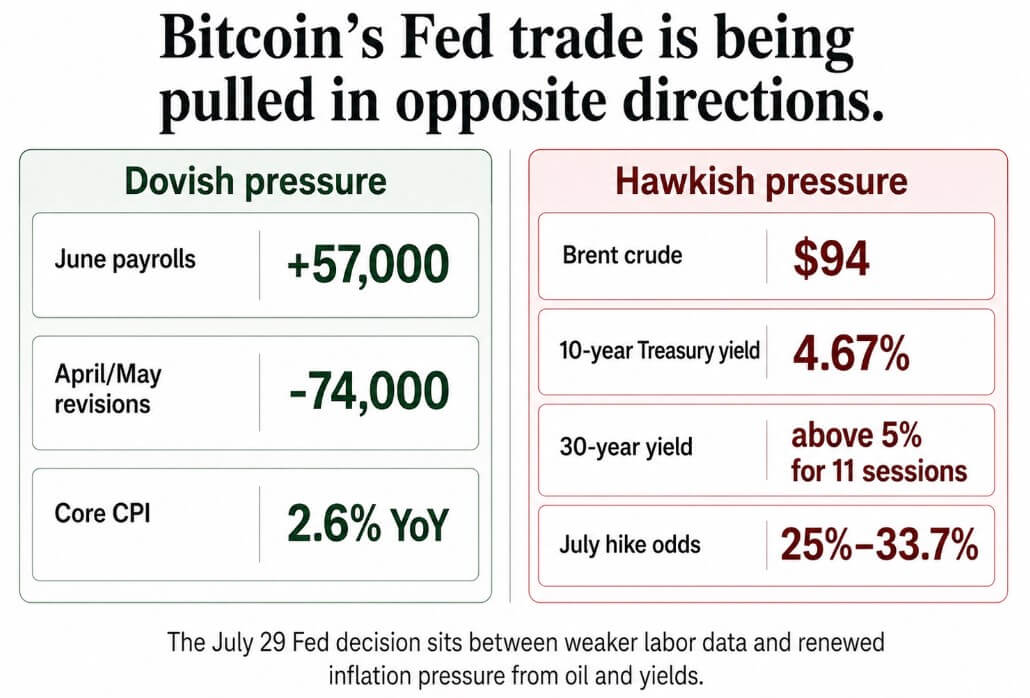
Glassnode on-chain data shows that Bitcoin is already pricing in an optimistic outcome that weak labor data and a new oil shock will converge on the same Fed decision.
Short positions were unwound, downside hedges collapsed, currency inflows fell to multi-week lows, and Bitcoin outperformed stocks through the oil crisis. The Spot Bitcoin ETF recorded six consecutive positive trades from July 14th to July 21st, adding approximately $930.2 million, reversing the $424.7 million outflow from July 13th.
According to Glassnode cohort data, wallets hold between 1,000 and 10,000 BTC, a range typical of funds and large trading desks and driving most of the recent accumulation. Mid-sized holders are diversifying again, with Glassnode’s aggregate market gauge still showing risk-off.
Current trading conditions remain in place as limited large buyers and new ETF demand continue to move higher based on the Fed’s unrealized pivot.
If the Fed disappoints, ETF buyers and the 1,000-10,000 BTC group currently holding the rebound will be the first to absorb the reversal, as widespread participation from small holders has not returned.
| signal | Current measurement value | Content | Meaning of the article |
|---|---|---|---|
| BTC spot price | ~$65,978 | below the cost basis of short-term holders | No rebound confirmed yet |
| Short-term holder cost basis | ~$69,000 | Recent buyers still need breakout confirmation | A key test for the Fed and pivot trades |
| demand shelf | ~$63,000 | About 10% of the supply is nearby. | Main downside audit zones |
| ETF flow | +$930.2 million in 6 positive sessions | Institutional bids are back | Supportive, but durability not yet proven |
| ETF flow on July 13th | -$424.7 million | The recent outflow shock has reversed. | It shows that the flow changes quickly. |
| Main accumulation cohort | 1,000-10,000 BTC wallet | Large holder that pulls rebound | rally remains narrow |
| medium holder | Redistributing | lack of broad participation | There is no limit to recovery |
| glassnode market compass | risk off | The complex regime has not been reversed. | Rally remains conditional |
Government bond yields have been capped
With the 10-year U.S. Treasury yield near 4.67% and the 10-year TIPS yield near 2.36%, both maintain high discount rates for risky assets, constraining bond yields below the $69,000 area.
The three-month Brent crude time spread widened to about $9.26, the steepest backwardation since May 22, suggesting traders expect near-term supply to remain tight.
This structure is typically accompanied by a tightening of cash markets, which impacts headline inflation expectations, the same input that pushed up the odds of a July rate hike this week.
Glassnode’s research currently positions Bitcoin as a liquid asset for the dollar, pointing out that its inverse relationship with the dollar is deepening. In its previous report, the company set the upper limit for the 10-year yield at around 4.45% and the upper limit for the dollar at around $99 as standard values for risk assets.
The 10-year bond yield is 4.67%, and the dollar index is around 101.14.
Setup until July 29th
In a bullish case, the Fed would hold interest rates steady and frame labor weakness as a key risk. Brent has cooled towards EIA’s July third-quarter forecast of $74, and the 10-year bond yield has fallen below the 4.45% ceiling that Glassnode warned was decisive.
ETF inflows persisted, FX inflows remained low, accumulation expanded beyond whale wallets, and Bitcoin broke above $69,000 and reached the $84,000 zone that Glassnode identifies as the next open range.
If it’s bearish, the Fed will hold interest rates steady, leaving room for a later hike if oil prices remain elevated. With Brent crude holding near $94 and the 30-year Treasury yield hovering above 5%, real yields keep non-yielding assets expensive to hold.
ETF inflows weaken or reverse, and currency inflows increase again, but $69,000 is rejected. Bitcoin will likely retest the $63,000 shelf, where about 10% of its supply resides.
| scenario | Fed/Crude Oil/Yield Trigger | On-chain confirmation | BTC zones to watch | meaning |
|---|---|---|---|---|
| blue case | The Fed is prioritizing labor weakness. Brent cools towards EIA’s Q3 forecast of $74. 10-year bond yield is below 4.45% | ETF inflows continue, FX inflows remain low, accumulation expands beyond whales | $69,000 → $84,000 | Bitcoin rebound becomes real liquidity trading |
| bear case | The Fed remains hawkish as oil prices remain near $94. The yield on the 30-year bond remains above 5%. Real yields continue to rise | ETF inflows decrease, foreign exchange inflows increase, whale-led accumulation does not expand | $69,000 Rejected → $63,000 | Rally looks like a tactical bet for the Fed and Pivot |
| Failure location | Bond markets reject dovish interpretation | $63,000 shelf breaks or absorbs large supply | Less than $63,000 | Institutional bid fails first major stress test |
EIA’s July outlook expects average Brent prices to reach $74 per barrel in the third quarter and $65 per barrel in 2027, $20 to $30 below current prices.
The IMF’s July update forecasts global growth of 3.0% in 2026, and that projection assumes the Strait of Hormuz reopens by mid-July and normalization by March 2027, with oil prices averaging around $89 a year, and the Brent assumption has already been violated.
The Fed’s July 29 decision will determine whether the ETF buyers and large wallets currently carrying Bitcoin’s rally represent a true rebound in institutional demand or a short-term bet on a dovish outcome, and the $69,000 recovery from broader participation confirms the initial reading.
If Bitcoin rejects $69,000 and falls toward the $63,000 shelf after shorts, hedges, and sellers have already been cleared out, on-chain data will show that bond markets are still pricing in inflation risk and subdued crypto-native demand.
The shelf, which holds about 10% of supply, will be audited by the market on July 29 to see whether new institutional bids are durable or just tactical bets.
(Tag translation) Bitcoin


