


Yield Basis incurred $12 million in fees in the first quarter as Bitcoin volatility drove trading activity. The protocol’s model shows how market fluctuations are translated into yields for liquidity providers.
Important points
- Yield Basis processed $1.1 billion in trading volume in Q1 2026 and generated $12 million in fees from volatility.
- Bitcoin volatility increased trading volume by $436 million in two weeks, proving that DeFi can monetize market turmoil.
- Yield-based TVL has reached $180 million as demand grows, hinting at a future fee-based DeFi model.
Market turmoil increases trading volume by $1.1 billion on a yield basis
Bitcoin’s rapid price fluctuations in early 2026 proved difficult for many investors, but for one DeFi protocol, volatility became a source of profit.
Yield Basis, a liquidity platform built on the Curve Finance infrastructure, reported first quarter trading volume of $1.1 billion and fees of over $12 million. The results provide a case study on how market disruption can be monetized rather than avoided.
The protocol is designed to capture trading activity during periods of price fluctuations, allowing liquidity providers to earn fees while maintaining exposure to assets such as Bitcoin and Ethereum. Unlike many DeFi platforms that rely on token incentives, Yield Basis generates revenue directly from trade flow.
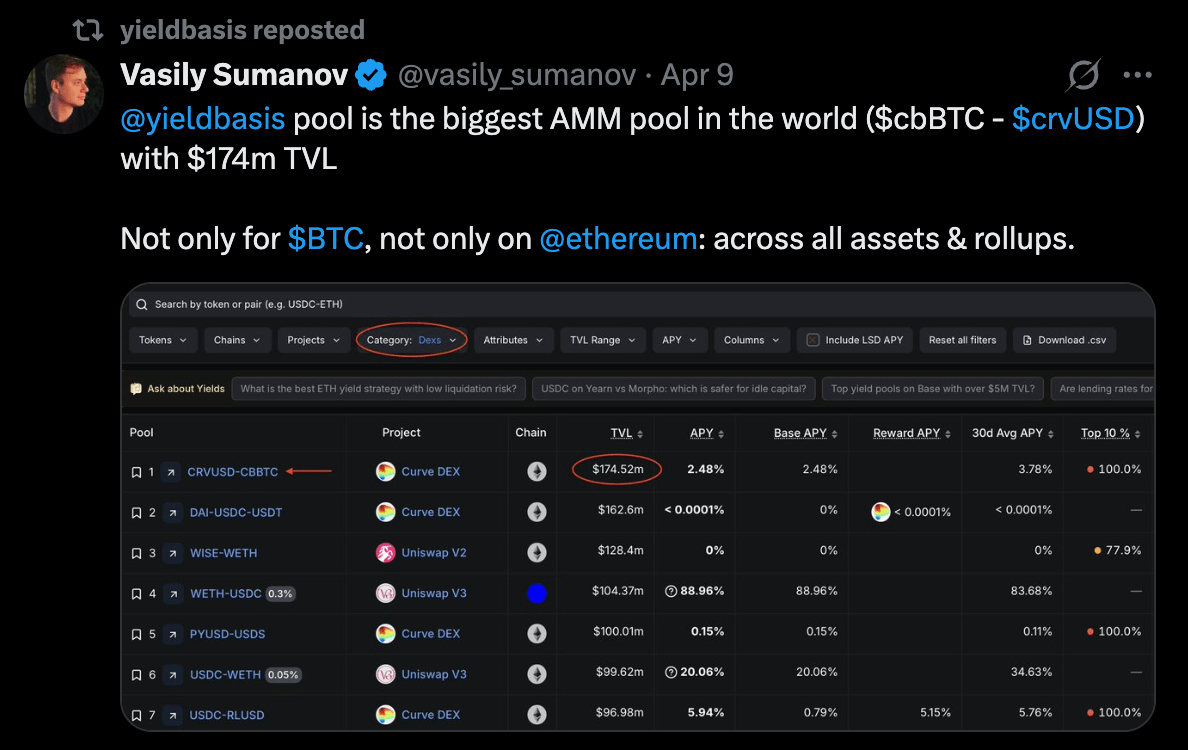
By the end of March, the platform had approximately $180 million in total value locked. Its largest pool, Bitcoin-denominated pairs, accounts for approximately $174 million of that total, making it one of the largest pools of its kind in decentralized finance.
Activity peaked during periods of heightened volatility. In the two weeks since January 28, when BTC plummeted and then rebounded quickly, the protocol processed approximately $436 million in trading volume. During that period, approximately $6 million in transaction fees were incurred.
The broader quarter followed a similar pattern. As prices fluctuated rapidly, traders changed positions, trading volumes increased, and commission accruals also increased. Approximately $1.2 million was distributed to token holders in February alone.
Curve Finance and Yield Basis founder Michael Egorov said the protocol was designed to address a structural gap in decentralized finance.
Yield Basis was created to solve a core inefficiency in DeFi: Bitcoin’s inability to generate sustainable yields due to inefficient liquidity provision due to impermanent losses (IL). By eliminating IL, Yield Basis removes this limitation and creates a model that allows liquidity providers to earn organic yield from trading activity.
Automated market makers and temporary losses
This model addresses a long-standing problem with automated market makers known as permanent losses, where liquidity providers can underperform during price fluctuations. By focusing on volatility-driven trading, Yield Basis aims to offset that risk with higher fee income.
User participation increased with activity. The amount of YB tokens locked in the protocol increased from 53 million to 89 million during the quarter, indicating a growing demand to earn fee-based revenue.
The platform has begun expanding its infrastructure to support further growth. The recently launched Hybrid Vault, designed to combine liquidity provision with crvUSD demand, attracted $4.54 million in deposits in its first week, including approximately $2 million in stablecoins.
The results highlight broader changes in decentralized finance. As the market matures, protocols are increasingly looking for ways to generate sustainable revenue beyond token issuance.


