


Bitcoin’s first recovery test is near $69,000. Its lower on-chain stress boundary lies further below, around $52,900.
According to Bitcoin market data from igcurrencynews, BTC is worth $64,672. A gain of approximately 6.69% is required to reach the recent purchaser cost base of around $69,000, while a decline to Glassnode’s stated realized price of $52,891.91 represents an 18.22% decline.
These levels define a two-sided test. A recent spot-driven rally in the buyer base would strengthen the case that Bitcoin has formed a higher low. If selling pressure accelerates again, a sustained decline below that would leave the floor of realized prices exposed.
Bottoming data has been improving since early July. Losses for long-term holders are starting to subside, with buyers absorbing June’s lows. Demand has not completed its signal yet, leaving Bitcoin between easing declines and an unconfirmed recovery.

Hallway between $69,000 and $52,900
Realized price is realized capital divided by circulating supply. Estimates the average price at which the existing Bitcoin supply last moved on-chain. If the spot exceeds the index, the total holder base will have unrealized gains, but if it falls below the index, the entire market will have a net unrealized loss.
At Glassnode, we describe the realized price as a natural bear market boundary. This level represents a structural risk rather than a mandatory destination or guaranteed floor.
The current corridor consists of moving thresholds that have changed dates.
| market level | Validated value and timestamp | Distance from spot and signal |
|---|---|---|
| true market average | $76,600, Glassnode report dated July 8th | 18.44% more than the actual price. Broader regime recovery threshold |
| short-term holder cost basis | Nearly $69,000, Glassnode report dated July 15th | Approximately 6.69% more than the actual price. Instant confirmation test |
| bitcoin spot | $64,672, igcurrencynews Updated July 19th 07:14 UTC | Current reference point |
| realized price | $52,891, the latest daily Glassnode reading was taken on July 19th and is labeled as approximately 24 hours old | 18.22% more than the actual price. lower bound of bear market stress boundary |
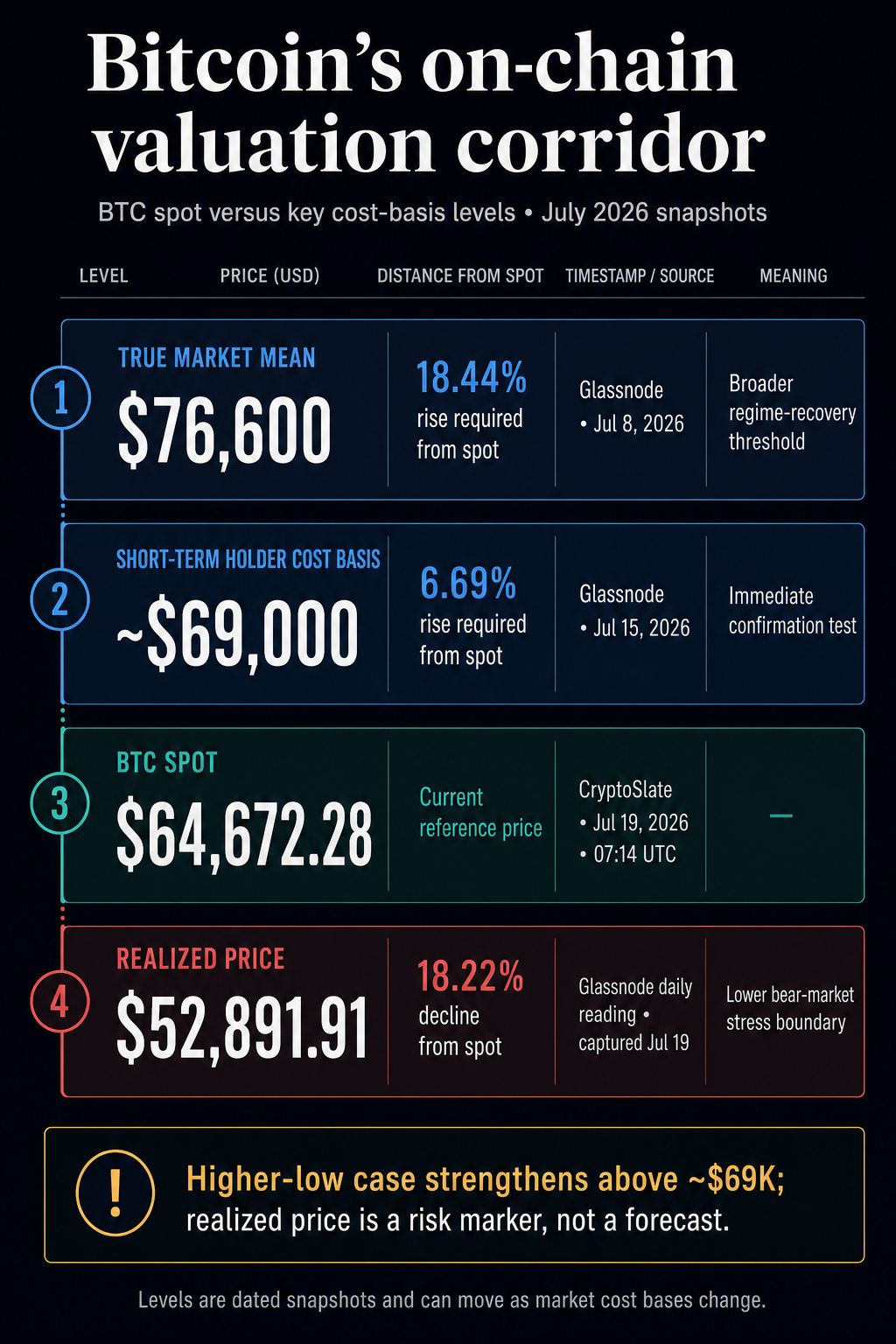
The cost-based metrics change as the coin changes hands. Glassnode’s July 8 analysis has a short-term holder cost basis of $72,200 and a true market average of $76,600, after nearly five months in which Bitcoin has underperformed both. The July 15 update brought recent buyers’ criteria closer to $69,000, making that floor line the immediate test.
Bitcoin is already trading below the average entry price for short-term holders. Further declines would put recently acquired supply under water, increasing the losses incurred by that cohort before prices approach the aggregate prevailing price boundary.
Older holders entered July under similar pressure. Glassnode found that as of July 8, realized losses for long-term holders accounted for 43% of total realized value. The company’s individually adjusted long-term holder realized loss measure recently hit nearly $280 million per day, the highest level since December 2022.
So sliding towards $52,900 will test two groups in turn. Recent buyers will likely deepen their losses first. A broader holder base will only approach total breakeven near the realized price. The outcome will depend on whether buyers who absorbed June’s lows return or allow loss realization to accelerate again.

Surrender cooled before demand recovered
Glassnode’s July 15th update changes the tone of the bottoming process.
For the first time, the entity-adjusted realized loss series for long-term holders has declined from its cycle peak. Loss pressure among long-term holders was losing momentum after supplying much of the market’s early selling.
Buyers of various wallet sizes also absorbed June’s lows. Coins sold during the decline found demand and gave the market a basis above realized prices.
One turn lower realized loss cannot establish exhaustion by itself. A new shock could restart the series, and the strength of the accumulation faded after prices stabilized. The evidence points to a tentative stabilization rather than a complete bottom.

Institutional demand and spot demand remain to be confirmed. According to Glassnode Market Pulse dated July 13, the US Spot Bitcoin ETF has returned to net inflows. In its weekly report two days later, it said redemptions had slowed but inflows had not yet returned and sustained.
The reports cover various dates and measurement periods. Reading these together shows that the individual inflow sessions had not yet turned into sustained institutional bids.
The same message was delivered in Spot activities. Glassnode reported that trading volumes contracted and spot cumulative volume delta turned negative during the recovery. Prices improved without widespread purchasing power taking the lead.
This sequence is similar to a market where sellers are exhausted before buyers fully arrive. This is enough to allow for higher lows, but the transition still requires price and demand confirmation.
What supports higher lows?
The first signal is a sustained recovery in the cost basis for short-term holders around $69,000.
A short-term move above the line will be less significant than spot-driven purchases that keep Bitcoin higher than the average entry of recent buyers. Such a move would turn an overhead source into potential support and significantly weaken the near-term downside scenario.
The broader benchmark is the July 8th true market average of $76,600, which is 18.44% above the July 19th spot snapshot. A sustained recovery would see Bitcoin surpass the broader active market cost threshold, undermining the argument that Bitcoin remains trapped in a deep bear market.
Prices will be strongest when long-term holder losses continue to cool, combined with ETF inflows sustaining beyond the isolated session. Taken together, these signals indicate that easing supply pressure has given way to durable demand.
The downside path also remains conditional. Recent rejections below the buyer base, a renewed acceleration in long-term holder losses, waning accumulation, and institutional demand that has failed to stabilize will keep $52,891.91 relevant as a lower stress marker.
Bitcoin may reach a bottom above the realized price. July data provides evidence of that possibility, but spot demand still needs to push the market back on a recent buyer cost basis.
Until then, the 18.22% difference below remains a measurable risk rather than a prediction.
(Tag translation) Bitcoin


