

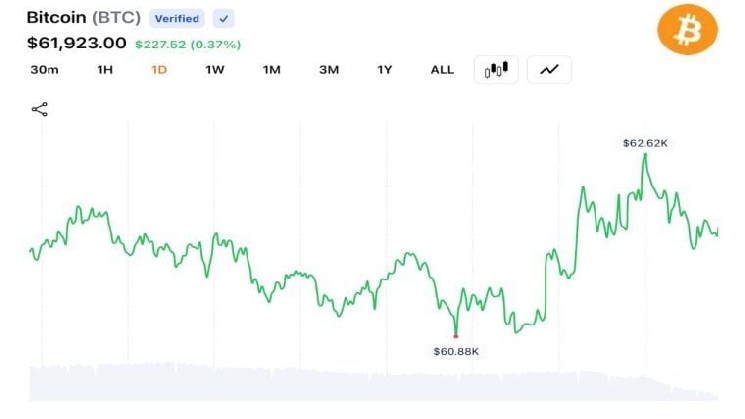
Bitcoin regained the $62,000 threshold on Wednesday, recovering from an intraday drop to $60,679 and pushing the overall crypto market valuation to $2.21 trillion.
Important points:
- Bitcoin bounced back to $62,000 on Wednesday, shaking off a brief drop below $61,000 after the overnight US-Iran fires.
- The BLS reported that the headline CPI reached 4.2% in May, reducing investor appetite for speculative digital assets.
- The unresolved conflict in the Middle East has raised concerns that the Federal Reserve, led by Kevin Warsh, will raise interest rates on June 17th.
Middle East conflict intensifies after helicopter shot down
Bitcoin on Wednesday appeared to ignore overnight military exchanges between the US and Iranian militaries, briefly falling below $61,000 before regaining the $62,000 level in just a few hours. According to market data, the cryptocurrency had been steadily declining before plummeting to an intraday low of $60,679.
Shortly after, Bitcoin began to rise, rising above $62,000 by 9:39 a.m. ET, erasing earlier losses. Less than two hours later, another wave of buying pushed the price to just under $62,800, and then most of that gain was erased. As of 1:15 p.m. ET, Bitcoin was trading just above $62,000, up 0.5% on the day.
The rally boosted Bitcoin’s market capitalization to $1.24 trillion, pushing the value of the broader cryptocurrency market to $2.21 trillion. The sideways trade also liquidated nearly $94 million in leveraged Bitcoin positions in 24 hours, with short positions accounting for $61 million and long positions accounting for the remainder.
The sudden volatility in the market came on the heels of a sharp deterioration in the situation in the Middle East after US President Donald Trump announced that he would attack Iran in retaliation for the reported downing of an American Apache attack helicopter. US Central Command then turned rhetoric into action, admitting that it had launched targeted attacks against several military targets in Iran. The Iranian government quickly counterattacked, targeting U.S. military facilities across the region.
The fierce gunfight lasted several hours and disrupted global markets, but stopped short of derailing ongoing peace talks. However, President Trump’s subsequent postings on Truth Social warned of further attacks, raising concerns that the two countries were headed for a broader conflict.
A new wave of macro anxiety has hit the crypto market following the latest US inflation report, coupled with further geopolitical influences from the Middle East. The U.S. Bureau of Labor Statistics reported that headline consumer price index (CPI) inflation rose to 4.2% in May, with persistent energy shortages pushing up nearly 60% of the monthly increase. Even though the headline indicators were simply in line with market expectations, the real story emerged in the structural gap between headline inflation and core CPI (2.9%). The widening chasm highlights how deep and isolated the supply-side energy shock is, rattling risk-off assets like Bitcoin.
This latest inflation shock was a baptism of fire for newly installed Fed Chairman Kevin Warsh, shifting pressure on the Fed just days before its June 17 policy meeting. With consumer prices remaining high, the possibility of a June interest rate cut has completely disappeared. Rather, the continued economic tensions and apparent lack of a diplomatic breakthrough from the U.S.-Iranian conflict have created new volatility in monetary policy forecasts, rekindling talk of a once-unthinkable interest rate hike on the horizon.
For investors, a prolonged period of rising interest rates will make traditional risk-free yields more attractive, while weakening the appetite for speculative rotation into digital assets. As a result, this restrictive financial backdrop will cast a long shadow over crypto performance trajectories for the rest of 2026, tempering earlier bullish forecasts.


