

Bitcoin signatures rely on elliptic curve cryptography, a system where a private key generates a public key through mathematics that is performed in only one direction. Anyone can see the public key, but no one can trace it back to the private key. But Scholl’s algorithm is a quantum method published in 1994 for problems that regular computers can’t crack, and when you enter a public key, it returns the private key that generated it.
Hashing is a different kind of problem. Hashing scrambles the input into a fixed-length fingerprint and cannot be performed in reverse. The best quantum attack on it, called Grover’s algorithm, simply halves the exponent instead of folding it, obtaining a 256-bit hash from a guess of 2^256 to 2^128.
This is still more than a machine producing a billion per second could conceivably achieve within the lifetime of the universe.
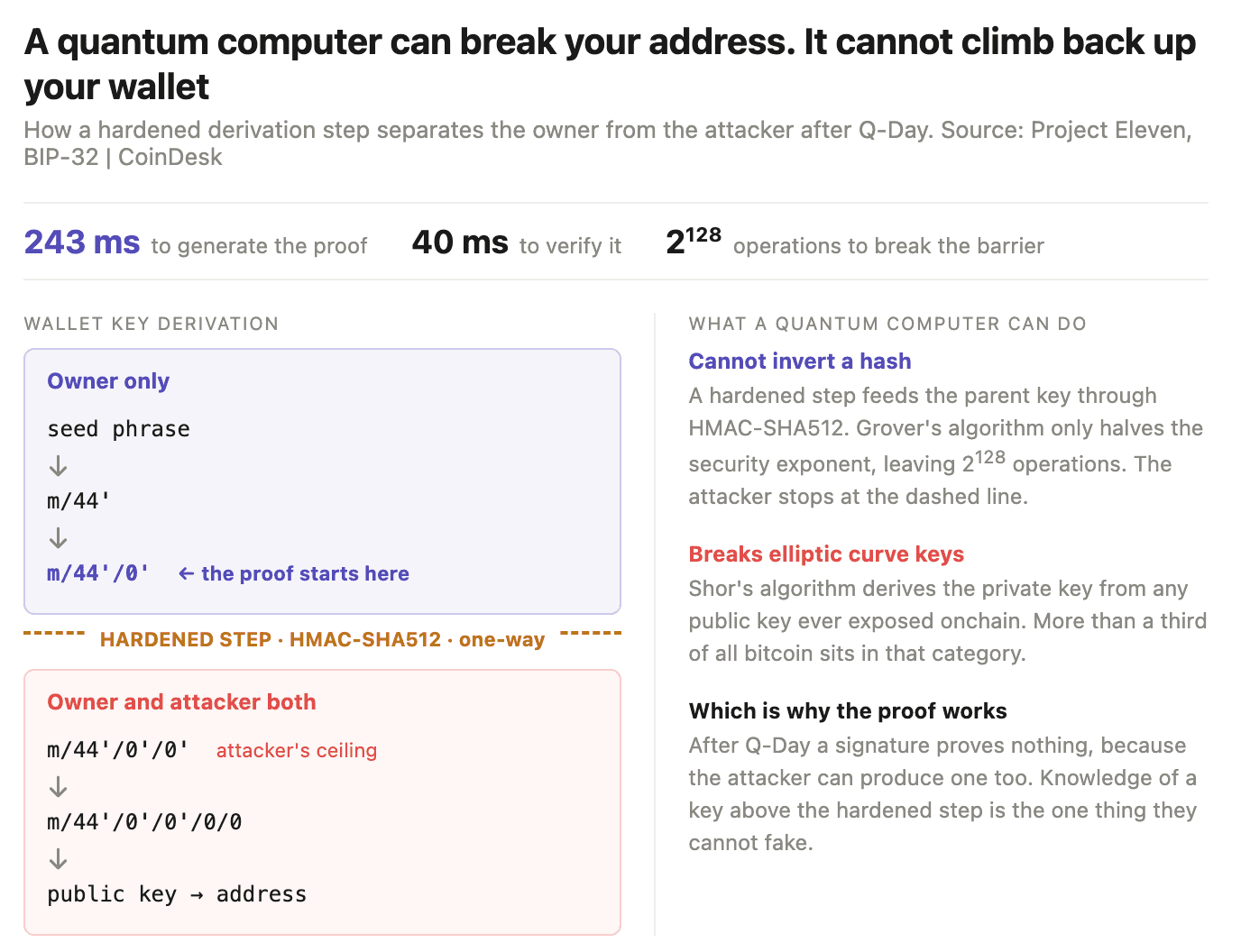
Modern wallets are built on hashing. The wallet generates addresses in the tree and derives each key from its parent. The “enhanced” derivation step feeds the parent’s private key through HMAC-SHA512 to generate the child key.
It’s a one-way function. An attacker who breaches the address after Q-Day will be left with the key they held and will not be able to climb the tree to the original key.


