




Bitcoin regains $715,000, breaks through old ATH band, now market needs to prove it can stay there
Bitcoin did over the past 24-48 hours what the market has repeatedly failed to do throughout the first half of this year. It broke through the $71,500 ceiling, regained $72,000, and then began trading within the old $73,500 to $73,800 resistance pocket.
According to the latest 30-minute data, Bitcoin traded around $74,485 after hitting an intraday high near $74,947. This pushed the market up about 5.2% in 24 hours and 4.1% in 48 hours, widening the short-term range from about $70,685 to $74,947 from the previous day.
Market capitalization $1.49 trillion
24 hour volume $37.65 billion
Best ever $126,198.07
That sequence fits my channel work, which has been framing the structure of Bitcoin since 2024.

In my original article, the Bitcoin channel prediction was consistent with market movements over a 6-month period, and the argument was straightforward. Bitcoin tends to respect recurring horizontal zones as areas of negotiation rather than isolated price tags.
A break above the all-time high of $73,700 could be a new resistance level to watch, with the next ladder being pre-mapped, with the market expected to face resistance near $77,056 and $78,959 once it enters price discovery above the previous high.
My subsequent job was back on the same ladder from the opposite direction. Bitcoin’s seven failures to break above $71,500 is far more ominous than the boring sideways action that treats $71,500 as a pressure point, while the next move in Bitcoin’s price could be $92,000 or $79,000? Let’s break down the areas first at $71,500, then at $72,000, and then from $73,500 to $73,800 on the same upward ladder.
The latest move has brought the price to its full stack.
Changes in the short-term structure are clear. The market still needs to show that it can accept levels above previous highs, but the focus has changed. The key question is whether Bitcoin can use $73,518 and $73,764 as support. Because this pair indicates the lower and upper ends of the direct channel where the price is about to exist.
If this region holds, the next major test lies at $77,056, with $78,959 above it. If the market were to break back out of that band, $72,017 and $71,523 would return as the first lower shelves that would need to absorb the pullback. Below that, the old support channels of $67,995 and $66,894 reappear.
That’s the framework the market has given us. Bitcoin has climbed the exact resistance ladder that shaped our previous analysis.
The short-term challenge is no longer about getting the $71,500 back. Whether the market can stay above the old ceiling long enough to convert into a breakout base could determine whether the market has bottomed out or whether more pain is in store.
Repeated resistance turned into a test of support
Short-term charts show the clearest part of the movement. Bitcoin faced resistance early on, failed, retreated, and tried again. That’s why the $71,500 cap became so important in February and March.
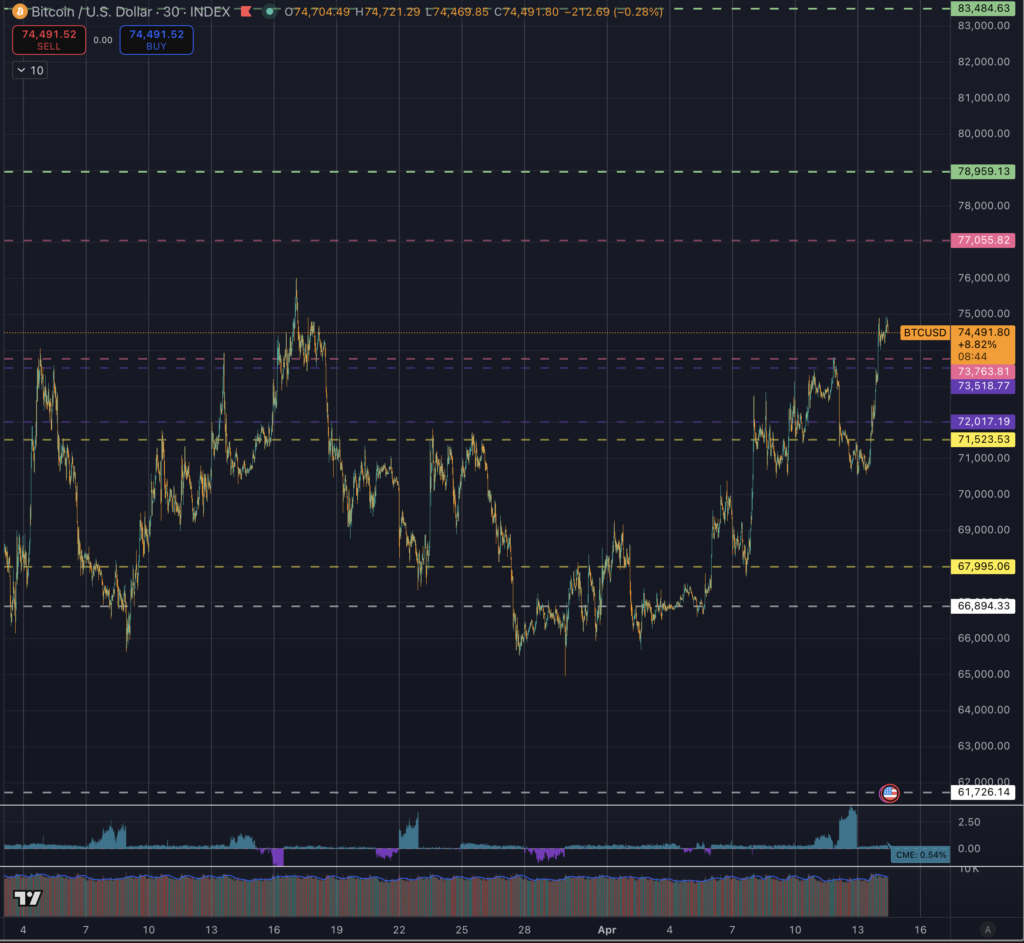
This level was the upper bound for a possible market rebound, but the follow-through could not be secured. With each failure, the pressure on the lower support increased, especially as momentum started to fade with each retest.
The market had enough buying interest to continue, but confidence remained too low to generate sustained expansion.
These actions are why the current push deserves to be treated as a structural change rather than an everyday Green Day.
Prices hovered from the low $70,000s, broke through $71,523, regained $72,017, and then began trading above the $73,518 to $73,764 zone that previously served as the upper resistance.
This order is important because the market often reveals its intentions through the order in which you complete levels.
Bitcoin did not suddenly jump out into the open space. Instead, it passed through the same ladder that had previously held it back. Each successful recall eased the burden on the next level and increased the likelihood that the market would at least explore the next channel higher.
The current structure can be organized in layers. The first layer is a repurposed support band that costs $73,518 to $73,764. This is the zone that should hold during short-term retracements. The second layer is $72,017, then $71,523.
These are the first supports that define successful resets and failed breakouts. This move remains constructive even as Bitcoin loses its upper band, falls to $72,000, and then rebuilds. If the price breaks below $71,500 and begins trading below it again, the breakout situation will become increasingly vulnerable.
The upside is equally obvious. Above the current range, the next channel high would be $77,056, followed by $78,959. These are the next historical resistance bands identified through the same framework that mapped previous all-time high areas. That’s why the rise to the mid-$74,000s carries more weight than a simple percentage increase.
Bitcoin is currently negotiating within a zone that once rejected its price. If buyers can keep the market above the old ceiling, a path to $77,000 and into the high $78,000s is the next logical development.
This is also where the broader cycle work matches the short-term chart. “It would be foolish to pretend this year’s $79,000 isn’t part of the Bitcoin story” The case was that $79,000 remained part of a reasonable operating range even after Bitcoin secured a position above its previous high. This view is based on the idea that when one channel is lost, the market typically seeks the next one. The current setup puts that logic on the table again.
Bitcoin has not yet reached $77,056 and has yet to test $78,959, but it has created the foundation that will eventually make those levels meaningful again.
Oil, Inflation, and Stocks Still Shape Bitcoin’s Short-Term Range
Bitcoin’s breakout attempt is occurring within a broader macro environment that remains highly sensitive to energy prices and risk appetite.
This context helps explain why a combined view of Bitcoin, S&P 500, and oil has been useful over the past few sessions. Bitcoin’s rise has developed in tandem with strong stock prices and a rebound in oil prices after the recent spike in oil prices. The three charts are going through the same macro sequence, even though their representations are different.
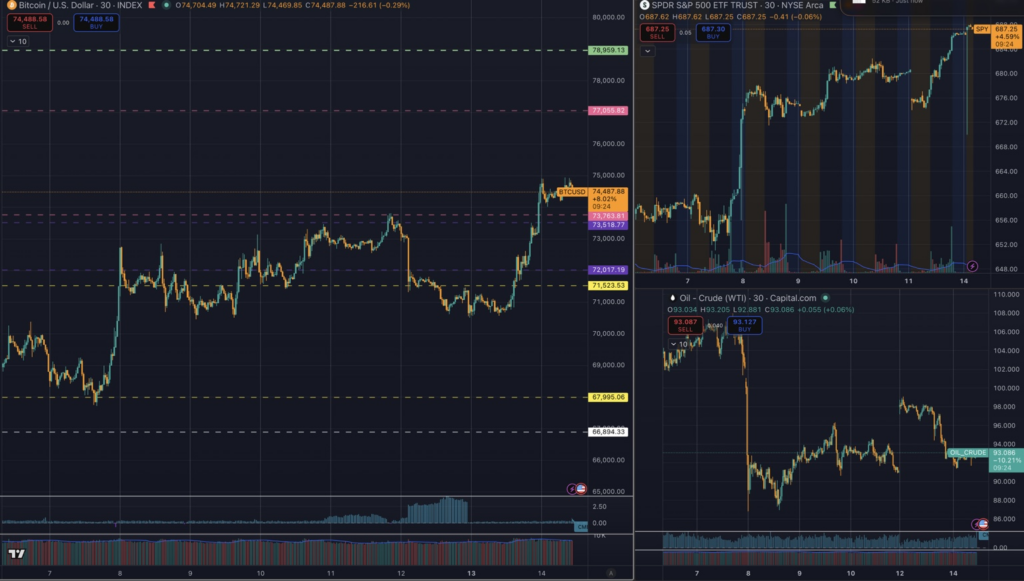
Macro progression is fairly straightforward. Oil prices soared after the U.S. announced it would block Iranian ports, and traders reacted to renewed pressure around the Strait of Hormuz. The move pushed Brent above $100, according to the Guardian, but prices have since fallen as diplomacy resumed.
At the same time, March’s inflation data showed how quickly energy is pumped throughout the economy. US CPI rose 3.3% year over year, but core results were weaker than most expected, with core CPI up 0.2% month over month and 2.6% annualized.

This combination created a mixed but tradable background for risk assets. Headline inflation remained high due to energy, but core inflation gave the market room to argue that the shock was not yet spread evenly across the underlying data.
The stock market also reacted accordingly. With oil prices pulling back from their highs, risk sentiment has improved, giving Bitcoin room to rally in the broader market rather than trading as a separate crypto event.
recent crypto slate Analysis of April’s historic rally had already framed the environment as a bailout rebound related to easing geopolitical pressures, but the improvement was still tentative at the start of the month.
That’s why Bitcoin’s latest movements should be viewed both technically and macro-wise. The technical aspect is clear by looking at how the price moved through the channel ladder. The macro aspect becomes visible in timing. Oil softened, stocks regained their footing, and Bitcoin reacted as a high-beta risk asset with strong internals.
This creates a balanced setup rather than a unilateral decision. Even on a constructive chart, Bitcoin could lose altitude if oil prices rise again and broad risk appetite weakens. If oil prices remain subdued and stock prices remain strong, Bitcoin has room to continue testing the top of its current channel map.
There is another reason why this background is especially important for Bitcoin. The asset has behaved for much of 2026 like a market that wants to rally whenever macro pressures ease, but it also showed that it could be pushed back into a downward channel if the external environment tightens.
In my November 2025 article, will the next move in Bitcoin price be $92,000 or $79,000? Let’s analyze it. The key idea was that Bitcoin tends to move between a ladder of scenarios rather than a smooth trend.
The same logic applies today. The macros form the ladder that the market has access to, and the channels define where the price is likely to negotiate once it gets there.
Acceptances above $73,500 to $73,800 will keep $77,000 and $79,000 in sight.
Bitcoin has already accomplished the first part of the job of breaking through the old ceiling and pocketing its former all-time high. The next part is less dramatic, but far more important for traders trying to understand whether there is any depth to this move.
Prices must continue to function above $73,518 and $73,764. That range is due to the previous resistance level starting to act as support. Typically, a market that sustains above the front cap invites the next wave of buyers. Markets that fall quickly after a breakout often revert to a more defensive posture.
This leaves $77,056 as the next obvious upside checkpoint. This is the next major channel on the chart and sits just below the broader upper band towards $78,959. These are the levels likely to appear in the next supply test.
If Bitcoin reaches them soon, the market will cover an incredible amount of territory in a short period of time. If it approaches more slowly while repeatedly holding onto the newly regained support, that would probably be a healthier pattern.
A market that builds a ledge below resistance typically has more room to continue than one that sprints from one ceiling to the next without pausing.
The lower threshold is equally clear. A pullback to $72,017 would qualify as a constructive reset, especially if buyers appear there. A deeper move towards $71,523 will bring focus back to the old front and force the market to prove that the breakout is more than a temporary overshoot.
Below that, the framework becomes less forgiving, returning stronger downside support at $67,995 and $66,894, which defined the early stages of the range.
Bitcoin has moved from collection mode to acceptance mode. The breakout has shape, the channel framework remains intact, and the broader macro environment has changed enough to oxygenate the move.
The next threshold is around $77,056, followed by $78,959. The important tasks between here and there are simple. The idea is to hold the old resistance pocket and continue to prove that $73.5k to $73.8k will be the new lower bound. If Bitcoin can do that, the path to $77,000 and then $79,000 remains open.
If it fails to do so, the market will quickly revert back to its previous ladder and traders will be forced to reevaluate whether this was a genuine expansion or if it just broke through resistance again and exploded in the short term.
(Tag translation) Bitcoin


