

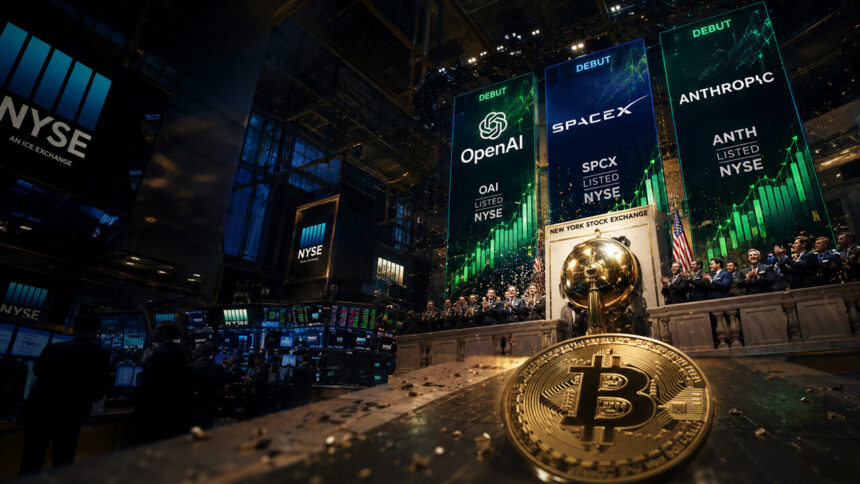
OpenAI has filed a confidential S-1 with the SEC and aims to make its public debut as early as September at a valuation of $852 billion to $1 trillion.
The filing arrives amid broader waves that Goldman Sachs said could generate a record $160 billion in U.S. IPO proceeds in 2026, SpaceX aims to raise $75 billion at a $1.75 trillion valuation, and Anthropic filed confidentially after a $965 billion funding round in late May.
Combined pipeline demand from SpaceX, OpenAI, and Anthropic already exceeds the overall U.S. IPO market by up to 4x in 2025, with rotation into AI visible in the flow data.
For Bitcoin, the IPO wave is a liquidity test, and the same capital that decides between SpaceX and OpenAI is the same capital that drove the ETF inflow cycle that took BTC to $126,000.
| IPO/market signals | Size/rating | Why is it important for BTC? |
|---|---|---|
| Goldman’s 2026 US IPO predictions | $160 billion in revenue | Potential record IPO supply |
| SpaceX IPO target | $75 billion raised / $1.75 trillion valuation | A single listing could rival the entire annual IPO market |
| OpenAI scope | Valuation between $852 billion and $1 trillion | Direct exposure to AI becomes publicly investable |
| human evaluation | $965 million | Added new Megacap AI destinations |
| Spot BTC ETF outflow | 1.7 billion in the first week of June. Past consecutive sales of $4.4 billion | Indicates that BTC capital has already flown out |
rotation is already included in the data
AI and semiconductor stocks have risen about 170% over the past year, while Bitcoin has fallen about 40% over the same period.
On June 3, the Philadelphia Semiconductor Index rose about 5.9%, while Bitcoin fell about 4% that day. This was a day-to-day split that directly demonstrated institutional investor rotation into AI and semiconductors as cryptocurrencies weakened.
The U.S.-traded Spot Bitcoin ETF lost more than $1.7 billion in the first week of June, adding to its previous $4.4 billion exit in 13 consecutive trading sessions.
A standout day was May 28, when BlackRock’s IBIT had the second-highest daily withdrawals in the fund’s history at approximately $528 million. Flow analysis pointed to intensive institutional rebalancing, with allocators moving money into AI and semiconductor stocks, which were hitting new highs at the same time.
If the outflow reflects a deliberate reallocation by institutional desks, the mega-IPO calendar gives those same desks a concrete destination for funds that previously went to Bitcoin ETFs.
Once Pure AI Labs is open to the public, the proxy demand previously met by institutions through Nvidia, Microsoft, and Alphabet will be incorporated directly into the new list.
Bitcoin has garnered institutional allocation as the most liquid high-beta vehicle for speculative exposure, and multi-trillion dollar AI listings within traditional brokerage accounts now offer the same profile with quarterly returns.
animal spirits are contagious
A mega-IPO of the size Goldman Sachs is predicting would require a receptive stock market, strong retail appetite and demand for growth from institutional investors.
The markets that are poised to absorb SpaceX’s $75 billion and OpenAI’s $1 trillion operate with high risk tolerances, and Bitcoin is increasingly being traded as a risky asset that moves with those tolerances.
Bitcoin’s correlation with the Nasdaq 100 and S&P 500 has strengthened through institutional milestones such as the Spot Bitcoin ETF and the strategy’s inclusion in the Nasdaq 100, peaking at 0.87 in 2024.
If SpaceX’s pricing is positive, OpenAI’s roadshow confirms institutional investor appetite, Anthropic’s October target maintenance is confirmed, and the IPO window opens cleanly, the resulting risk-on backdrop could push Bitcoin ETF flows back into positive territory alongside equities.
Glassnode’s 14-day moving average of ETF flows has bottomed near the local Bitcoin low, and sustained ETF selling often coincides with a turning point.
If this pattern holds, the current round of outflows centered on institutional rebalancing may already be nearing exhaustion of selling pressure, and a successful IPO cycle could be the macro catalyst to reverse it.
There is an estimated $8 trillion sitting in U.S. money market funds, and the $75 billion raised by SpaceX represents about 1% of that pool.
At that size, a wave of IPOs could tap into a liquidity reservoir large enough to fund both asset classes simultaneously.
| path | transmission chain | BTC results |
|---|---|---|
| Bullish: Animal spirit spreads | AI IPO prices are strong → NASDAQ/Growth-oriented → ETF buyers return → BTC regains high-beta role | BTC benefits from new risk appetite. $75,000-$79,000 recovery trend becomes reality |
| Bearish: AI takes away trades | OpenAI/SpaceX/Anthropic absorbs speculative capital → Financial institutions prefer exposure to AI stocks → BTC ETFs continue to bleed | BTC loses its role as default high-beta liquidity proxy |
| Shared risk: Fed pressure | Interest rate rise or Fed rebound → AI valuation compresses → Risk assets are sold all at once | BTC and AI both have problems as high duration/high beta assets |

Bitcoin loses its high beta role
If institutional allocators treat rebalancing away from BTC as a permanent portfolio shift, the damage will mount even in the absence of further price collapse.
AI megacaps have delivered record results in recent quarters, turning their AI ramp-up into a tangible cash flow story. Bitcoin bull phases consist of another engine that runs based on liquidity, narrative, ETF-driven structural demand, and shuts down when the tide reverses.
OpenAI spends $1.22 for every dollar of revenue and is still targeting a $1 trillion valuation. That means the IPO wave itself is a speculative bet on the product, its 50 million consumer subscribers, and its $25 billion annual corporate profit margin.
Bitcoin offers a scarcity argument, but when revenue-driven momentum grows at 170% per year within the same risk tier, the scarcity narrative loses ground.
While Bitcoin ETF outflows continued, Nvidia rose 6% and semiconductor stocks hit new highs, suggesting the decline was driven by crypto-specific factors and AI rotation.
An interest rate shock that reprices AI’s IPO valuations is likely to hit Bitcoin along with the technology. The same correlation that amplifies upside in risk-on conditions also accelerates drawdowns when sentiment reverses.
Goldman Sachs warned that volatility and exposure to software stocks remain key risks for its $160 billion IPO forecast, and continued repricing of the AI listing will remove the risk-on backdrop needed for Bitcoin’s recovery.
The impact of the IPO wave on Bitcoin will depend on whether Bitcoin ETF flows turn net positive while IPO demand increases, whether Nasdaq’s strength extends beyond the AI leader to the broader market, and whether Bitcoin’s The answer will be whether the 30-day moving average near $5,685 and 200-day moving average near $78,840 are regained, and whether the Fed’s interest rate stance remains stable enough to prevent stock supply at AI’s overvalued valuation. Avoid triggering widespread risk aversion.
| Indicators to watch | BTC bullish signal | BTC bearish signal |
|---|---|---|
| Bitcoin ETF flow | Sustained net inflows return while IPO demand rises | ETF outflows continue despite AI IPO enthusiasm |
| nasdaq width | Rally extends beyond AI leaders | Profits remain concentrated in semis and AI megacaps |
| BTC technology level | The 30-day moving average has recovered to around $75,685 and the 200-day moving average has recovered to around $78,840. | Fails below trend level and retests $60,000 |
| Fed/interest rate | Stable yields support risk assets | Interest rate shocks will reprice AI and cryptocurrencies |
| prediction market | Kalsi’s $100,000 odds up from 21% | Under $50,000 / Under $55,000 Odds Continue to Rise |
Goldman Sachs expects U.S. IPO proceeds to reach a record $160 billion in 2026, with big-name companies such as SpaceX, OpenAI and Anthropic going public.
That condition depends on whether market conditions remain receptive into the second half of the year, and with Bitcoin already down 33% and ETFs in net outflows for the year, Kalsi only estimates a 21% chance of BTC exceeding $100,000 by January 2027.
(Tag translation) Bitcoin


