

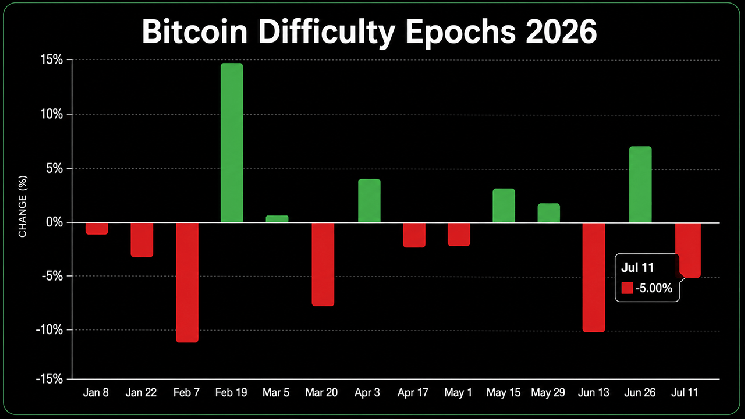
The adjustment reached block height 957600. The difficulty went from 133.87 trillion to 127.17 trillion, a decrease of about 6.7 trillion. Based on the block timestamp, the change took effect at 4:09:11 p.m. The previous epoch took approximately 14 days, 18 hours and 9 minutes. BitcoinThe 14-day goal is 2,016 blocks. At this pace, the average block time would be 10 minutes and 32 seconds, approximately 5.1% slower than the protocol’s goal of 10 minutes. The 5% reduction moved the network back toward that goal.
A year defined by large fluctuations
Of the 14 difficulty adjustments made through 2026, 8 were negative and 6 were positive. The average adjusted value was -0.87%, while the average absolute value was 5.30%. This difference indicates a violent back-and-forth movement hidden behind the seemingly calm average value. Difficulties that occurred before the first correction on January 8 caused the network to decline approximately 14.22%. The July 11 measurement is the third lowest of the year, after June 13 at 124.93 trillion and February 7 at 125.86 trillion.
Hashrate falls towards 2026 range
7 day average hash rate via hashrateindex.com was around 908 EH/s on July 11, down about 14.8% from the January 1 level of about 1,065 EH/s. This figure is about 21.3% below the one-year peak of 1,154EH/s recorded in October 2025, and only 3.3% above the 2026 low of 879EH/s recorded in early February.
The recent decline occurred quickly. hash rate On July 1st, it was around 986 EH/s, but by July 11th it had dropped to about 908 EH/s, a decline of about 7.9% in 10 days. This setback slowed block production, which was directly reflected in a 5% reduction in difficulty.
Although hash price rises, large discounts continue
Hashprice, the revenue miners are expected to earn per petahash per second, closed at around $31.1 on July 11th. While this represents a recovery of about 12.5% from the $27.6 level seen around July 1, the index remains down about 16.4% since January 1 and about 37.2% below the one-year high of $49.4 recorded in late October 2025. $27.2 appeared in early June.
Relationship between difficulty, hash rate, and hash price
Difficulty is a measure of delay. don’t track hash rate Directly, but it reacts to how fast the previous 2,016 blocks were mined. when hash rate falling, blocking will be slower and the difficulty will be lowered with the next adjustment. Lower difficulty increases the expected return for each unit of hashing power you run, potentially increasing the hash price if: BitcoinThe price and fee income are stable.
The period from June to July shows that the mechanism is at work. Hash price bottomed out around $27.2 in early June. On June 13th, the difficulty level decreased by 10.09%. The hashrate has since returned, and on June 26th, the difficulty increased by 7.15%. The hashrate weakened again, with difficulty dropping another 5% on July 11th and the hashprice ended the period at $31.1.
All three indicators follow a pattern of peaks becoming lower in 2026. The difficulty level peaked at 146.47 trillion on January 8, but has not reached that level since then, peaking at 138.97 trillion in April and around 133.87 trillion in June. Hash price peaked at $49.4 in October 2025, followed by $41.8 in January and $39 in May. The hashrate peaked at 1,154 EH/s in October 2025, 1,087 EH/s in late February, and has struggled to maintain 1,000 EH/s since then.
What it means for miners and traders
Each recovery in hashrate and hashprice is below the previous recovery. Although the difficulty reduction softened the blow for miners still operating, it was not enough to bring hash prices back to previous levels. For traders, this pattern suggests that the mining sector is adapting to narrower margins rather than one sustained decline. Effective computing power repeatedly returned to the range of approximately 880 to 910 EH/s before rebounding, but it remains unclear whether that range represents a durable lower bound or if it stops on the way below.


