


Currently, FUD in the market appears to be testing investors’ patience.
From a technical perspective, major high-value assets fell below key psychological levels, with more than $100 billion disappearing from the market within 72 hours. Bitcoin ($BTC) is also below the $80,000 level, and traders are closely monitoring the next directional move as macro FUD widens.
Against this backdrop, the Federal Reserve plans to inject $26.3 billion into the financial system, starting with a $6.5 billion liquidity operation on May 18th. Historically, liquidity injections of this size have tended to support risky assets. The logic is simple. As liquidity increases in risk-off conditions, markets tend to stabilize as capital gradually moves back into high-risk trades.
However, this cycle appears to be structurally different.
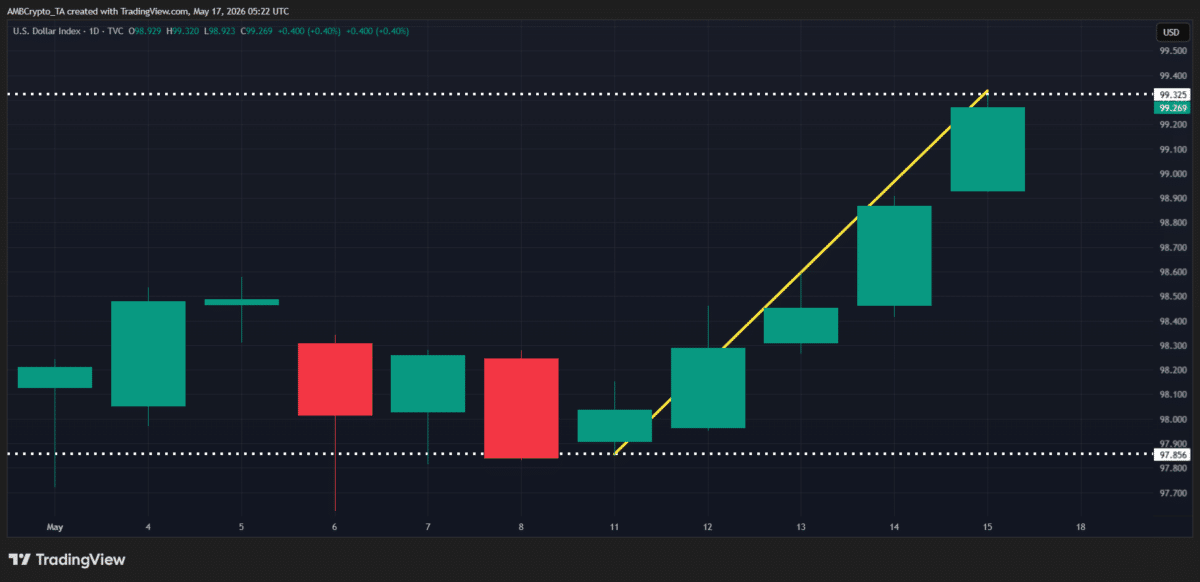
On the macroscopic side, these injections are reaching an unusually unstable environment. The U.S. dollar index (DXY) continued to rise, rising for the fifth day in a row and gaining about 1.5% for the week after April’s inflation rate hit 3.8%. At the same time, U.S. Treasury yields are rising, making traditional yield-producing assets (bonds) more attractive as investors take a defensive stance against volatility.
In this environment, additional liquidity could end up supporting the dollar rather than risky assets. Historically, capital inflows into Bitcoin have slowed during periods of strong dollar strength. As a result, rather than fueling $BTCThese liquidity injections could increase near-term market volatility, especially as the market begins to price in the possibility of a $60,000 retest.
Bitcoin liquidity injection or liquidity trap?
At the micro level, incoming liquidity is already encountering a volatile Bitcoin structure.
On-chain data reflects this uncertainty through stablecoin activity on Binance. Analysts noted that stablecoin net inflows surged to more than $1.5 billion on May 14, suggesting a temporary liquidity influx. However, the overall trends remain mixed. Transactions so far have been dominated by outflows, with about $1.3 billion recorded on May 12 alone.
Looking deeper, the way liquidity is circulating across markets suggests increased risk rather than stability. As the chart below shows, US margin debt soared by $83 billion in April, pushing total leverage to a record high of $1.3 trillion. Margin debt has expanded by 53% over the past 12 months, indicating that the market is already highly leveraged. In other words, speculation around Bitcoin appears to be increasingly leverage-driven.
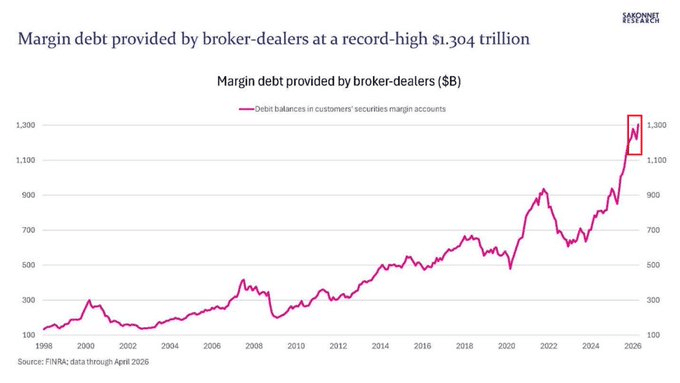
Against the backdrop of the current macro environment, this positioning leaves Bitcoin longs exposed to rapid fluctuations.
In this context, $26.3 billion of liquidity may not stabilize the market. Rather, the added liquidity could stimulate speculative activity and increase volatility, as both macro and micro signals favor short-term trading over long-term conviction.
As a result, the possibility of a $60,000 retest of Bitcoin is no longer likely.
Final summary
- Although liquidity is rising, a strengthening dollar environment and rising yields are limiting capital inflows into Bitcoin.
- With leverage rising, Bitcoin remains vulnerable to increased volatility and a retest of $60,000.


